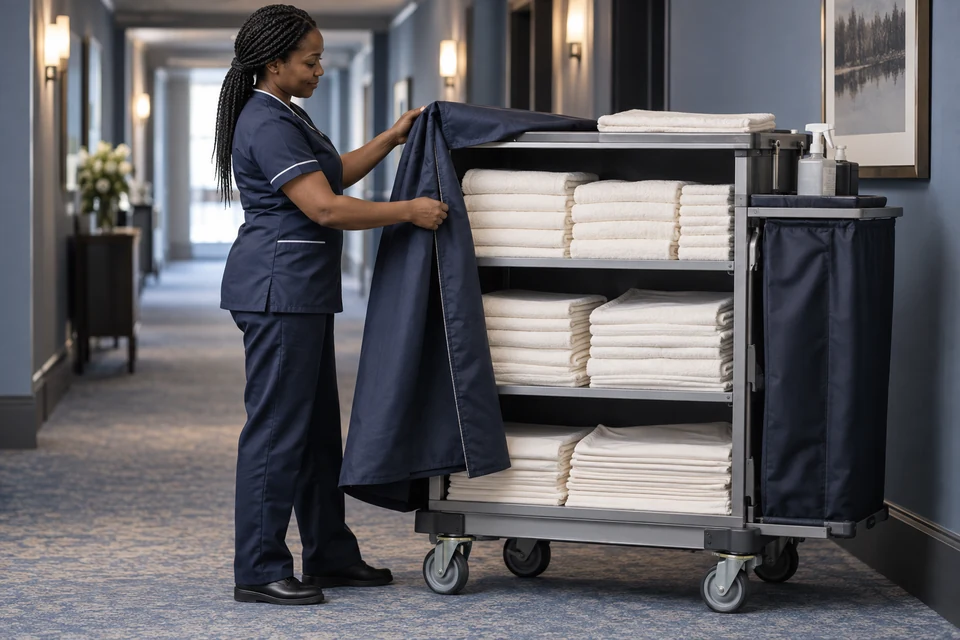
A linen-cart cover can fit the cart when closed yet become awkward to remove while staff retrieve clean stock. Buyers should review the cover, cart and access sequence together instead of treating the cover as a simple rectangular textile. The assessment should follow the property's existing clean-stock procedures and identify practical handling limitations. It does not establish infection-control performance or replace the hotel's hygiene policy, equipment instructions or staff training.
Define the cart and access route
Use the actual service arrangement
Identify the cart model or measured reference, cover construction and locations where clean stock is retrieved. Include any side compartments, top storage or handles that affect access. The trolley and shelf-fit review should provide the underlying cart arrangement; this trial adds the cover's opening and removal sequence. A cover demonstrated on an empty display frame does not show how it interacts with the stocked service cart.
Ask the property to identify which openings are used during normal service and whether the cover is removed fully or only partly opened. Keep the answer tied to the existing operating procedure rather than inventing a new cleanliness routine for the article. Record the available space around the cart and the intended place for a removed cover. If that place is undefined, the handling trial has an unresolved question before product approval begins. Identify how the removed cover is distinguished from covers awaiting the property's required care or review, so staff do not have to infer its status from where it happens to be placed.
- Identify the actual cart and stocked arrangement.
- Record the openings used in routine service.
- Confirm full removal or partial access requirements.
- Define an authorized place for the removed cover.
Inspect the complete cover
Record attachments and contact points
Examine the cover's closures, attachment positions, lower edges and contact with the cart. Confirm that the proposed sample represents the intended construction and size. A different fastening arrangement can change the access sequence even when the overall dimensions look similar. Keep the component reference linked to the sample so a later zipper, strap or fabric substitution does not pass unnoticed as the same approved item.
Record contact points with wheels, handles, shelves or adjacent stock while the cart remains stationary under the property's procedure. Do not suggest that staff defeat equipment features to make the cover fit. If the sample interferes with normal operation, refer the issue to the responsible equipment or housekeeping owner. Product fit and safe cart operation are connected, but a textile supplier's appearance sample does not authorize changes to the cart's intended use.
- Identify closures and attachment references.
- Check lower edges and contact with cart features.
- Preserve the equipment's authorized operating arrangement.
- Escalate interference rather than improvising a workaround.
Observe the access sequence
Keep clean-stock handling within policy
Have the authorized team demonstrate opening, stock retrieval and reclosing using the normal service method. Record where the cover moves, what it touches and whether the intended stock remains accessible. The buyer should not prescribe a new hygienic technique remotely. Instead, the property's responsible owner should assess the observed sequence against its existing requirements and identify any practical limitation that the product design needs to address before purchasing.
Keep the observation record specific. A cover that touches the floor during one demonstration should be recorded as that event, not converted into an unsupported claim about contamination levels. The linen handling handover provides related coordination context, but the cover trial remains a distinct interface review. State what was observed and what specialist assessment remains necessary rather than implying that visual cleanliness proves hygienic suitability.
- Follow the property's authorized handling method.
- Record contact and access observations directly.
- Avoid unsupported hygiene-performance conclusions.
- Assign policy questions to the responsible property owner.
Compare practical revisions
Include storage and repeated handling
Where access is awkward, compare identified design revisions or arrangements that the property is willing to use. A revised opening position, closure layout or cover size may affect the sequence, but change variables deliberately and record the difference. Do not approve a solution solely because the reviewer can hold the cover clear for one photograph. Include the intended place and method for holding or storing it between access events.
If care preparation is part of the project's review, identify the process and sample condition before repeating the fit and access check. The dimensional-stability evidence addresses a separate material question; the complete cover still needs to be reviewed on the cart after the relevant preparation. Do not claim that a material result proves every closure remains convenient or that the cover retains a universal service life.
- Identify each design or arrangement revision.
- Include the intended removed-cover storage position.
- Record care state when repeating the trial.
- Keep material evidence separate from complete-product access.
Approve the operational combination
Make the handover reproducible
The final decision should identify the cart, cover revision, stock arrangement and authorized access sequence. State the care condition and other limitations covered by the assessment. The project approval record can retain photographs and the decision owner, adapted to the service area. A later cart replacement or cover redesign should trigger review of the affected assumptions rather than automatic reuse of the old photograph.
Share the cart reference, cover requirements and property-approved handling constraints with FY through the hospitality sourcing brief. Request an identified sample discussion and leave hygiene-policy decisions with the property. The procurement outcome should be a workable cover-and-cart combination with a clear handover, not an unsupported promise of contamination prevention. That gives both the supplier and housekeeping team a bounded requirement they can actually review.
- Identify the cart-and-cover combination in the decision.
- Record the approved sequence and assessed conditions.
- Keep policy and equipment limitations visible.
- Reassess relevant cart or cover changes.
Approve the stocked cart, cover and access sequence together under the property's existing procedures; visual fit alone does not establish hygienic or operational suitability.