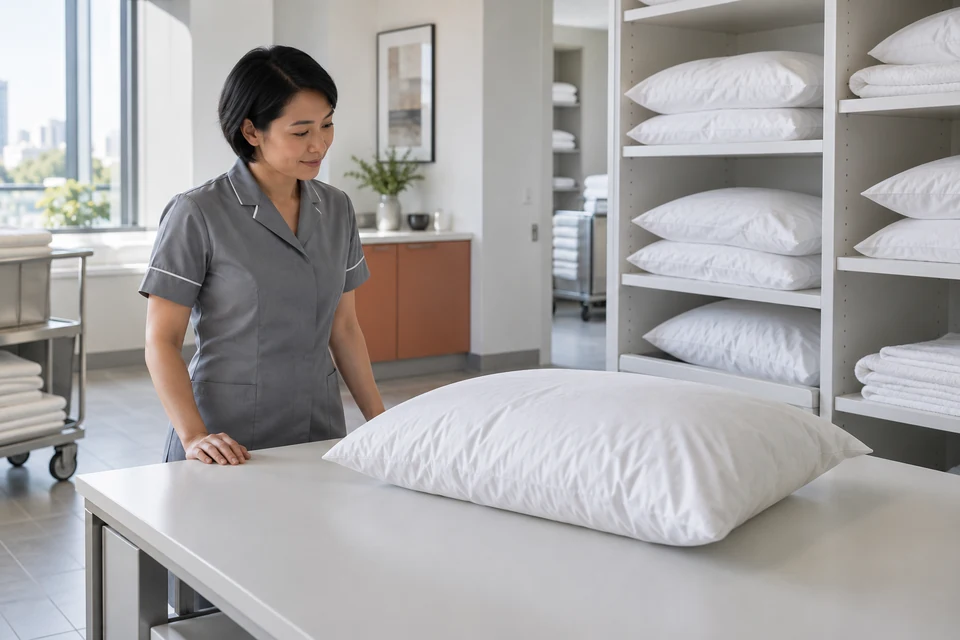
A pillow can meet its approved specification yet arrive at the guest room looking flattened after crowded storage. Purchasing therefore needs a storage-and-retrieval trial as well as a product sample review. The question is not whether a pillow survives an arbitrary laboratory load, but whether the selected pillow, shelf arrangement and housekeeping routine produce a presentable item when the property actually needs it. Keep that operational decision separate from claims about long-term filling durability.
Map the actual shelf
Space is part of the buying brief
Start with the linen room used by the property, including clear shelf height, depth, access direction and the number of pillows normally held there. An empty display shelf is not a useful stand-in for peak occupancy storage. Ask housekeeping to show the arrangement used during a busy changeover, including protective covers and neighboring stock. Connect this observation to the property's pillow selection matrix so different pillow types are not silently treated as interchangeable.
Describe how staff retrieve an item from the middle or bottom of the arrangement. If removal requires squeezing, pulling against a shelf lip or moving several other pillows, record that handling separately from the effect of time in storage. A clean-stock shelf and trolley review helps keep access, cleanliness and product shape in the same operational discussion without inventing a universal stacking limit.
- Measure usable shelf space rather than nominal cabinet dimensions.
- Record the actual pillow count in each proposed arrangement.
- Identify covers, dividers and contact surfaces.
- Photograph the arrangement before any pillow is removed.
Choose a representative set
Preserve the product identity
Use pillows from the proposed construction and size, not whichever showroom samples happen to fit the shelf. Record the shell, filling reference, fill quantity where specified, sample condition and any prior compression history. A previously handled sample may not represent untouched incoming stock. Where several firmness options are offered, include the options most likely to occupy different volumes rather than assuming that one approval covers the whole menu.
Retain an unstored comparison pillow under recorded conditions and distinguish it from the stored specimens. This does not create a standardized performance test; it gives the team a more interpretable comparison. Review the existing fill recovery evidence for its own stated method and scope. Do not convert a supplier's laboratory result into a promise about the hotel's cabinet arrangement without checking that the situations are genuinely comparable.
- Identify each sample before storage begins.
- Separate unused references from operational trial pieces.
- Note previous laundering or compression.
- Include relevant sizes and firmness variants explicitly.
Observe retrieval readiness
Use the real service window
Agree when observations will be made after retrieval and what handling is permitted before each observation. If staff normally place the pillow into a protector immediately, include that step. If the routine allows resting or a supplier-approved reshaping action, record the action and timing rather than presenting the result as spontaneous recovery. The service window should come from the property, not from an unsupported generic recommendation about how long every pillow takes to recover.
Inspect the outline, corner fullness, visible creases and fit inside the intended protector and pillowcase. Use the same viewing position for the stored and comparison pieces. An attractive loose pillow on a table may behave differently after the full bedding combination is assembled; the protector procurement guide can support that compatibility review. Record uncomfortable or impractical handling as a separate operational concern instead of hiding it inside a single appearance score.
- Define the observation times before starting.
- Keep permitted handling consistent across samples.
- Review the complete protector and pillowcase combination.
- Record shape, access effort and service readiness separately.
Compare storage alternatives
Change one controllable variable
If the proposed arrangement gives inconsistent presentation, compare practical alternatives such as fewer items per shelf, a different orientation or a separate position for bulky variants. Change one variable at a time where feasible. Replacing the pillow and the storage layout simultaneously makes it difficult to identify which change mattered. A smaller storage count also has replenishment implications, so the decision should include the staff responsible for stock movement rather than only the purchasing team.
Keep the comparison proportionate to the risk and property scale. Record available shelf capacity and the replenishment routine needed for each option, but do not claim a space-saving percentage without measured counts and a defined baseline. Relate the preferred arrangement to the property's broader stock planning approach, adapting it to pillows rather than copying bath-linen quantities. The objective is a workable combination of inventory access and guest-facing presentation.
- Compare feasible layouts rather than idealized displays.
- Keep sample identity and observation conditions stable.
- Include replenishment consequences in the decision.
- Retain photographs of both accepted and rejected arrangements.
Release the storage instruction
Make the approved arrangement repeatable
Record the selected shelf arrangement, covered pillow variants, retrieval method and appearance reference in the property handover. Name who can approve a later change. New storage covers, different cabinet dimensions or an alternative pillow construction should prompt a review of the affected assumptions rather than automatic reuse of the old approval. Keep this instruction linked to the purchasing specification so a reorder does not quietly introduce a bulkier or differently packed pillow.
For a new hotel project, send FY the pillow options, cabinet measurements and the intended room-service timing through the project enquiry form. Ask for a scoped sample discussion, not a blanket assurance that any pillow can be tightly stored. The final record should show what was observed, what remains untested and which arrangement the property accepted. That makes the approval useful to both procurement and housekeeping when the opening team changes.
- Attach the approved storage photograph to the handover.
- Identify the exact pillow variants covered.
- Record limits and unresolved observations.
- Require review when the storage or product changes.
Approve the pillow and storage arrangement together only after the actual retrieval routine produces an acceptable presentation within the property's stated service window.