A tablecloth clip joins three purchasing decisions that are often reviewed separately: the table edge, the finished cloth and the accessory. A clip that looks suitable in an empty sample box may not accommodate an underlay or the actual edge profile. Procurement should approve the identified combination and record its limits before ordering clips for a hotel or restaurant. This review concerns fit and textile contact, not a structural capacity rating, a wind-resistance claim or permission to modify the property's furniture.
Identify the edge profile
Measure the contact area rather than the nominal table size
Ask the property to identify the tables on which clips are intended to be used. Record the edge thickness and shape, underside obstructions and any protective finish at the attachment point. The table-linen furniture matrix should distinguish these installations rather than treating every rectangular table as interchangeable. An apron, rounded lip or extension joint can change the usable attachment area without changing the tabletop's published length and width.
Keep the underlay and cloth layers in the record. If the approved presentation includes both, assess the clip with both in place rather than testing it on bare furniture. Ask the responsible property team to confirm that the proposed accessory is permitted on that surface. Procurement should not assume that a supplier's generic description authorizes use on a coated, upholstered or specially finished table edge. Where several table variants share one cloth size, give each edge configuration its own trial reference and record whether the same clip was accepted or a separate accessory decision remains necessary.
- Identify the actual edge profile.
- Record underside obstructions.
- Include approved textile layers.
- Obtain property confirmation of accessory use.
Select an identified clip
Review contact surfaces before installation
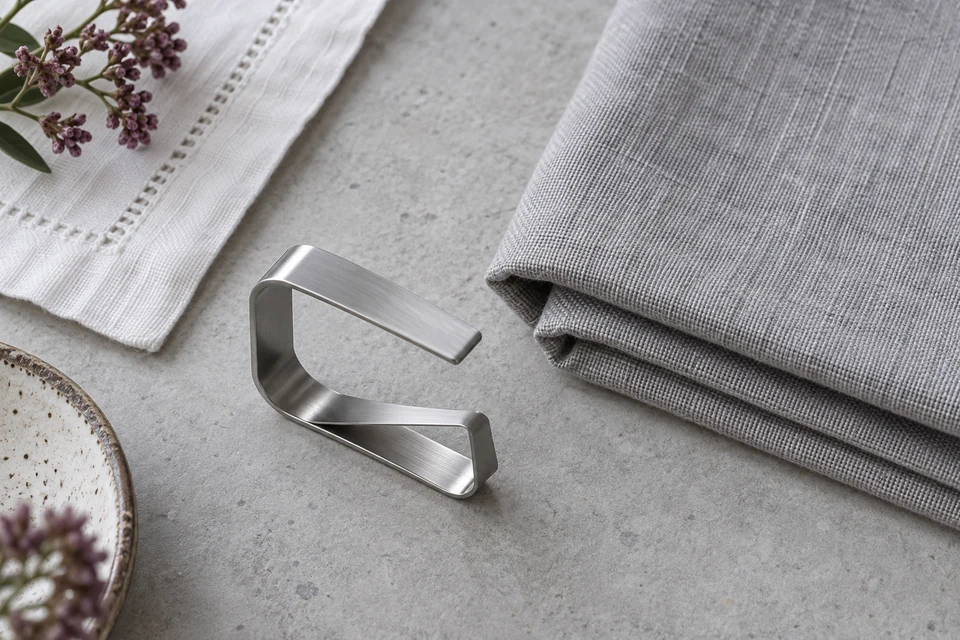
Record the clip's material, product reference, geometry and the supplier's intended application range. Inspect the surfaces that contact the cloth and table for visible roughness or an unsuitable edge. Do not infer that a heavier-looking clip is more appropriate or that a polished appearance proves a harmless contact surface. Keep the sample with the approved physical reference so later deliveries can be compared with the actual selected accessory.
Use the supplier's instructions and the property-approved method for any fitting trial. Do not bend, grind or pad an accessory informally to make it fit and then call the modified item approved. Such a change creates another construction and may affect its function. If a supplied sample cannot be used as intended on the specified table, document the mismatch and request an identified alternative from the responsible supplier.
- Identify the exact accessory reference.
- Inspect the fabric-contact surfaces.
- Follow the approved application method.
- Reject undocumented modifications as a release reference.
Trial the finished cloth
Observe both placement and removal
Use a finished tablecloth in the intended material, size and care state, with the specified underlay where applicable. Record where the clips are placed and how the cloth is arranged before fitting. The seam and drop review remains a separate part of the presentation decision. A clip should not be used to disguise an incorrectly sized cloth or an unapproved seam position during sampling.
Have authorized property personnel demonstrate normal placement and removal, then inspect the same textile contact area. Note local creasing, displaced yarns, abrasion or marks if present. Compare with the starting condition rather than attributing every irregularity to the clip. The surface-damage guide helps define observations, but this practical review does not establish a universal snagging or abrasion performance rating.
- Use the complete intended cloth arrangement.
- Record the selected clip positions.
- Inspect the same area before and after use.
- Distinguish observed marks from inferred causes.
Compare the purchasing options
Preserve the reason for a changed arrangement
If the combination is unsuitable, compare another identified clip, an approved textile arrangement or a property-authorized presentation without the accessory. Record why the earlier option was rejected and which variable changed. Avoid changing the table, cloth and clip together and then claiming that one particular change solved the issue. A controlled comparison gives the buyer a usable decision instead of another attractive but unexplained sample photograph.
Consider the normal setup and reset routine when selecting the option. Additional handling may affect restaurant preparation even if the final appearance is acceptable. Record any extra step without inventing a time saving, labour cost or service-life improvement. If the cloth itself changes, revisit the care and operating trial rather than assuming that compatibility at the table proves suitability for the property's whole linen process.
- Compare identified alternatives.
- Record the variable that changed.
- Include ordinary setup and removal effort.
- Reassess other textile requirements when the cloth changes.
Release by table combination
Keep replacements tied to the accepted interface
The final record should identify the table variant, cloth revision, underlay, clip reference and accepted placement. State any exclusions rather than extending one trial to every furniture type in the property. Include a view of the complete presentation and a close view of the attachment area. Keep the property decision and technical observations distinguishable so an aesthetic acceptance does not erase an unresolved compatibility concern.
Carry those references into the reorder specification. A similar-looking replacement clip or another tabletop finish should trigger the relevant review before use. When requesting samples, share the actual edge profile and textile layers with the sourcing team. That enables a proposal for the working combination rather than a generic accessory order based only on the tablecloth colour or the number of dining tables.
- Identify every part of the approved combination.
- State excluded table variants.
- Preserve overall and detail photographs.
- Recheck substituted accessories or surfaces.
Approve the tablecloth clip against the actual property-authorized table edge and textile layers; do not use improvised accessory modifications or infer performance beyond the observed trial.