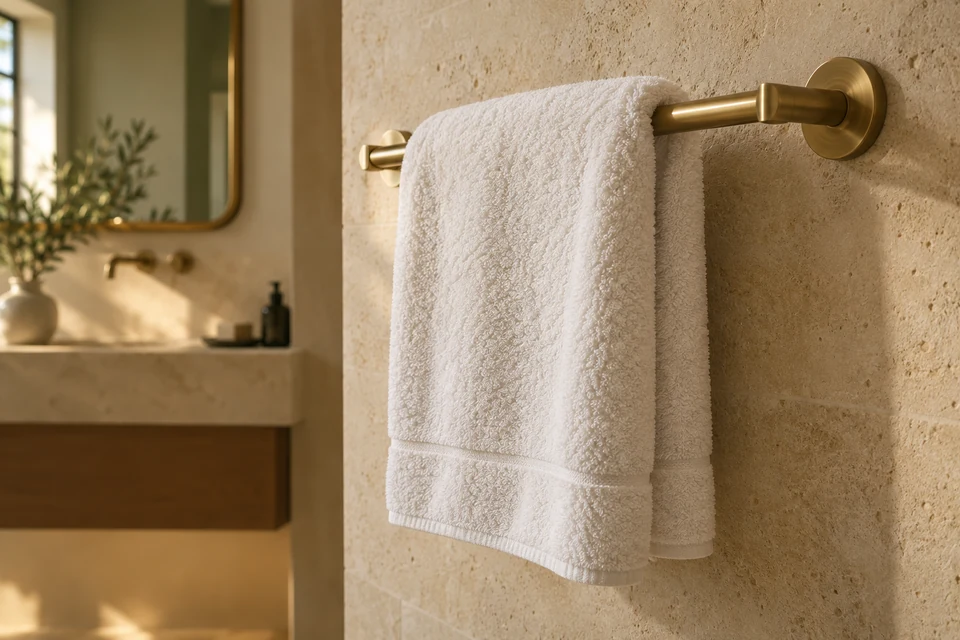
A towel selected by size and weight still needs to work on the rail installed in the hotel bathroom. Folded depth, rail projection and neighboring fittings can affect how the towel hangs and how easily it is removed and replaced. The purchasing decision is the compatibility of the approved towel with that installation. This guide does not assess structural rail capacity, accessibility compliance or towel drying performance, each of which needs its own appropriate review and evidence.
Identify the installed rail
Record the textile's actual available space
Ask the property to identify the rail model, usable bar length, wall projection and nearby fittings in the intended bathroom. Record the installed arrangement rather than relying only on a supplier's styling image. The mock-up room record should connect the review to a room type and installation revision. Different rooms may need separate records even when the towel specification is shared.
Note whether the presentation uses one towel, a pair or nested sizes, and which bar is intended for each item. Do not assume that every visible bar is available for the procurement arrangement. Have the property resolve any installation or access requirements through the responsible personnel. The textile review should use that confirmed arrangement, not change the fitting or its approved use to accommodate a sample.
- Identify the installed rail and room type.
- Record usable space and adjacent fittings.
- State the intended towel arrangement.
- Keep installation questions with responsible property personnel.
Prepare the correct towel
Compare the full folded bulk, not an empty measurement
Use finished towels in the intended size, material and care state. Record the fold sequence and the number of layers passing over the bar. A nominal open dimension does not describe the depth of the folded stack. The towel weight guide provides one material attribute, but weight alone cannot approve the complete rail presentation or replace a physical sample.
Include the identified post-care sample where that represents normal service. Keep new and laundered observations separate instead of swapping samples between photographs. Refer to the border and dimensional-change review if the towel's shape changes during the care trial. This rail evaluation should not absorb those construction decisions into an unexplained overall appearance result.
- Use the complete finished towel.
- Record fold sequence and layer count.
- Distinguish new and post-care samples.
- Keep construction changes separately traceable.
Observe placement and removal
Use the normal housekeeping arrangement
Have the property team place the towel on the confirmed rail and observe the relationship between the folded textile, wall and adjoining items. Record compressed areas, unintended contact or difficulty arranging the towel if present. Do not prescribe a universal clearance value. The accepted setup should come from the property's actual installation and operational review, with competent input for matters outside textile appearance.
Ask housekeeping to demonstrate ordinary removal and replacement without a special fold invented only for the sample review. Keep the question separate from the logo-visibility review: a visible border does not establish that the folded depth works on the rail. Note when the presentation requires extra repositioning or conflicts with another planned item on the same fitting.
- Observe folded contact points.
- Use ordinary placement and replacement.
- Record conflicts with neighboring items.
- Separate physical fit from logo visibility.
Compare practical alternatives
Keep the installation and textile decisions coordinated
If the arrangement is unsuitable, compare a property-approved fold, a different towel allocation or another identified towel candidate. Do not move fittings or alter the intended room arrangement as an informal sample adjustment. Changing the textile may also affect care, stock and guest presentation, so keep those consequences visible rather than selecting solely by how little space the folded sample occupies.
Review the new candidate through the care and operating trial as appropriate. A towel that fits when new may need another observation in its service condition. Avoid claiming that an accepted gap proves faster drying or improved hygiene; those are separate questions with different evidence. Record which alternative the property selected and why the earlier setup was not accepted. Capture the accepted number of towels on each rail in the reference, not merely the towel code. A sample reviewed alone may present differently when the property's intended second item is added beside or over it. If the property changes the arrangement for suites or different room types, record those variants rather than crowding them into one approval. This turns the physical trial into a usable allocation instruction while preserving its limits. It also allows purchasing to distinguish a need for another towel construction from a need to clarify the room's presentation plan with the property team.
- Compare identified alternatives.
- Obtain property approval for arrangement changes.
- Recheck the representative care state.
- Avoid unsupported drying or hygiene claims.
Preserve the room-specific reference
Make replenishment follow the accepted combination
The final record should show the rail installation, towel revision, fold, item count and accepted presentation. Include enough of the surrounding wall and fittings to make the arrangement recognizable. Link it to the property textile standardization record without assuming that one room's arrangement covers all bathrooms or every replacement towel offered under a similar size label.
Revisit the combination when the rail, towel construction, care result or planned item count changes. Keep the reference available to housekeeping and purchasing so replenishment does not gradually replace it with an incompatible sample. Share the actual installation and towel arrangement with the sourcing team when requesting options; that makes the buying brief more useful than a request for a premium towel alone.
- Preserve the complete room-specific arrangement.
- Identify the accepted towel and fold.
- Review relevant installation or textile changes.
- Share the reference with housekeeping and purchasing.
Approve the towel's folded depth and handling on the actual property-confirmed rail arrangement; do not infer compatibility, drying performance or compliance from towel weight and nominal size alone.