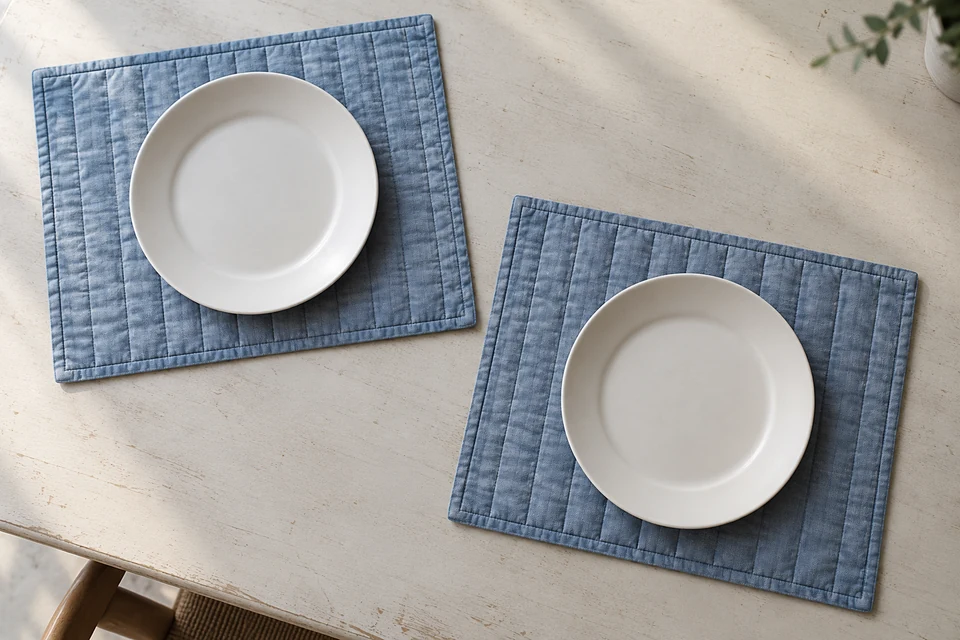
A quilted placemat can introduce a raised pattern and substantial edge into a table setting. Those features deserve their own sample review: the outline may be correctly sized while the corners lift, or a plate may sit across an uneven stitched profile. This guide focuses on the layered mat and its contact with the tabletop. It does not replace planning the full neighboring place settings, and it does not treat textile thickness as proof of heat protection or slip resistance. Approval should describe the actual construction, the observed profile and the ordinary preparation needed to reproduce the accepted condition.
- 1. Identify the complete layered mat and its intended surfaces
- 2. Map the stitch relief across the usable tabletop area
- 3. Inspect corner build-up and perimeter contact
- 4. Separate profile decisions from stitch workmanship
- 5. Review the service-ready condition after care and storage
- 6. Release a profile reference with the purchasing specification
Identify the complete layered mat and its intended surfaces
A quilted appearance does not disclose the components underneath
Ask the source to identify the face, reverse, internal layer if present, quilting construction and perimeter treatment proposed for the sample. Do not infer the inside material from an exterior photograph. Record whether the mat has an intended upper surface or whether both surfaces are part of the proposed presentation. Request enough construction information to distinguish a change of fabric from a change of the internal assembly. The component identity record can organize those references without supplying a generic placemat construction.
Set the intended tabletop and ordinary service role in the brief. A buyer reviewing a decorative retail mat may have a different preparation routine from a restaurant that resets several tables between services. Describe that routine rather than labeling the item heavy duty. If the project requires heat-related or friction-related performance, leave a separate evidence request with the appropriate technical owner. A pleasant layered surface, a thicker edge or a textile sample sold as quilted cannot establish those functions by appearance alone.
- Identify the face, reverse, internal assembly and perimeter.
- Keep any protective or friction claim outside appearance approval.
Map the stitch relief across the usable tabletop area
The quilted pattern has a profile as well as an outline
Spread the complete sample in its agreed preparation state on the identified table. View it from above and from a low side angle, without holding the edges down for the photograph. Mark prominent ridges, depressions and changes where stitching lines cross or approach the border. Describe their location using a simple pattern map. Where a measurement is needed, ask the technical owner to define the method and contact conditions; do not press the mat flat and call that compressed state its ordinary profile.
Place the representative dishes used for the local review at the intended positions and observe how they sit across the stitched areas. Record the actual dish shapes and positions rather than declaring the surface universally stable. The separate complete place-setting guide handles footprint and neighboring diners. This inspection asks a narrower question: whether the selected layered profile presents acceptable contact beneath the identified objects in the reviewed arrangement. A pattern change can alter that relationship even when the mat dimensions remain unchanged.
- Photograph the unrestrained profile from above and from the side.
- Identify dishes and locations used to observe tabletop contact.
Inspect corner build-up and perimeter contact
Check each corner without treating forced flattening as a result
Review all corners of the mat, including how quilting approaches the edge and how the perimeter finish turns. Look for a concentrated stack of layers, a lifted tip or a transition that gives the corner a different profile from the straight edge. Mark the concern on the sample drawing and record whether it appears before or after ordinary preparation. If the source proposes another corner finish, compare complete prototypes rather than assuming a familiar sewing term will guarantee a flatter result.
Trace each straight edge against the table and distinguish a visible outline difference from a local rise. Show both surfaces where the construction makes them relevant. The napkin corner guide provides a neighboring finishing discussion, but a layered mat has a different assembly and tabletop duty. Ask the maker to explain the actual corner and border construction here. Do not approve a sample that only lies in the accepted shape while a stylist pins it or conceals a lifted corner beneath tableware.
- Review every corner and its transition into the straight perimeter.
- Describe any required preparation instead of hiding it during photography.
Separate profile decisions from stitch workmanship
A deliberately raised area is not the same as an unintended stitch event
Confirm the accepted quilting path, thread appearance and visible start or stop locations. Then inspect the face and reverse for workmanship concerns without confusing the intended relief with a defect. A raised motif may be a deliberate part of the design, while an unapproved local bunching needs its own review. Record which observation is at issue so a maker does not flatten the entire design to correct one small area. Use the sample identity and mapped location in every revision discussion.
Refer interruptions and proposed corrections to the stitch-continuity inspection framework where useful, but have the responsible team define the rule for this mat. That broader article concerns stitch events and repair control; it does not approve tabletop flatness. If a correction changes local thickness, inspect the corrected placemat on the table again. A visually tidy repair can still create a different profile under the selected dish, so the workmanship and contact decisions should remain connected but separately recorded.
- Distinguish intentional relief from local bunching or stitch interruption.
- Recheck tabletop profile when a correction changes the assembly.
Review the service-ready condition after care and storage
A carefully prepared new mat may not represent the planned reset
Agree the proposed care and finishing route for the whole construction, including any internal layer or border. Process identified samples under that chosen review and reassess their outline, relief, corner contact and reverse appearance. The sample-conditioning approach can help keep before-and-after observations comparable. Ask the technical owner to set procedures appropriate to the mat, rather than copying a bed-size textile requirement. Retain the actual assessed samples so the buying team can distinguish an accepted change from an undocumented memory.
Store the mat in the proposed folded, stacked or other arrangement and prepare it with the ordinary routine the purchaser intends to use. Place it back on the same table with the same local dish arrangement. Record whether creases or corner lifting require an extra operation and who has accepted that operation. If the appearance depends on individual hand finishing, show that dependency in the operational brief. A limited care-and-storage review supports only its stated scope; it is not a promise of indefinite shape retention or protective performance.
- Repeat profile and corner observations after the agreed care route.
- Include storage and ordinary preparation in the accepted condition.
Release a profile reference with the purchasing specification
Make flatness review usable without a hidden universal limit
Prepare the accepted reference with a top view, low-angle images, corner details and the actual complete sample. Describe the intended relief and any permitted local appearance using the agreed inspection conditions. Where the team needs a numerical criterion, obtain a project-specific definition from its responsible technical owner and attach the method; this guide supplies no universal corner-gap limit. The technical-pack record should connect the pattern, materials, edge and preparation state so an alternative assembly cannot inherit approval silently.
Ask quotations to identify the finished mat, pack unit and color allocation, and confirm the minimums for the selected construction with the source. Buyers can review table-textile directions and request a quilted placemat sample that includes the proposed border and internal assembly. Give FY Bedding the intended table surface and local dish arrangement with the brief so availability and development can be discussed against real questions. Release the purchase only when the accepted profile and care-ready reference match the offered item.
- Link the accepted relief, corners and preparation to one complete sample.
- Require new review when a change affects profile or table contact.
Approve quilted placemats through the identified layered construction, mapped stitch relief, unrestrained corner contact and the ordinary service-ready condition. Keep footprint planning, stitch workmanship and any protective performance evidence as distinct decisions. None can be inferred from the mat looking substantial in a photograph.