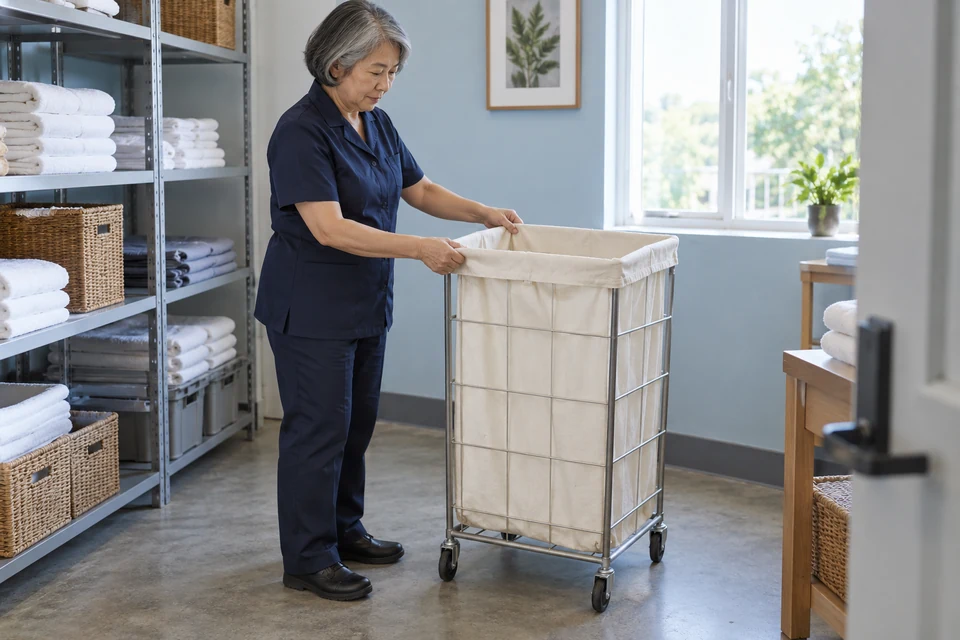
A removable liner belongs to a particular laundry hamper or collection container. It should not be treated as an ordinary carrying bag simply because both are sewn from fabric. The container's rim, depth, openings and access arrangement affect how the liner sits, is removed and returns to service. For a hotel or residential project, the buyer needs an accepted container-and-liner pairing before comparing textile prices. This guide addresses that interface and ordinary access planning. It supplies no lifting capacity, contamination barrier or infection-control approval, and an empty fitting demonstration cannot establish safe handling of a filled liner.
Identify the actual container
Measure the interface that receives the liner
Record the hamper or container reference, internal depth, footprint, tapered sides and rim profile. Note lids, dividers, hinges and other features that affect attachment or removal. Inspect the actual unit rather than assuming all containers with a similar advertised volume share a liner pattern. The dimensioned interface brief should show where measurements are taken and which furniture or equipment variant they represent. A supplier should not guess a three-dimensional liner from one front-facing room photograph.
Count variants and identify which can genuinely share an approved liner. If the project includes a new container not yet received, keep its pairing provisional until the agreed physical review is possible. Drawings are useful development inputs, not proof of finished fit. Distinguish the liner's intended seated shape from excess cloth that folds into the removal path. The buyer may prefer a deliberately loose interior, but should define that choice rather than accepting a poor fit because the top looks tidy when the lid is closed.
- Name the actual container variant.
- Measure depth, rim and obstructions.
- Keep untried pairings provisional.
Map the rim attachment and lower corners
The liner must be reviewed as an installed enclosure
Specify how the liner is retained at the rim: an accepted fold-over arrangement, loop, tie or other documented component. Show its position relative to lids and dividers. Inspect the proposed attachment on the empty actual container and record whether it shifts during normal opening and access. The component list should include retention parts rather than leaving them to be selected during bulk sewing. An attractive fabric swatch cannot establish whether a fold-over rim will remain in the intended position.
Check the bottom and lower corners without loading the container. Decide whether the liner intentionally rests on the base and how the approved shape avoids obstruction in the planned removal route. If the construction is changed to clear a feature, refit the complete sample instead of approving only a revised corner detail. Do not invent a required tension or lifting method. The responsible container and handling owners must determine what actions are appropriate for their actual equipment and use.
- Draw the proposed rim-retention arrangement.
- Review lids, dividers and corner clearance.
- Refit the whole liner after a pattern change.
Plan removal separately from transporting laundry
Fitting access does not create a carrying rating
Have the appropriate staff or customer reviewer demonstrate the agreed empty removal and replacement method. Observe whether attachments are reachable, cloth catches on the container or a lid blocks the route. Use the intended instruction and record adjustments rather than styling the liner between steps. The portable laundry-bag guide addresses a different supplied item and movement brief. A container liner must not inherit a carrying assumption simply because it has a similar drawstring or fabric handle.
If the owner intends the liner to be lifted or transported with contents, refer that separate function to the qualified handling and product owners for suitable requirements, evidence and instructions. This article does not authorize a load, lifting posture or demonstration with a filled hamper. Keep evidence outstanding until the actual assembly and intended operation have been assessed appropriately. Where a separate transport method is accepted, describe it clearly so staff do not improvise carrying a liner whose procurement approval established only empty fitting and removal.
- Observe the accepted empty access route.
- Separate liner removal from loaded transport.
- Refer carrying functions to appropriate evidence owners.
Choose textile and care for the installed construction
The whole liner enters the maintenance decision
Confirm the actual offered material, finish, seams and retention components. Review visible contact with the container and inspect interior workmanship that will be harder to see once installed. The seam identity guide can collect construction fields, but it does not establish a universal seam for every liner or a contamination-control function. Any barrier, antimicrobial or other protective statement needs evidence specifically relevant to the intended assembly and claim, not a general material brochure.
Agree the appropriate cleaning and drying route with the responsible owner. Review an identified complete liner afterward, including corner shape, rim relationship and the empty removal method. The property care record helps state observed conditions without prescribing them for every accessory. Confirm whether retention components can remain attached for that route or require an accepted removal step. Do not label the entire assembly machine washable simply because the main textile has been used in other washable products.
Keep the container's own maintenance and the textile liner's care separately described. Removing the liner does not prove the underlying container is clean or ready for another use. Any operational cleanliness or handling policy belongs to the property and its qualified owners. The procurement record can identify the required interface and documentation, but should not offer infection-control assurance or replace the owner's established procedures with a generic textile checklist.
- Identify material and every retention component.
- Repeat fitting after the stated care route.
- Keep container and textile maintenance responsibilities distinct.
Release liner variants and the replenishment record
Container changes can invalidate a familiar pattern
Quote the accepted pattern and container variants, material, seams, attachments, sold unit and packaging. Confirm actual minima and sample needs, including any separate pattern development for differing containers. The offer comparison guide helps expose exclusions without treating one low unit price as evidence that every interface is included. If a supplier offers a liner-only unit while another includes a rigid container, compare them as different scopes rather than normalizing away the furniture component.
Retain the accepted container identity with the liner pattern and care reference. Recheck compatibility when a property changes hampers, lids, dividers or removal practices, using the repeat-order record to keep those interfaces visible. Buyers can share a removable-liner brief with measured container views and the accepted empty removal method for a scoped sourcing discussion. Supply availability and any additional functional evidence must still be confirmed. An old accessory name should not authorize a new container pairing or an unsupported loaded-carrying claim.
- Quote liner-only and container-included offers separately.
- Keep container identity with pattern revisions.
- Reapprove changed interfaces and functions.
Approve a hamper liner against its real container and accepted empty removal route. Recheck the complete construction after care, and keep carrying, protective and hygiene functions conditional on their own appropriate assessment.