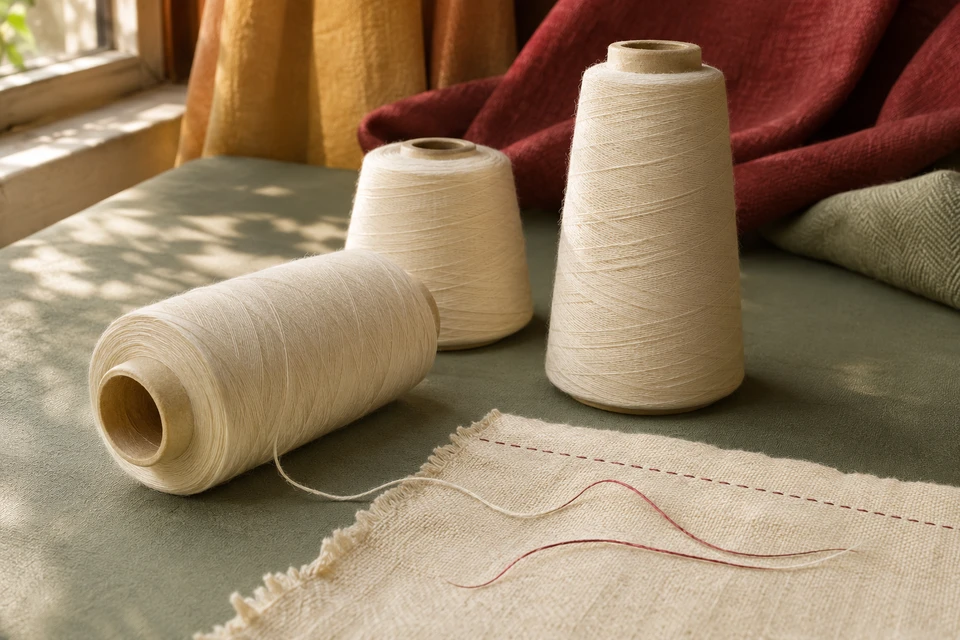
Two sewing threads marked with the same ticket number are not automatically the same size. A purchasing team can make a confident-looking comparison while combining different numbering conventions or manufacturer references. Before approving a substitute for a bedding seam, ask what the number means and how it relates to the complete thread being supplied. Aligning the size basis is a separate task from deciding whether the thread performs adequately in the seam.
- 1. Read the unit before comparing the number
- 2. Treat a ticket number as a supplier reference until clarified
- 3. Confirm whether the size describes the complete thread
- 4. Separate size equivalence from material equivalence
- 5. Put the clarified identity into the order record
- 6. Ask for a comparison that can be audited
Read the unit before comparing the number
Some numbering systems move in opposite directions
Coats' technical explanation distinguishes fixed-length systems from fixed-weight systems. Tex expresses mass in grams per one thousand metres: within that system, a larger number represents greater linear density. Other numbering approaches can run in the opposite direction. A quotation that gives only a bare number therefore leaves out information needed to interpret it. Request the system name rather than assuming that a familiar value means the same thing in every offer.
Record the original supplier wording alongside the clarified size basis. This preserves traceability if a catalogue code is later found to use a different convention. Do not replace every source number with an unverified conversion and discard the original. The purchasing record should let the buyer and technical team understand both the commercial reference used to order the thread and the comparable measure used to evaluate its size.
Treat a ticket number as a supplier reference until clarified
Matching labels do not guarantee matching thread
Coats describes ticket numbering as a commercial reference and notes that the same ticket number can refer to different thread types. Ask each supplier to identify the product family, its ticket convention and the corresponding resultant size information for the offered thread. Do not apply a single universal ticket-to-Tex formula across manufacturers and constructions. Where a conversion is used, its source and scope should be explicit.
For example, an enquiry may receive one offer described only as ticket 40 and another with a named Tex value. The next step is to obtain the first supplier's confirmed size basis, not to choose a conversion found without context. The example is a purchasing situation, not a statement that those two unspecified offers are equivalent. Keep the comparison open until both suppliers have identified what their numbers describe.
Confirm whether the size describes the complete thread
Component yarn data can be mistaken for the final result
Ask whether a stated number applies to the finished sewing thread or to a constituent yarn before combination. Ply information can help explain the construction, but it does not remove the need to identify the resultant thread size. Have the maker supply the relevant finished-thread value and construction reference. Avoid presenting a calculation from incomplete component information as confirmed evidence of the supplied thread's linear density.
Keep the notation exactly as clarified by the supplier, including the named system and any component or ply description. If the technical team needs to calculate a comparison, document the assumptions and have the material source confirm the interpretation where appropriate. A useful approval record should not leave a later purchaser guessing whether a slash, multiplier or number refers to a single element, the combined thread or a commercial stock code.
Separate size equivalence from material equivalence
The same Tex does not make every thread interchangeable
Once the size basis is aligned, retain the fibre composition, construction, finish and other relevant product identifiers in the comparison. Threads with the same stated linear density may still differ in ways that matter to sewing and the finished seam. The size check resolves one ambiguity; it does not prove equal strength, appearance, handling or care performance. Do not let a successful numerical match close the whole substitution review.
Refer the proposed alternative to the responsible sewing and quality team using the actual fabric assembly. Record any required sample trial and evidence separately from the numbering clarification. A supplier's claim that its thread is the equivalent of another reference should identify the basis for that claim. Buyers should know whether equivalent means a similar nominal size, a proposed application match or a broader performance comparison supported by appropriate data.
Put the clarified identity into the order record
A cone photograph is not a complete ordering reference
Record the manufacturer or supplier product reference, colour reference, ticket system, confirmed resultant size and relevant construction details together. Include the identifiers used on the commercial documents and material packaging. If the supplier changes its catalogue notation, request a cross-reference rather than silently replacing the approved item. The goal is to keep the ordering language connected to the technical identity already reviewed.
When incoming material is checked, compare the supplied identifiers with that record and refer discrepancies for clarification. Do not infer thread size from cone dimensions, the apparent thickness in a photograph or the total quantity on a package. Those observations can raise questions but do not establish linear density. If a physical measurement is required, agree an appropriate method with the technical team and keep its results tied to the identified sample.
Ask for a comparison that can be audited
Resolve the number before negotiating an equivalent offer
In a quotation request, include the current thread's full reference and ask the supplier to state any proposed alternative in the same clarified fields. Show the original commercial notation and the comparable size basis side by side. Request the proposed minimums, colour availability and sample arrangements without assuming that every size convention maps to an available product. A transparent alternative offer makes both its similarities and unresolved differences visible.
For a bedding project discussed with FY Bedding, provide the fabric assembly and the known thread reference rather than specifying only a ticket number from memory. Ask for technical clarification and a sample review appropriate to the proposed seam. No numbering system establishes a factory capability or a test result by itself. The purchasing decision becomes more reliable when the team first understands the size being offered, then separately verifies whether that identified thread is suitable for the actual product.
Capture the system name, supplier ticket convention and resultant thread size. Keep the original reference, avoid universal conversions and review seam suitability separately from numerical size equivalence.
Method references: Coats: thread-numbering systems and ticket references.