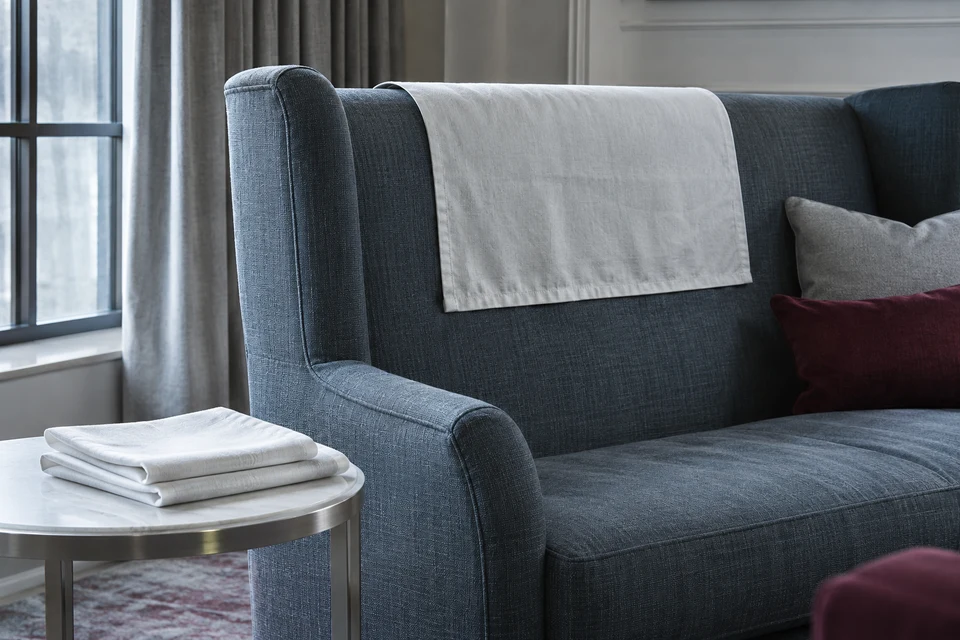
A removable headrest cloth, often called an antimacassar, is a small flat textile with a specific placement job. It should cover the intended upper-back contact area while remaining straightforward to remove, launder and reset. It is not the same as a fitted sofa cover or a decorative throw over the whole seat. Buyers should approve its position on the actual upholstery profile and decide how much repositioning is acceptable during ordinary use before choosing the size or ordering a common set.
Map the intended contact area on the furniture
Start from the seat and back profile, not a standard rectangle
Identify the sofa or chair model and record the height, curve and width of the upper back at the intended seat position. A narrow high-back chair and a broad low sofa may need different cloth proportions even if their fabric colors match. Photograph the intended front coverage and the portion that drapes over the back. Define whether each seat gets a separate cloth or whether one piece spans a shared backrest.
Use an agreed seating trial to observe the relevant contact area without treating it as a universal ergonomic measurement. Keep the trial voluntary and practical, using the furniture's normal purpose. The cloth should not obstruct controls, headrest adjustment or moving parts. If the furniture reclines or changes shape, evaluate those permitted positions under the furniture maker's instructions before deciding that one drape works for the whole range.
- Identify the furniture model and normal approved positions.
- Show the desired front coverage and rear drape on a placement photograph.
Choose a flat cloth that stays presentable
Review movement before adding retention features
Place candidate cloths on the actual upholstery and compare their appearance after ordinary sitting, standing and resetting. Record whether the cloth slides, twists, folds into a narrow strip or stays close to the accepted position. The trial should use the proposed fabric and finished hems because a paper template cannot reproduce the same drape. Avoid approving an arrangement that only works when every edge has been carefully pinned for a photograph.
If movement is unacceptable, discuss a revised size, different fabric or a separately approved retention proposal. Do not add adhesive, pins or hooks to hotel furniture without the responsible owner's approval and a contact review. A weighted or textured alternative also changes the product and requires a new sample. The goal is a documented placement solution, not an unsupported promise that a particular cloth will never slip.
- Record the reset needed after the agreed use sequence.
- Keep unapproved fixings out of both the sample and the product image.
Coordinate the visible cloth with the upholstery
Inspect both faces and the edge where guests make contact
Review the cloth color and texture against the upholstery under the room's normal light. Decide whether the item should blend into the sofa or be deliberately visible as a removable textile. Inspect the reverse and any label where it may contact the furniture. If a decorative border is included, position it deliberately rather than allowing it to fall at an arbitrary point on the curved back.
Agree observations for surface transfer, loose fibers and edge roughness using the actual material pair. These observations do not establish stain-proof, antimicrobial or waterproof performance. Any such claim requires its own evidence for the offered construction. Keep the product description focused on the agreed removable textile and placement function unless the buyer has a properly supported reason to make a broader claim.
- Approve the upholstery and cloth as a visual pair.
- Check label and hem placement in the occupied contact zone.
Build the laundering and reset routine into approval
Review the cloth after the proposed care process
Ask the service team how the cloth will be collected, cleaned, dried and returned to the furniture. Test the proposed process on the complete sample, including the hem and decoration, then compare the dimensions and flatness with the reference. A cloth that becomes visibly skewed or curls at the edge may require a revised material or finishing proposal even if it still covers the same approximate area.
Reposition the cared-for sample on the same furniture and repeat the practical use trial. Record whether the rear drape and front coverage still correspond to the approved placement photograph. Establish how staff will identify different sizes when several furniture models are in service. A discreet identifier may be useful, but its visibility and attachment should be reviewed as part of the finished product rather than added at packout.
- Review post-care placement, not only post-care flat dimensions.
- Separate clean spare stock from cloths awaiting inspection or replacement.
Order by furniture group and service routine
Make spare quantities a planned operational choice
Create a furniture-to-cloth schedule listing the model, placement photograph, cloth size, material and quantity. Determine spare quantities from the property's own collection and laundry routine rather than borrowing a generic par level. Ask the supplier to identify minimums for the fabric, color and any decoration, and distinguish a shared fabric minimum from separate sewing patterns for different furniture groups.
For rollout, trial a limited number in the intended room or lounge before issuing the complete allocation. Keep a record of reset effort and appearance so the decision can be revisited with evidence. Send FY Bedding the furniture references and textile schedule for a project-specific sample discussion. Do not describe the result as universally compatible or maintenance-free; the useful deliverable is a repeatable fit and service plan for the specified furniture.
- Retain a post-care placement reference for each size.
- Keep replacement orders linked to the same furniture and cloth revision.
Choose the headrest cloth by its performance in the agreed placement and service trial, not by a standard rectangle alone. Approve coverage, repositioning effort, upholstery contact and post-care drape before the property-wide order.