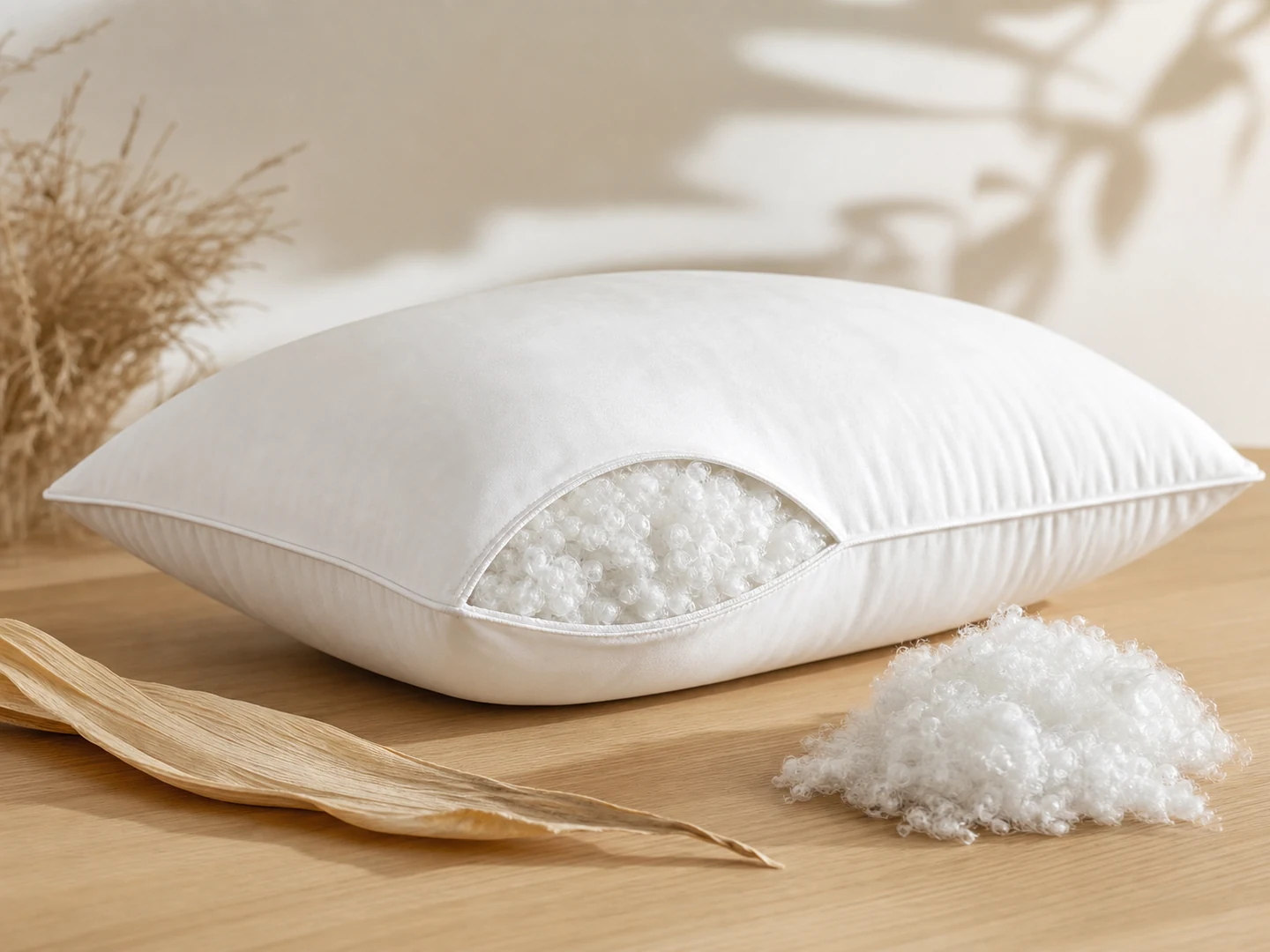
Synthetic fiberfill should not be approved only as a bag of material that feels soft in the hand. Linear density, commonly expressed as denier, cut length, crimp form and surface finish influence how a staple fiber opens, blends, travels through processing, distributes inside a shell and interacts with neighboring fibers. None of those inputs, however, proves the loft, firmness, recovery, warmth or service life of a finished pillow or duvet by itself. The buyer must control the raw-material identity and its permitted variation, then verify the selected material in the actual development route. This guide explains how to build a purchasing specification for conventional synthetic staple fiberfill without assigning a universal denier, length, finish level or performance promise. It deliberately stops before finished-product fill weight, blend-ratio approval and duvet construction, which need their own controls. The objective is to let the buyer, fiber supplier, filling facility and inspector identify the same material; compare samples under stated conditions; evaluate process-representative trials; and manage later lot or source changes without relying on ambiguous labels such as soft, premium or equivalent. Claims about composition, recycled content, origin or compliance remain subject to current, product-specific evidence and the buyer's destination-market review.
- 1. Define the fiber identity before choosing a denier
- 2. Specify linear density and cut length with defined methods
- 3. Control crimp and surface finish as process-relevant attributes
- 4. Approve samples and substitutions through a controlled evidence chain
- 5. Release incoming lots with traceability and exception controls
Define the fiber identity before choosing a denier
Separate material architecture from finished bedding performance
Start with a controlled raw-material description that names the polymer family, staple form and construction relevant to the project. Record whether the fiber is solid or hollow, whether more than one component or geometry is present, the nominal linear density, nominal cut length, crimp description, surface-finish description, color and any other property needed to distinguish the approved grade. Identify the supplier, manufacturing source when disclosure is required, grade or item reference, revision and lot-format convention. If a recycled-content or other material claim is proposed, place the claim wording, scope and supporting document under a separate evidence review; a commercial grade name is not proof of content or compliance. The broader FY Bedding materials overview can help a buyer frame material questions, but the signed specification and current evidence must control the order.
State the intended product and process context without turning it into an unsupported outcome. A pillow insert, chambered hospitality pillow and duvet may expose the same fiber to different opening, transport, filling, quilting, compression and recovery conditions. Use the duvet and comforter fill specification guide for finished duvet decisions, and keep shell construction, fill weight and compartment geometry out of the raw-fiber identity. Likewise, the pillow fill-weight and filling-station guide controls the mass placed into each finished unit rather than the dimensions of an individual staple. Define which facility and trial route will assess process fit so a material approved for one operation is not automatically represented as suitable for every filling system or product architecture.
- Name the polymer family, staple architecture, grade, source and revision.
- Record solid, hollow or other relevant cross-section identity separately.
- Keep composition and recycled-content claims tied to current scoped evidence.
- State the intended product and process without promising finished performance.
Specify linear density and cut length with defined methods
Control the measurement population, units and permitted variation
Denier is a linear-density unit, not a direct measurement of softness, diameter or quality. A fiber's apparent diameter can also depend on polymer density and cross-section geometry, while hand feel changes with crimp, finish, opening and the assembled product. State whether the requirement concerns a nominal single-fiber linear density, a declared grade range or another agreed supplier measurement, and record the units, method reference, conditioning, specimen selection, number of observations, calculation and rounding. If the supplier reports another linear-density unit, nominate one controlled conversion rather than repeatedly converting rounded values. Define what summary data accompany a sample or lot and what the buyer will independently check. The sample conditioning and measurement guide helps make preparation, environment and recording precision visible instead of treating unlike results as comparable.
Control cut length as a distribution observed across a representative sample, not only as one nominal figure on a data sheet. Describe the cutting form and expected length, then agree how specimens are taken, straightened without damaging or stretching them, measured and classified. Record any permitted short, long, fused, unopened or otherwise atypical pieces through project-specific definitions rather than inventing a universal tolerance. If the grade intentionally contains more than one denier or length, list each controlled component and its basis; do not hide a designed mixture behind an average. Cut length can affect opening and entanglement, but the buyer should evaluate that interaction in the actual process. Keep later blend-ratio and contamination checks within the fill blend-uniformity and contamination workflow rather than claiming that length measurement alone proves a uniform finished filling.
- Define the linear-density unit, specimen population, method and rounding.
- Do not use denier as a substitute for diameter, softness or finished support.
- Measure cut length through a stated representative sampling procedure.
- Document intentional multi-denier or multi-length grades component by component.
Control crimp and surface finish as process-relevant attributes
Compare physical form and handling behavior under repeatable conditions
Describe crimp in terms that can be observed and compared: the crimp type or form, how the sample is prepared, the length or mass examined, the counting or imaging approach where used, and any project-approved range or reference sample. A count without specimen preparation can be misleading because opening, tension and conditioning may alter the apparent waves. Include visual observations for collapsed, uneven, fused or poorly opened portions where those conditions matter to the filling route. Treat crimp as one raw-material attribute rather than a guarantee of bulk or resilience. Finished recovery requires a defined load history, sample state and observation sequence, which are addressed separately in the pillow fill recovery and compression guide. Preserve both records so a raw-fiber change and a finished-product response are not confused.
Define the surface finish by the approved grade or controlled formulation reference available from the supplier, intended function, application status and any evidence the buyer requires for the destination and use. Descriptions such as siliconized, slick, dry or conjugated can conceal meaningful differences and should not stand alone as acceptance criteria. Agree a practical comparison route for opening, static behavior, fiber-to-fiber slip, clumping, equipment deposits or shell contamination as relevant, and record the actual trial conditions. A bench hand comparison may screen samples, but it cannot replace a process-representative opening and filling trial. Review any chemistry or compliance statement against the actual supplied grade, named entity, scope and current validity; do not infer finished-product certification from a fiber supplier document or carry a finish approval across an unreviewed source change.
- Define crimp preparation, observation method and reference condition.
- Separate raw-fiber crimp from finished-product loft and recovery evidence.
- Identify the surface finish by controlled grade or formulation reference.
- Evaluate opening and filling behavior under recorded process conditions.
Approve samples and substitutions through a controlled evidence chain
Keep the fiber bag, process trial and product sample on one revision
Build a staged approval set rather than approving an anonymous handful of fiber. Begin with the technical record and a sealed, labeled raw-fiber sample traceable to supplier, source, grade, lot and receipt date. Compare identity, denier, cut length, crimp and finish observations under the agreed methods, then move an acceptable candidate into a documented opening and filling trial. Retain the trial inputs, equipment or line identification supplied by the processor, settings relevant to comparison, environmental conditions where important, quantity used and observations. Link the resulting pillow or duvet sample to the same material lot and bill-of-materials revision through the bedding BOM control workflow. Buyers can use the sample-development route to frame a scoped request, while final criteria remain project-specific.
Define change triggers before production: supplier or manufacturing source, polymer or content declaration, grade, denier, length, crimp, finish, color, process route, packaging, storage condition or test method. A proposed alternative should enter the approved material-substitution protocol with a reason, comparison matrix, current evidence, risk review and trial plan. Apply the broader supplier change-control process when the source or responsible party changes. Similar data-sheet values do not establish equivalence, and a purchasing urgency does not erase approval steps. The decision record should state whether the alternative is rejected, limited to further testing, approved for a named SKU or order, or released more broadly, including who approved it and when.
- Seal and label the retained fiber sample with source, grade, lot and date.
- Trace each process trial and finished sample to the same BOM revision.
- List material, source, finish and method changes that require reapproval.
- Record substitution scope, evidence, decision owner and effective date.
Release incoming lots with traceability and exception controls
Use supplier records, buyer checks and retained samples together
For each delivery, reconcile the purchase specification, supplier identity, source, grade, lot codes, quantity, packaging condition and accompanying documents before material enters approved stock. Define an incoming sampling plan that reflects the lot structure and project risk, then record identity checks and the agreed denier, length, crimp, finish or visual observations. A supplier certificate of analysis can be useful lot information, but the buyer should state which fields it must contain and whether any values require verification; the document is not a substitute for correct sampling or physical identity. Use the product traceability and lot-coding guide to preserve links from received fiber through storage, issue, filling and finished-product lots. Prevent unapproved mixing of lots when the investigation or release plan requires separation.
Define hold, segregation, investigation, disposition and reinspection steps for missing records, damaged packs, identity conflicts or results outside the approved limits. Retain representative material and the decision record for the project-defined period, and make rework or controlled blending subject to explicit approval rather than an informal adjustment. Before bulk filling, confirm the released fiber revision, current BOM, process-trial reference and change status during the home textile pre-production meeting. Final-product inspection through the bedding final-inspection framework remains necessary, because incoming fiber conformity does not prove correct fill mass, distribution, shell construction or packing. Buyers can submit a project brief with the product architecture, candidate fiber grades, evidence needs and trial route for a scoped discussion.
- Reconcile delivery identity, lot codes, quantity, packaging and documents.
- Define incoming sample selection and buyer verification responsibilities.
- Segregate held or changed lots until a documented disposition is approved.
- Keep incoming-fiber release separate from finished-product inspection.
Select one received fiberfill lot and prove that its supplier, source, grade, polymer identity, denier method, cut-length record, crimp and finish reference, retained sample, process trial, approved BOM, change status and finished-lot traceability all point to the same released revision without using hand feel or a generic data sheet as evidence of equivalence.