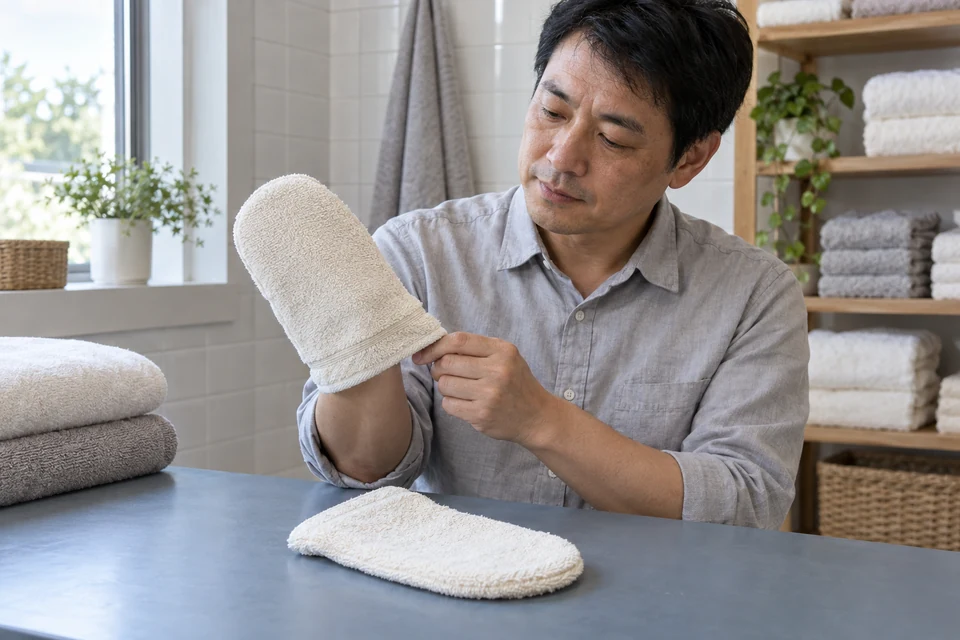
A terry wash mitt is shaped for a hand rather than used as a flat square. That simple difference changes what a buyer must measure, handle and describe in the retail offer. External size and a familiar towel material are only part of the brief: the usable opening, interior seam, fingertip area and included quantity all affect the completed accessory. This guide concerns ordinary bath textiles. It does not provide a medical, exfoliation, hygiene or skin-sensitivity claim, and it must not be confused with a protective oven mitt. The purchase should remain tied to the intended bath use and actual offered construction.
Specify the hand pocket, not only the rectangle
Usable space can differ from the outer dimensions
Measure the opening and internal usable length with the agreed non-distorting method. Show where the hand enters, how the sides taper and whether the upper end is rounded or squared. Include the seam allowance and any folded opening band in the construction drawing so the buyer understands why two mitts of the same outer size can feel different. The accessory technical pack should identify this pocket geometry separately from the dimensions used for a flat washcloth in the wider towel range.
Review sample access with appropriate participants under an agreed ordinary handling method. Record whether the opening folds inward, catches on a seam or requires unwanted pulling to position the hand. Do not convert a small group observation into a fits-all claim. The product owner should decide whether the proposed size range is suitable for the intended offer and what information customers need. Any special use involving vulnerable users or a health-related statement requires its own qualified review; it cannot inherit approval from the general bath accessory.
- Record usable opening and pocket length.
- Show shape and opening-band construction.
- Limit fit conclusions to the reviewed scope.
Turn the sample inside out
The concealed finish is part of the purchased product
Inspect both interior faces and the entire perimeter. Identify seam bulk, exposed thread ends, uneven edge treatment and any label placed where the hand will contact it. Ask for the proposed finished seam construction and a suitable workmanship reference. The interior seam review provides related questions about concealed finishing, but a wash mitt needs its own usable-pocket and contact decision rather than a copied pillowcase seam requirement. Examine actual production-route samples, not just a hand-trimmed showroom item.
Compare interior and exterior material identity if the construction uses different faces or an additional layer. Avoid assuming that a soft-looking exterior also describes the inside or that extra layers improve the intended bath use. The assembly component record should make those differences visible. If the maker revises an internal seam, repeat the pocket review because usable space and hand contact may change. A repair to workmanship and a pattern-size change should remain separately identifiable in the sample history.
- Inspect all interior seams and labels.
- Describe every offered layer.
- Recheck access after a seam revision.
Choose material through the completed accessory
Towel-family coordination is not automatic equivalence
Confirm the actual fiber content, terry construction, finish and face orientation offered. Compare the mitt with any towels it is meant to coordinate with, while acknowledging that a sewn pocket may show the fabric differently from a large hanging towel. The terry construction guide helps collect material identity without relying on a luxury descriptor. A higher apparent pile, familiar supplier or cotton label alone does not establish the accessory's hand feel, absorbency or approved retail claims.
Examine the folded opening, seams and fingertip area as well as the central fabric. Record whether the proposed terry makes those junctions look bulky, uneven or inconsistent with the collection. If technical water-handling evidence is required, have the responsible owner define the relevant sample and method. An informal wet touch can be an observation, but it is not a test report and supplies no skin-care result. Avoid claims such as antibacterial, therapeutic or suitable for sensitive skin unless separately substantiated for the actual item.
- Confirm terry identity and face direction.
- Review bulky junctions on the sewn mitt.
- Keep technical and health claims evidence-specific.
Review care, identification and the sold quantity
One item and a pair are not the same commercial unit
Process the identified completed sample through the agreed care route, then remeasure the opening and pocket and inspect the internal finish again. Compare the material and color with any coordinated bath items in the appropriate condition. The conditioned measurement record helps avoid comparing a damp, stretched mitt with a dry reference. Request any relevant care information from the product owner rather than borrowing a temperature or drying instruction from a flat towel made of superficially similar material.
Specify whether the order and consumer pack contain an individual mitt, two identical mitts or a deliberately different matched pair. Record the identity of each included article and its permitted appearance relationship. Do not let a photograph of two mitts imply a pair when the purchased unit is one. For hospitality issue stock, count by physical accessory and keep any guest presentation set distinct from laundry quantity. The pack-out completeness guide can connect the agreed contents to the actual packed offer without introducing an invented universal pairing rule.
If a hanging loop or decorative trim is included, review its location and effect on the opening, interior and packed state. Keep those components in the care assessment and the inspection sheet instead of treating them as optional styling details. A later addition can change the finished accessory even when the central terry stays identical. Reconcile the complete sample with the issued material and packing records, and retain the post-care reference separately from clean sale stock.
- Recheck usable size in the stated care condition.
- Identify individual and pair units explicitly.
- Include loops and trims in the finished assessment.
Compare offers for a clearly described bath accessory
Do not borrow another mitt category's evidence
Issue the confirmed pocket geometry, terry identity, interior finish, component list, sold quantity and packaging requirements to each proposed supplier. Ask for actual sampling, minimum and delivery conditions for that scope. The quote comparison framework can reveal whether a lower figure excludes pair packing, a loop or an agreed interior finish. Do not use a protective oven-mitt report as evidence for this accessory, or imply that ordinary bath-mitt acceptance establishes heat protection. Product purpose is a controlling part of the review.
Check final pack and website descriptions against the accepted scope. Use product photographs that show the opening and complete supplied quantity rather than only a coordinated bathroom scene. Buyers can send a bath-mitt brief with intended use, pocket observations and pair contents for a sourcing discussion. The relevant manufacturing route and availability remain project-specific. A useful decision is an accessory that can be measured, described and reordered honestly; no certification, special skin benefit or factory capability is created by this editorial guide.
- Quote pocket, finish and packing together.
- Keep bath and protective-mitt purposes separate.
- Use imagery consistent with actual contents.
Release a terry wash mitt only after usable pocket geometry, hidden seams, care condition and purchased quantity are aligned. Bath-accessory fit observations do not establish medical, cosmetic or protective performance.