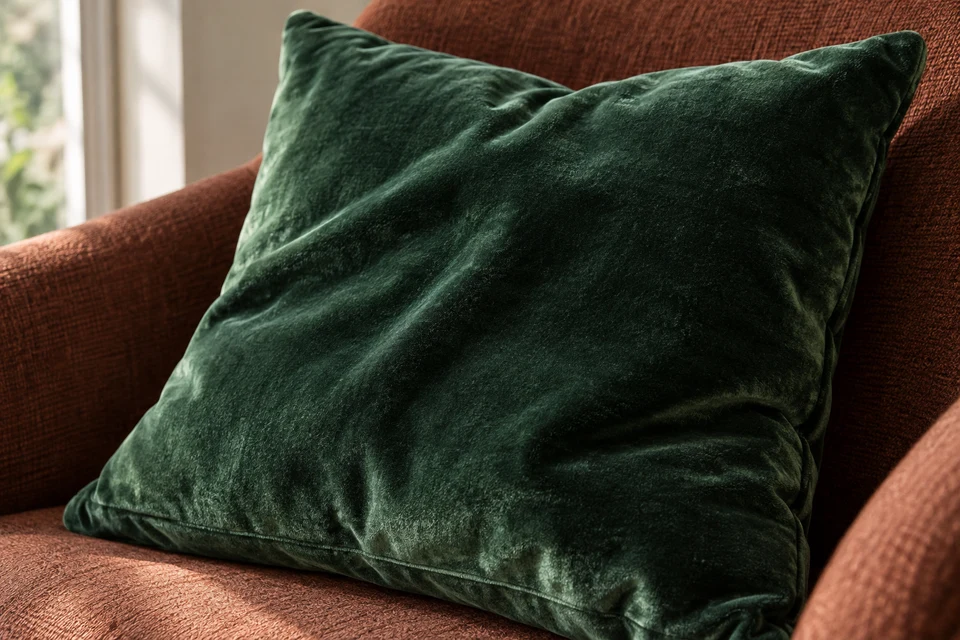
Velvet can show a strong change in light and shade when a panel is turned or the viewing direction changes. That visual behavior makes a cushion attractive, but it also complicates sample comparisons and retail photography. A buying brief should identify the intended directional appearance and distinguish it from unwanted marks. This guide concerns the approval process for the offered velvet cover; it does not assume a particular fiber, weaving route or recovery performance from the word velvet alone.
Establish a viewing direction before judging shade
Compare like with like
Place the reference and candidate covers in the same orientation under the agreed lighting. Keep their top edges and closure sides aligned, then view them from the same position. Turn both together and record the change. If only one sample is rotated, a directional contrast can be mistaken for a color mismatch. Label the orientation on the sample record, not on the photograph alone, so another reviewer can reproduce the comparison.
Use the shade approval process for actual color decisions and the multi-light review where lighting changes matter. The velvet-specific addition is a clear face-direction convention. Ask the supplier how that direction is identified before cutting. Do not prescribe a universal up or down rule: the buyer should choose the intended appearance on the filled cushion and record it. A direction that works for a square front may need reconsideration for a shaped panel.
- Align both samples before comparing.
- Record the chosen top edge and closure side.
Map direction across every visible panel
Seams can reveal inconsistent cutting
Inspect the front, back, gusset if present, and any decorative border as a complete object. Decide whether opposite faces should share the same directional convention when displayed or whether their appearance is intentionally different. Check adjoining panels at the sewn edge, where a sudden light-dark change can be more noticeable than in a loose swatch. Document the desired relationship using an annotated panel map in the technical pack.
Ask the supplier to explain how that map affects cutting and material use. Do not assume that rotating pieces to improve cutting yield will preserve the approved appearance. If a cost-saving arrangement changes direction, review it as an explicit alternative with its own sample and quotation. Match piping or other trim by the intended visual relationship rather than expecting a different material to behave exactly like velvet. The piping comparison is useful when a narrow edge creates its own shadow.
- Show direction on each panel.
- Approve yield-driven alternatives separately.
Separate pile impressions from permanent damage
Record what is observed before proposing treatment
Examine the newly opened sample before brushing, steaming or smoothing it. Note the location and shape of any pressure mark, fold line or flattened area. Compare it with the packing fold and contact points from tags, closures or stacked products. A mark aligned with the package is a useful observation, not proof of its cause or reversibility. Keep an untouched reference photograph and record the time and conditions of the assessment.
Any proposed recovery routine should come from the material or product technical owner and be evaluated on the actual sample. Do not publish a blanket instruction that steam will fix velvet marks. If the retail program requires an acceptable appearance immediately after opening, assess that state directly instead of relying on a treatment customers will not perform. Use the receipt-condition record to distinguish the delivered state from a later conditioned state. Both can be relevant, but they answer different buying questions.
- Inspect before any recovery treatment.
- Record contact points and fold locations.
Test the actual retail pack
Presentation pressure is part of the specification
Pack the cover or filled cushion exactly as proposed, with the real insert, labels, closures and protective materials where applicable. A cover-only pack should not borrow an approval from a filled presentation. Review whether a zipper pull, folded corner or decorative trim presses against a prominent face. Compare the unpacked front with the retained sample in the established viewing direction. Repeat the sequence after any material or fold change.
The fold and pack-dimension approval addresses the retail format; the velvet review adds the face-condition observation. Avoid promising a universal time for pile recovery. If the buyer needs a defined recovery interval, agree the test conditions and acceptance reference beforehand. Record pack quantity and stacking arrangement for the sample trial, because a single loosely packed cover does not represent a dense master carton. Do not convert this trial into a transport-performance claim without appropriate validation.
- Use the intended cover-only or filled configuration.
- Inspect contact from labels and zipper parts.
Release a direction-controlled range
Keep photography and inspection references consistent
Build the collection record with material identity, color reference, panel direction, insert scope and packing method. Ask whether each color or construction needs a separate sample, especially when the apparent contrast changes noticeably. Confirm minima by offered fabric and color rather than assuming one velvet approval permits unrestricted mixing. Keep quotation alternatives visible so a lower-cost material is not silently substituted after the directional sample is accepted.
For ecommerce photography, use the same orientation as the approved display and avoid retouching away ordinary directional variation. Explain the visual character accurately without describing every mark as normal. Send FY Bedding the desired palette, panel map and retail packing plan to discuss sample scope. The final inspection reference should include both a full filled view and close edge views, with any unacceptable marks illustrated by agreed examples. This gives the inspector a reproducible decision rather than an instruction to make the velvet look luxurious.
- Retain direction in product photography.
- Keep accepted variation distinct from rejected marks.
Before release, confirm that shade comparison, panel cutting, filled display and unpacked inspection all use the same recorded nap direction and the same material version.