A bedding carton can arrive intact and still allow its contents to be damaged during opening. When packed goods sit directly beneath a taped joint, the receiver may have little margin between the closure and the textile. Procurement should review access to the contents as part of packaging approval, not assume that successful transport proves safe unpacking. This guide focuses on product protection and opening instructions. It does not teach knife techniques, specify a universal cutting depth or replace the receiving site's safe-tool procedures.
Map the opening route and product position
Inspect the actual loaded carton
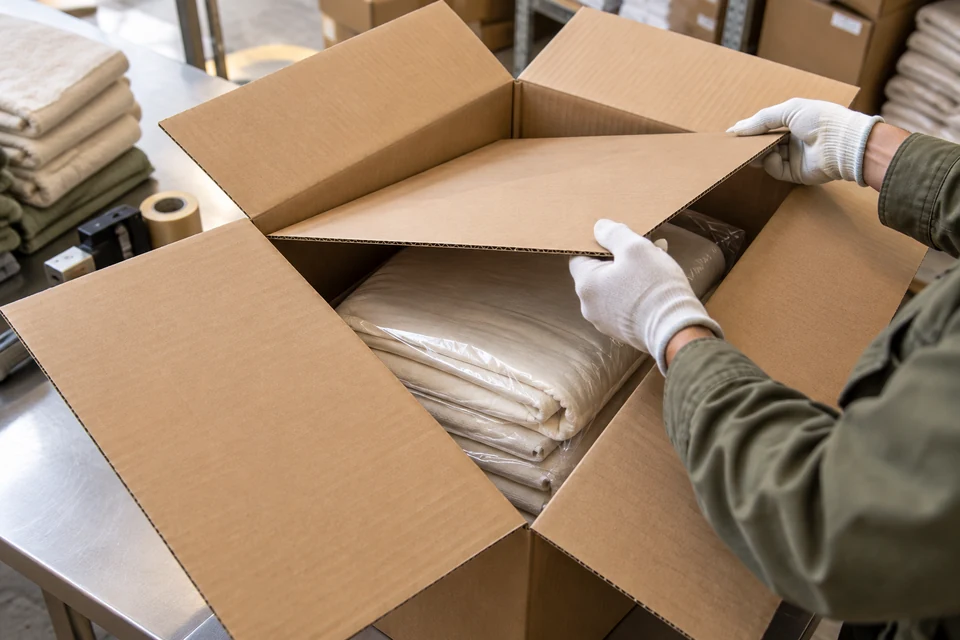
Record which face the receiver is expected to open and where the packed bedding sits relative to the closure. Include the real fold, inner packaging and loading orientation. An empty carton cannot reveal whether a textile rises into the opening area after loading. The carton specification guide establishes the outer package; this review adds the relationship between the opening joint and the goods immediately beneath it.
Identify whether the pack uses a protective insert, separation layer or another approved arrangement at that interface. Record the material and its position without assuming any cardboard sheet is a cut-proof barrier. Use the specification toolkit to distinguish a proposed protection feature from one that has been evaluated in the actual carton. Keep the intended opening route visible to packing and receiving teams so an internal design assumption does not disappear during distribution.
- Identify the intended opening face.
- Use the actual loaded configuration.
- Record protection features and their positions.
- Avoid describing unevaluated inserts as cut-proof.
Review access with the receiving team
Follow approved tools and procedures
Ask the receiving organization to review the proposed opening arrangement using its own approved safe-tool and handling procedures. The review should establish whether staff can identify the correct face and access the closure without unnecessary improvisation. Do not prescribe exposed blade lengths, cutting directions or hand positions from a generic purchasing document. If the package requires a technique outside the site's authorized procedure, refer that conflict to the responsible safety and packaging personnel before release.
Record the opening method actually approved for the trial, the personnel role conducting it and any difficulty reaching the closure. A carton that opens neatly in a design studio may be awkward on a receiving bench or pallet. The receiving inspection guide supports the handover record, but quantity and product-identity checks remain separate. An acknowledgment that cartons arrived should not be treated as acceptance of an unreviewed opening method.
- Involve the actual receiving operation.
- Use authorized safe-tool procedures.
- Escalate packages requiring unsafe improvisation.
- Record access difficulties separately from receipt counts.
Compare protective arrangements in context
Do not hide changes to pack performance
If contents are exposed near the closure, ask the packaging team to compare feasible arrangements using complete loaded samples. Keep the product fold and carton identity controlled so the comparison shows what changed. An insert that protects one joint may shift or obstruct access if its placement is not repeatable. Record how it is installed and whether receivers can remove it without confusing it with a component intended to remain with the bedding.
Review changes against the wider packaging requirements. Added separation may affect carton fill or how the goods are restrained, so the revised arrangement may need renewed handling assessment. The transit validation guide addresses that separate evidence stream. A better opening interface is not permission to discard other acceptance criteria, and a previous transit result should not be attached to a materially different packing configuration without a documented scope review.
- Compare complete loaded samples.
- Record repeatable insert placement.
- Check removal and receiver understanding.
- Revisit affected transport requirements after changes.
Observe contents before redistribution
Preserve evidence of opening-related damage
After the approved opening trial, inspect the relevant surfaces before goods are mixed into general stock or removed from their identification. Record any mark, cut, puncture or disturbed inner packaging with its location relative to the opening area. Do not assume the opening caused every observed defect; compare the available starting condition and transit evidence. The record should distinguish a confirmed observation from a proposed explanation that still needs investigation.
If damage is found, retain the package and affected sample for the agreed review rather than cleaning up the evidence immediately. The inspection-photo linkage guide helps connect photographs with carton and item identities. Images should support a documented finding, not replace quantity or location records. A photograph of an undamaged top item also cannot establish the condition of every piece deeper inside the carton if those pieces were not examined.
- Inspect before mixing goods into stock.
- Record damage relative to the opening area.
- Separate observed damage from assumed cause.
- Retain the relevant carton and sample evidence.
Release packing and opening information together
Make revisions visible at both ends
The final approval should identify the carton, inner pack, protective arrangement and agreed receiving information as one configuration. Route any safety wording through the responsible organization's review rather than copying an improvised instruction onto the box. Keep printed artwork and packing instructions synchronized so a receiver is not directed to an opening face that the current packing arrangement no longer protects. Recheck the interface when carton orientation or product fold changes.
Send loaded-carton photographs, receiving constraints and the observed access issue through a packaging inquiry. Ask for a comparison that protects both the product and the permitted receiving workflow. The artwork revision guide supports any approved marking change. The desired outcome is a clear, repeatable path into the package, not an unsupported promise that no user could ever damage a textile while opening it.
- Release one coordinated packing configuration.
- Have safety wording reviewed appropriately.
- Synchronize artwork with the protected opening face.
- Recheck after orientation or fold changes.
Approve carton access using the real loaded pack and the receiver's authorized procedure, with protection placement, observations and opening information controlled together.