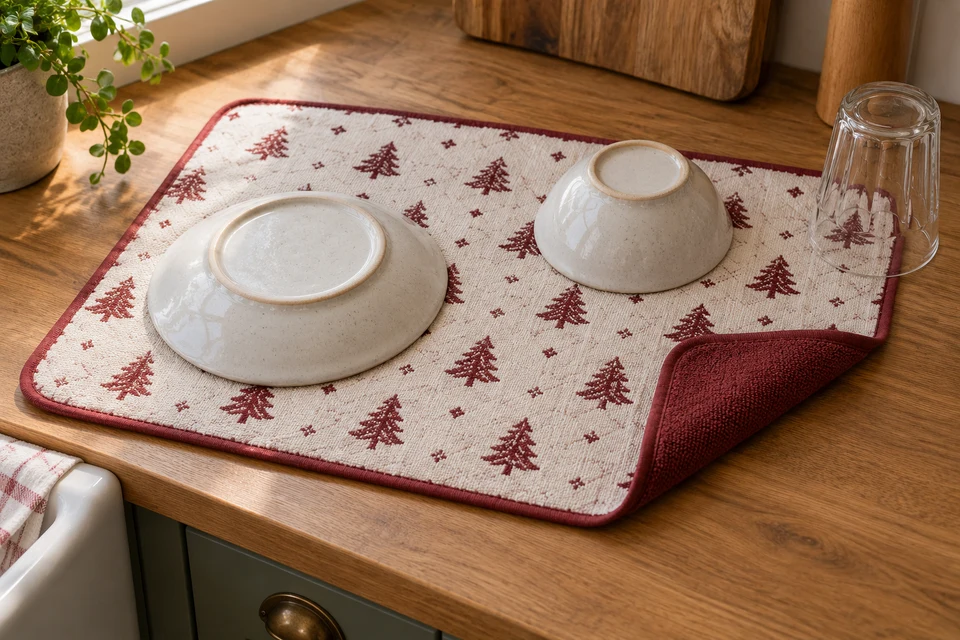
The festive face of a dish-drying mat sells the collection, but the reverse spends the working day against the counter. A buying decision based only on the printed surface misses how the complete construction behaves during use and between uses. Treat seasonal artwork approval and wet-use review as separate decisions, then bring them together in a sample file that the supplier, retailer and technical reviewer can all follow.
Write the kitchen-use brief first
Define what the mat is and what it is not
Clarify whether the item is intended as a stand-alone drying surface, a textile beneath a separate rack, or a decorative accessory supplied with another component. Those are different product briefs. List the expected dish types, counter-contact arrangement and how the customer is meant to dry and store the mat. Do not quietly describe it as a hot-pad, cutting surface or food-contact item when those uses have not been evaluated.
Provide a simple use sketch alongside the size specification. Show where the rack feet or dishes sit and which face is intended to be upward. If both sides may be used, request evidence and instructions for both rather than calling the item reversible because the reverse looks presentable. The home-textile tech-pack guide helps keep these intended-use details visible to everyone quoting the order.
- Name the intended top face and counter-contact face.
- List excluded uses so the packaging team does not add unsupported functions.
Request the complete layer description
A printed swatch does not represent the finished mat
Ask for the fibre and construction description of each layer, the way the layers are joined and the edge treatment. Identify whether the reverse is a fabric, coating or other specified component. A colour strike-off can approve a Christmas motif, but it cannot demonstrate the behaviour of the complete assembled mat. Require a sample with the proposed thickness, stitching and perimeter finish before deciding on the construction.
Check that seasonal artwork does not conceal changes in the base product. For example, a different face fabric or print process should be recorded as a material change rather than treated as a colour-only variation. Review the bill-of-materials control guide to assign an identity to every component. Keep the decorative reference separate from any performance sample that used a different reverse or internal layer.
- Bind the sample reference to a complete layer list.
- Photograph the face, reverse and edge in the approval record.
Observe a defined wet-use sequence
Record conditions rather than inventing a universal result
Agree a practical observation plan with the technical reviewer: sample conditioning, water application, dish arrangement, counter material, observation intervals and the way the mat is left to dry. Use the same sequence when comparing candidates. Record visible transfer to the counter, pooled water, colour transfer, distortion and the condition of the underside. A casual photograph taken once cannot support a broad absorbency or fast-drying statement.
Separate the observations from the acceptance decision. The buyer should specify which findings require a revised construction or additional evaluation, and retain the actual records. Do not present a small internal trial as a certified laboratory result. The absorbency evidence guide is useful for framing questions about methods and sample scope, while the drying-mat project still needs its own appropriate procedure and evidence.
- Log the counter material and both mat faces.
- Compare candidates only under the agreed common conditions.
Connect care instructions to the reverse
Review the mat after use, washing and drying
Ask how the proposed care instructions were established for the whole construction. A face fabric may appear sound while an edge, reverse or joined layer changes. After the agreed care sequence, inspect the same sample for curling, separation, staining and changes in the seasonal motif. Measure and photograph the item without manually flattening the result for the approval image. Keep any revised care wording tied to the tested construction.
Discuss how customers should dry the mat between uses and how that instruction will fit on the product or pack. Avoid promising antimicrobial, mould-resistant or hygienic performance without suitable product-specific substantiation. The care-label artwork checklist supports version control, not automatic approval of a washing method. If care wording changes late, review the packaging and online listing together so the buyer does not receive conflicting instructions.
- Retain the exact care wording reviewed with the sample.
- Inspect the reverse after the same sequence used for the face.
Approve a seasonal pack without expanding the claims
Keep the retail message within the evidence
Use the festive artwork to communicate the collection while keeping functional wording specific and supportable. Show the actual supplied item, distinguish included accessories from styling props and state the correct finished dimensions. If the product is folded for retail, check that the fold does not hide the face designation or compress a component beyond the accepted presentation. Review the real packed sample before approving print quantities.
Prepare a release sheet listing the construction, artwork, test or trial references, care wording and permitted claims. Consult the retail claim matrix for the relationship between a statement and its evidence. Confirm quantity, sampling cost and the current delivery plan separately from design approval. FY Bedding can review a project brief containing the intended kitchen use and retail format; no stock or arrival date should be assumed from the image.
- Make pack and ecommerce descriptions agree.
- Hold unresolved performance statements out of the final artwork.
The release decision should cover both sides of the actual assembled drying mat. If the festive strike-off, wet-use sample and care sample use different constructions, they are three separate approvals that must be reconciled before ordering.