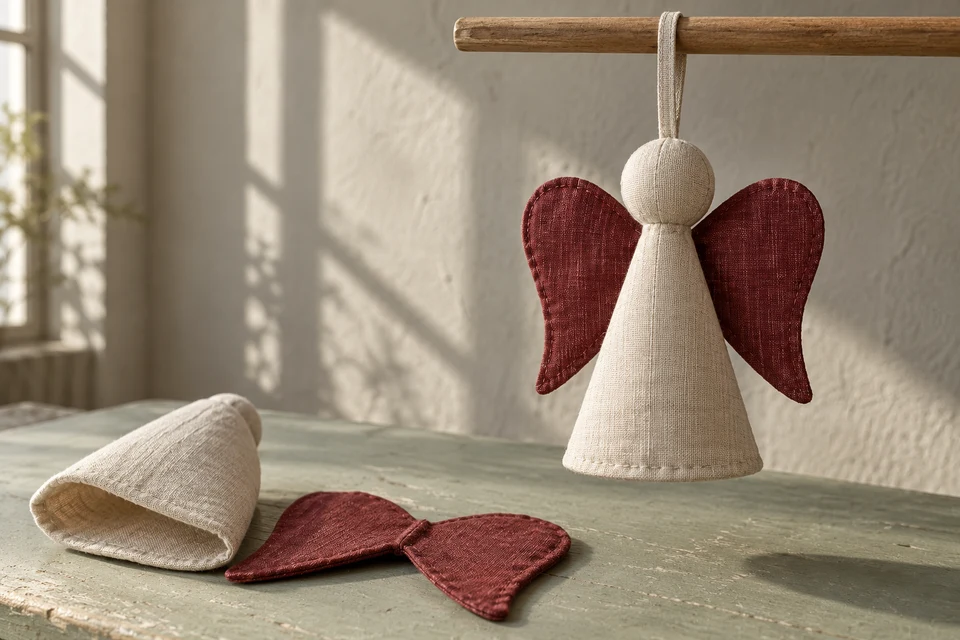
A paired wing panel can look balanced on a table yet turn an assembled fabric angel sideways when it hangs. The buyer is approving the relationship among the body, wings and suspension point, not three unrelated components. Start with the intended hanging view, then ask the maker to show how the proposed assembly produces that view without concealed supports. Keep the product scope decorative; a soft angel figure does not establish toy suitability, attachment strength or a particular manufacturing origin.
Define the body and wing pair together
Use the centerline as a common reference
Prepare front, rear and side views showing the body centerline and both wings. Identify the intended wing span, the height of the connection and the amount of wing visible beyond each side of the body. State whether small asymmetries are deliberate design features. An overall width cannot distinguish a correctly placed pair from a panel shifted to one side, so give reviewers landmarks they can locate on the finished ornament.
The technical brief should distinguish the cut wing shape, finished wing panel and complete assembled silhouette. Ask whether the wings are one joined piece or two separately attached components. Keep the body shell, head and any filling or support identified. A photograph of linen texture is not evidence that all internal materials have the same composition.
- Use one body centerline for all alignment references.
- Identify joined-pair versus separately attached wing construction.
Review the connection before the body is closed
The hidden junction influences the visible wing angle
Request a construction sample or an accessible view of the wing-to-body connection. Locate the attachment relative to the centerline and show which edges are fixed and which are free to move. A broad fixed connection and a small central attachment can produce different silhouettes even when the wing panel itself is identical. Ask the maker to explain the proposed arrangement instead of accepting a generic note that the wings are securely attached.
Use the stitch specification record for the proposed joining detail. Visual neatness is separate from whatever technical attachment evidence the intended market and use require. If the connection is revised, examine the complete angel again. A local stitch change may pull one wing forward, flatten the other or distort the body at the point where all components meet.
- Record fixed and free edges at the wing junction.
- Recheck the assembled silhouette after a connection revision.
Place suspension for the intended facing direction
Flat alignment is not hanging approval
Identify the hanging-loop material, attachment location and supplied length. Suspend the finished ornament from the intended support and let it settle without a hand holding the body. Observe the front, side and rear. Decide whether a slight natural turn is acceptable or whether the display concept depends on a more consistent front-facing view. Record that expectation without pretending a soft ornament will remain fixed in every environment.
The product assessment plan should keep any required technical questions separate from this appearance review. Do not improvise a pull test or publish a load claim from the photograph. If the loop location, head construction or internal material changes, repeat the hanging observation; the same wing outline can behave differently when the overall assembly changes.
- Observe the sample after it settles freely.
- Reassess balance after any suspension or body-component change.
Check both wing surfaces and the lower body edge
Customers can see behind a hanging ornament
Inspect the reverse wing surface, exposed seam terminations and the lower edge of the body. Decide whether the body is open, closed or intentionally shaped around a separate component, and keep that choice visible in the specification. A cropped front photograph should not hide an unfinished-looking underside that will be visible when the ornament is hung above eye level. Review the intended display height as part of the visual decision.
Use the retail image review to compare listing photographs with the physical sample. Do not digitally enlarge wings, straighten the body or remove a visible connection to create a more balanced promotional view. Generated editorial imagery is a separate illustrative asset and must not be substituted for the supplier's production-intent sample photographs.
- Review reverse and underside from normal display angles.
- Keep listing imagery faithful to the accepted assembly.
Pack without folding the two wings differently
The supplied shape includes the unpacking experience
Trial the actual pack with the completed ornament, including its loop. Note whether the wings are both flat, both folded or treated differently to fit the carton. Open the pack and hang the ornament before restyling it. Record any permitted smoothing action and compare the result with the retained reference. Do not announce a recovery time or reusable lifetime without supporting evaluation for the exact construction.
The packaging reference can identify the body and wing color combination, loop inclusion and unit count. Ask for minimums against that complete combination, not just the outer fabric color. Keep sample approval, production readiness and seasonal delivery planning as separate decisions. A substitute wing material may change both the visual edge and the hanging posture, so require another relevant sample before accepting it.
- Compare the two wings immediately after unpacking.
- Release only the approved body, wing and loop combination.
Send FY Bedding the angel silhouette, intended display height and desired wing relationship. Ask for a component-defined sample that hangs freely, plus a packed example. Approve the hidden connection, settled pose and ordinary unpacking result before committing the Christmas decoration order.