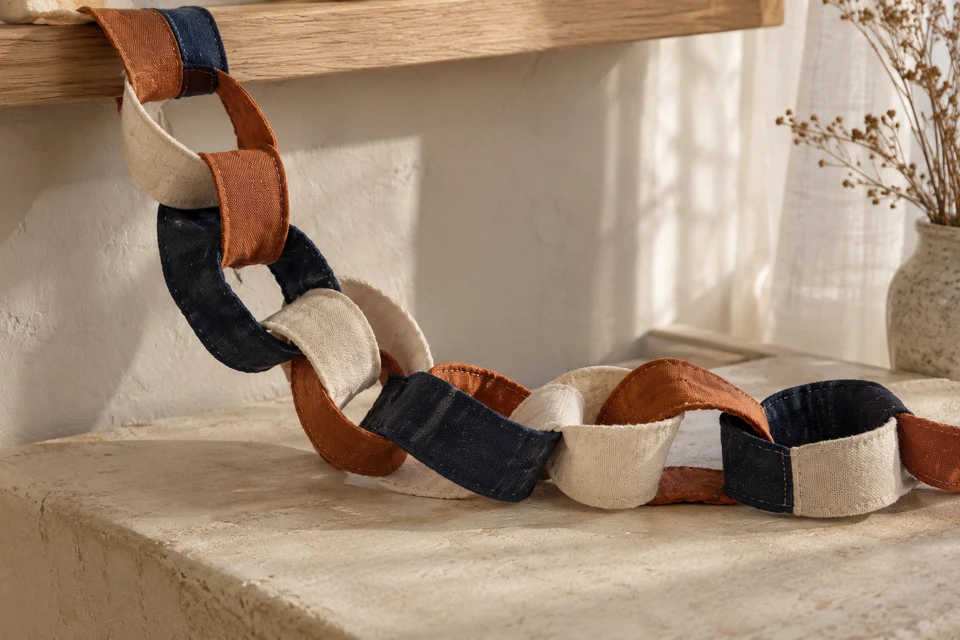
A fabric chain garland connects textile loops directly through one another. Unlike a line of motifs hanging from a separate cord, each loop is part of the visible chain structure. Its closure, fabric faces and color arrangement remain on display as the chain turns and drapes. Buyers should approve an actual linked sample and a defined complete length, without assuming load-bearing use or installation suitability from a decorative photograph.
Define the individual link construction
A strip becomes a loop with a visible connection
Specify the proposed strip material, finished width, edge treatment and loop closure. State whether a link uses one fabric or joined color blocks; the photo alone may show only part of the loop. Add a flat component view and an assembled loop to the technical pack. Do not treat every soft loop as equivalent merely because it has the same outer color.
Ask the maker to show the actual closure from both sides. A sewn overlap, fastening component or another arrangement creates a different appearance and assembly scope. Record the offered method and identify whether it is permanent or intended to open. Use the seam specification method only for sewn parts actually present, and retain the physical closure sample for comparison.
- Identify strip edges, color blocks and the real closure method.
- Review the closure from both faces of the loop.
Approve the linked sequence
The chain turns the fabric face and reverse into view
Build a short linked sample containing a complete design cycle. Observe how adjacent loops rotate and which faces become visible in the intended drape. A sequence of flat strips cannot show that interaction. Decide whether the reverse is intended to match, contrast or remain visibly different, and keep that decision connected to the actual material proposal rather than a front-only swatch board.
Use the design version record to define the color cycle and any multi-color link construction. Mark where the cycle starts and how it ends on a complete garland. If the design changes from single-color loops to joined blocks within a loop, review it as a revised construction. Do not describe those alternatives as identical simply because the same three colors appear in both.
- Review a full cycle as linked loops, not loose strips.
- Specify the visible reverse and any within-link color blocks.
Measure the complete chain in a defined condition
Link count and displayed length answer different questions
Specify the number of links and the method used to measure the complete chain. Identify whether the measurement is taken in a relaxed laid-out arrangement or another agreed condition, without stretching the textile to reach a target. The same links can create different apparent lengths when gathered or draped. Keep the finished product record distinct from the span between display points in a lifestyle photograph.
Record the first and last link arrangements and any separate attachment accessories. If the buyer wants several lengths, define their link counts and complete color cycles rather than cutting an unspecified chain wherever convenient. Ask the supplier to explain any proposed changes in link size or closure used to meet a length target. Those changes affect the visible construction and should receive a new linked-sample review.
- Record both link count and the measurement condition.
- Define end links and color-cycle completion for each length.
Separate decorative construction from installation claims
A textile chain is not a rated support
Describe the garland as a decorative product within the intended display scope. Do not imply that it can carry other objects or act as a barrier or restraint. Identify any supplied mounting accessories and have the responsible operator review the proposed placement. The buyer resource checklist can keep installation responsibilities and market-specific requirements visible without inventing a universal suitability statement.
Put any requested material, closure or handling evaluation into a product evidence plan for the actual assembly. A visually neat loop is not proof of connection strength or fire performance. If a venue requires specific evidence, obtain the relevant documents and scope before making claims. Keep the final retail instructions consistent with the reviewed decorative use and supplied components.
- Keep load-bearing and venue-performance claims out unless supported.
- Identify supplied mounting accessories and the responsible placement review.
Unpack and reconcile the complete color cycle
Packing can hide a missed or reversed link
Agree how the flexible chain is folded or gathered in the selling pack. Open a sample fully and verify link count, closure completion, color sequence and end treatment. Check the natural appearance without first arranging every loop for a photograph. The assortment verification method can distinguish complete garlands from loose replacement links or styling components.
Compare quotations only after material, link construction, color cycle, complete length and packing are aligned. Ask which lengths or color-block variants create separate minimums or sample work. Request actual production and delivery milestones before planning a Christmas display launch. A linked design sample should not be described as proof of stock, a confirmed delivery date or finished compliance evidence.
- Check the fully opened chain rather than only the packed bundle.
- Align complete length and color cycle before price comparison.
Share the intended color cycle, link construction and display length with FY Bedding. Request a fully linked sample and packed garland so closures, reverse faces and complete assortment counts can be approved together.