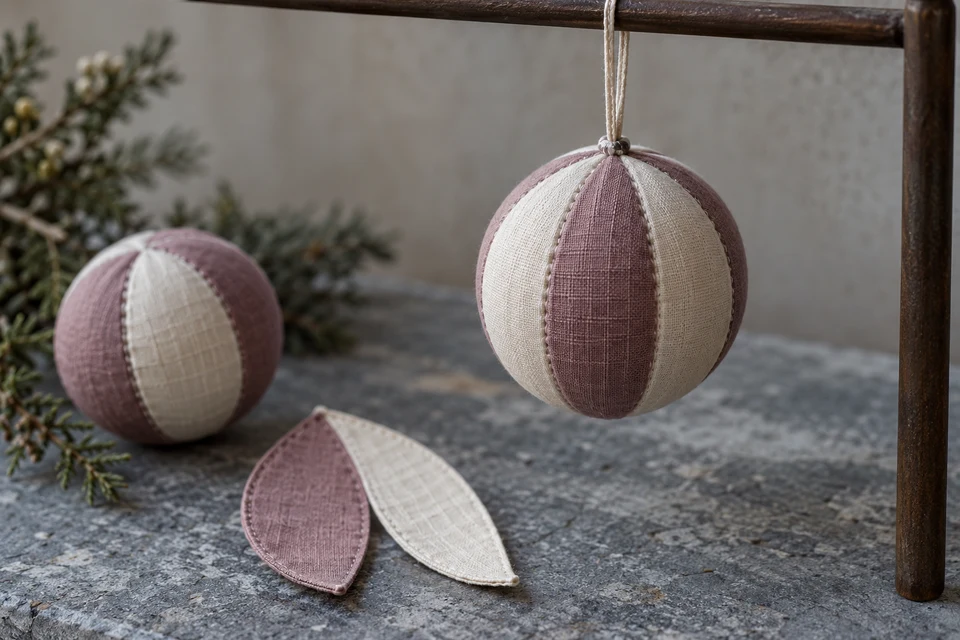
Segmented fabric-covered baubles combine a round core, curved textile panels and a hanging connection. The buyer sees the panel rhythm around the sphere, but production also has to resolve where those panels converge at the top and bottom. A front-facing photograph can conceal both joins. The procurement decision should therefore connect the core and covering specification with an actual freely hanging sample, without assuming material composition or attachment performance from appearance.
Identify the core separately from the covering
The textile surface does not describe the complete ornament
Ask the supplier to identify the proposed core, covering material and any intermediate layer or adhesive. Record the finished diameter and the measurement condition, distinguishing the core dimension from the covered product. A soft fabric surface may conceal a firm core, while a fully stuffed ornament behaves differently. Put the offered construction into the technical pack instead of using one generic fabric-ball description for both.
Request an explanatory sample or construction view that makes the layer sequence understandable. Keep each material declaration linked to the proposed component rather than implying that the whole ornament shares the covering's composition. If the supplier changes the core to solve a shape or cost problem, repeat the relevant sample review. The original covering swatch cannot by itself approve a different complete assembly or support new sustainability claims.
- List core, textile and other proposed components separately.
- Measure the finished covered sphere in a defined condition.
Map the curved panels around the sphere
A flat color sequence becomes a three-dimensional rhythm
Specify the panel count, color order and intended face of each segment. Show how the last panel meets the first, not only the three panels visible from the front. Ask for a turned sample view or a sequence of photographs around the entire sphere. Alternating colors can expose an unintended join immediately, while similar shades may hide a panel width change until the ornament rotates on display.
Keep the pattern and surface decoration coordinated through the artwork control record. A stripe or motif on the flat segment may curve differently at the poles and equator. Mark which appearance is intentional and which region is the principal display face. If a fabric has an obvious direction, approve its orientation on every segment rather than assuming all pieces can be rotated during cutting.
- Check the complete circumference and the final-to-first join.
- Approve directional fabric on the curved finished panel.
Inspect the convergence at both poles
The lower join needs its own acceptance view
Review the top and bottom points where panel edges converge. Identify whether the design uses a visible seam, a small cover or another stated finish at each pole. Keep the agreed finish proportional to the sphere and consistent with the sample; a larger cap should not become an unrecorded way to hide an assembly change. Inspect local puckering and panel displacement without pulling the fabric into position for the photograph.
The seam record can capture the actual panel joins when they are sewn. For another construction, document the real method instead of inventing a stitch description. Ask how the maker keeps the panel sequence consistent through assembly and which observations are checked at release. A neat equator does not prove that the bottom convergence matches the approved reference.
- Include close views of both top and bottom poles.
- Document the actual join rather than assuming a sewn construction.
Review the ornament on its actual loop
Hand-held alignment can hide a tilted display
Show where the hanging loop enters the assembly and how its attachment relates to the panel layout. Suspend the finished ornament freely from the proposed loop and observe its resting orientation. Do not hold the sphere upright or twist the loop for the approval image. If the intended front is important, record the accepted natural view and discuss whether the assembly can reasonably provide that presentation.
Separate this display observation from attachment testing. Any required evaluation belongs in a product evidence plan for the specified construction and use. Do not call the loop load-rated or the ornament unbreakable without appropriate support. Recheck the hanging view after changing the core, pole finish or loop position because each may alter the finished assembly.
- Observe a freely hanging finished sample.
- Keep orientation review distinct from attachment performance evidence.
Release a defined packed unit
Protect the textile surface without hiding the joins
Agree whether the selling unit contains one bauble or a defined color assortment, and record all included loops and accessories. Inspect a packed sample for contact marks, seam flattening and changes around the poles after ordinary unpacking. Any reshaping instruction must be appropriate to the offered construction; a firm covered core and a soft stuffed ornament cannot automatically share the same handling advice.
Use the assortment checklist to reconcile panel-color variants and complete selling units. Compare quotations only after core, panel count, loop, pole treatment and packaging agree. Ask which changes create separate minimums or sample work, and request the supplier's actual production milestones. Keep Christmas delivery expectations conditional on the confirmed order and logistics plan.
- Inspect the unpacked poles, surface and loop.
- Compare complete assemblies with the same core and panel specification.
Send FY Bedding the proposed diameter, panel sequence and display direction. Request all-around sample views, both pole details and a freely hanging packed-unit sample before confirming the ornament assortment.