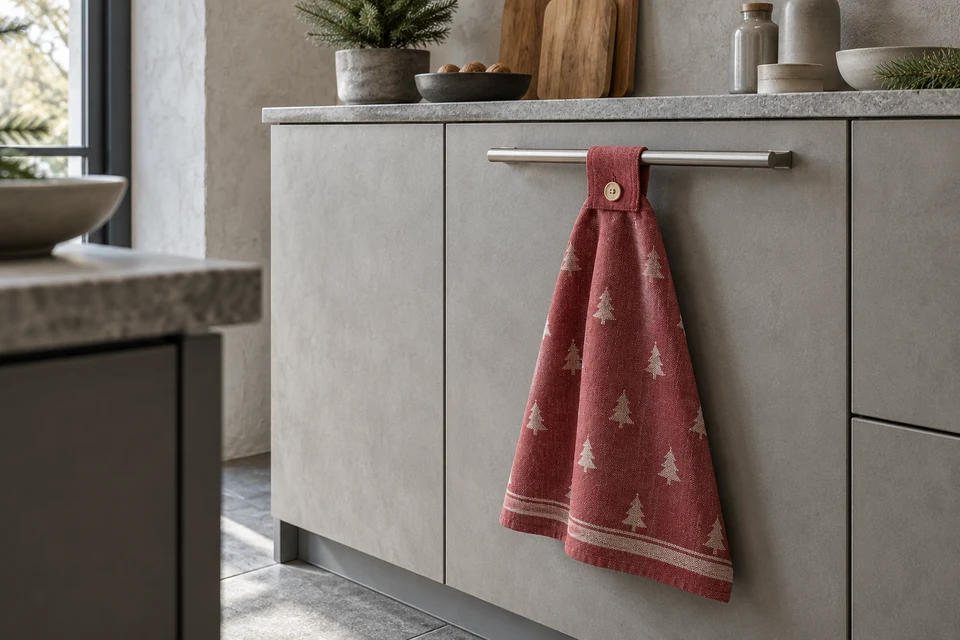
A festive towel that looks balanced in a flat photograph can hang too low, twist sideways or become awkward to remove when fitted to a kitchen handle. For a Christmas kitchen assortment, the hanging system is part of the product, not a styling accessory. Buy the towel, tab and closure as one approved assembly, and define the handles and locations it is intended to fit before ordering seasonal stock.
Start with the intended handle
Measure the route around it
Collect representative handle dimensions from the intended retail use case: bar thickness, distance from the cabinet face, usable bar length and the space below it. A towel shown on one narrow showroom handle does not establish universal fit. Ask the supplier to photograph the sample around the selected handles from the front and side, with the tab closure visible rather than hidden behind the towel.
Keep kitchen drawer use separate from appliance-door use. If the proposed location is an appliance, obtain and follow its manufacturer's placement guidance; a decorative textile is not heat protection. Do not use a holiday photograph to imply suitability near a heat source. The broader kitchen towel assortment brief helps distinguish a working towel from a decorative hanging accent.
- Record handle perimeter and wall clearance separately.
- Identify intended placement and excluded locations.
- Approve the towel while actually hanging, not only laid flat.
Specify the closed tab, not only its cut length
Account for the folded attachment
Draw the tab in its open and closed positions. State finished width, attachment location, closure overlap and the distance from the handle to the towel's upper edge. A long tab may fit a wider bar yet allow the towel to swing against a lower drawer. A short tab can crowd the closure against the handle and make removal difficult. Request a second sample where more than one handle range is genuinely needed.
Choose the closure deliberately. A button, snap or other fastening changes opening effort, appearance and component sourcing. Ask how attachment and repeated opening will be evaluated on the complete assembly; do not treat an attractive button as proof of durability. Specify the junction using the seam and stitch checklist, including the reverse face that customers see when removing the towel.
- Mark closure position from a finished reference edge.
- Inspect the underside of the tab attachment.
Review the Christmas motif in the hanging view
Preserve the visible part of the design
Gathering at the top can hide part of an embroidered tree or split a repeated snowflake. Require both flat artwork approval and a hanging sample approval. Identify the visible design zone beneath the tab and check whether the lower border remains level. A centred flat print may not appear centred once the fabric folds naturally, especially when the towel is displayed over a thick handle.
For an assortment, compare each colour and motif on the same handle with the same camera distance. This prevents a close-up of one option from disguising a smaller visible motif on another. Keep the actual thread, body fabric and tab fabric in the component specification. A shade substitution in the small tab can change the coordinated appearance even when the main towel fabric is unchanged.
Repeat the clearance check after care
Assess the whole assembled towel
Agree a care trial appropriate to the proposed consumer instructions and evaluate the complete towel, including tab, fastening and decoration. Record the starting hanging length and the same measurement after conditioning following the trial. Look for twisted tabs, puckered attachment seams, distorted borders and closures that are harder to operate. These observations support an approval decision; they are not a substitute for any required product testing.
Use the dimensional stability review to document the method and sample identity. If the tab and towel respond differently, revise the construction or materials and repeat the assembled trial. Avoid approving a body-fabric swatch while assuming its result automatically covers a reinforced tab or embroidered area.
- Repeat removal and rehanging with the agreed sample handles.
- Record appearance and clearance before and after the agreed care trial.
Quote a complete seasonal sales unit
Keep dates and variants explicit
Ask whether the offer covers one hanging towel, a matched pair or a mixed-motif pack. List the closure count, label, folding arrangement and retail presentation alongside the towel itself. Compare quantities by colour and tab variant rather than treating a mixed Christmas order as a single undifferentiated total. The quotation comparison guide provides a useful structure for identifying exclusions.
Build the delivery discussion around confirmed sampling, material and packing milestones. Do not promise Christmas arrival from an unconfirmed production estimate. Retain an approved hanging sample and its handle references for the final review. If you are developing a coordinated kitchen collection, send FY Bedding the handle range, motif artwork, sales-unit contents and intended destination so the project can be scoped before a production commitment.
- Freeze the approved tab version with the main towel SKU.
- Show the closure and visible motif in the pack-opening reference.
Release the order only when the selected handle range, closed-tab dimensions, complete care-trial sample and seasonal pack contents refer to the same approved version.