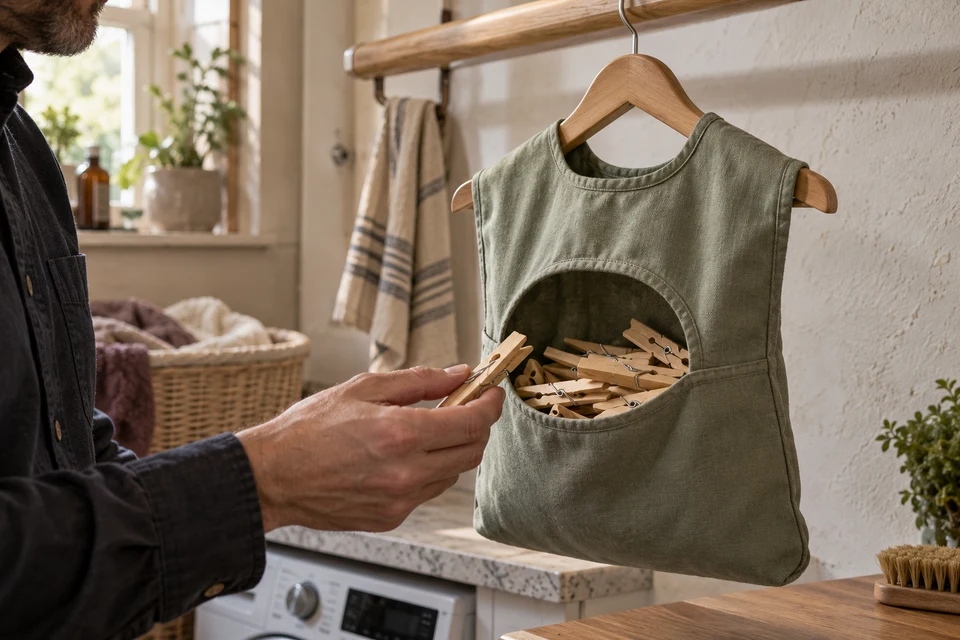
A fabric peg bag is a small hanging dispenser, not a sack for carrying laundry. Its usefulness depends on how the hanger supports the body and whether the user can reach the remaining pegs as the pocket empties. Buyers should review the supported opening and the loaded shape before choosing colours or retail packaging.
Specify the supplied support arrangement
A photographed hanger may not be included
State whether the order includes a hanger, a separate hook, a textile suspension loop or only the sewn bag. Identify the intended indoor or other reviewed setting and the support used for sample approval. A bag sold without a hanger needs a clear compatibility description, not an assumption that any household hanger will work. Record the hanger shoulder span, shape and exit route alongside the textile dimensions.
The bill of materials should distinguish supplied hardware from photography props. Inspect how the bag remains on the support during normal handling and when it is briefly unloaded. An open top may be convenient for removing the hanger but can also change retention. Ask the responsible reviewer to assess the complete assembly and intended contents; a hanging photograph is not a load rating.
- Name the support and whether it is supplied.
- Approve the bag and hanger as a combination.
Review the mouth under its ordinary load
Flat cutout dimensions do not describe access
Record the front opening shape and position on the supported bag. Load a representative quantity and mix of the intended pegs, then observe whether the mouth narrows, tips forward or collapses into the pocket. Check access at a nearly full and a nearly empty state. The user should not need to stretch the edge or pull the bag off its support merely to reach a peg at the bottom.
Use a sample comparison record with the same hanger, contents and trial position for each proposed design. Record the observations rather than assigning an unsupported universal capacity. If the buyer wants one-handed dispensing, define that task and assess it directly. Keep changes to mouth size, pocket depth and hanger geometry identifiable so the reason for an improved or worse result remains visible.
- Compare full and nearly empty access.
- Use identical contents when comparing competing samples.
Inspect the load path through the sewn body
Do not judge reinforcement by patch appearance
Follow the construction from the pocket base through the sides and shoulder area to the support. Identify the seams, binding and any reinforcement that actually carry the intended contents. A decorative patch around the front opening may do little for the upper attachment. Ask for drawings or a clearly identified construction sample when the important join is hidden behind a lining. Keep the sample assembled for normal usability checks.
The seam and stitch specification can record how the proposed joins are made. Any strength requirement should be supported by an agreed relevant evaluation rather than an improvised overload demonstration. Inspect the mouth finish for loose ends and places that catch the intended peg shapes. Review alternate plastic and wooden pegs separately if the product is intended for both; their bulk and contact geometry may differ.
- Map the pocket-to-hanger load path.
- Separate visual reinforcement approval from strength evidence.
Choose a realistic empty-bag care route
Removable hardware changes the handling instructions
Identify the shell, lining, trim and support materials. Decide whether hardware is removed before cleaning and demonstrate the removal and reassembly process on the sample. A technically removable hanger is not a practical feature if replacing it twists the pocket or damages the top opening. Confirm that the proposed care instructions apply to the complete product as supplied, with explicit preparation steps where those are required.
After the agreed care trial, repeat the loaded-mouth check with the same reference contents. Record changes in pocket depth, opening shape, hanger retention and seam appearance using the care-label approval checklist. Do not infer outdoor weather resistance, antimicrobial performance or indefinite wash durability from a simple cotton construction. Any additional claim needs evidence and should be reviewed before it appears on a hangtag or website.
- Demonstrate hardware removal and correct refitting.
- Reassess access after the proposed care procedure.
Approve a sellable set and replenishment reference
Count bags, hangers and pegs independently
List the contents of a retail unit. If pegs are included, record their type and count; if they are only styling props, say so consistently. Consider how the pack holds the hanger and whether folding leaves the mouth distorted. Open the proposed pack and hang the bag using the normal instructions before assessing its display appearance. A separate peg bundle should not be mistaken for filling used only to hold the bag's shape.
Discuss fabric, colour and hardware minimums using the MOQ comparison framework, then obtain a sample and delivery plan for the actual assortment. Keep the accepted hanger, loaded-mouth photographs and care steps with the reorder reference. FY Bedding can review a brief containing the support, intended peg mix, quantity split and packaging scope; this does not imply a confirmed supply route or a tested carrying capacity.
- Specify exactly which accessories are in the pack.
- Retain the support reference with replacement orders.
Select a peg bag from supported access and real contents, not its flat outline. Hanger retention, mouth shape and reassembly after care belong in one approval.