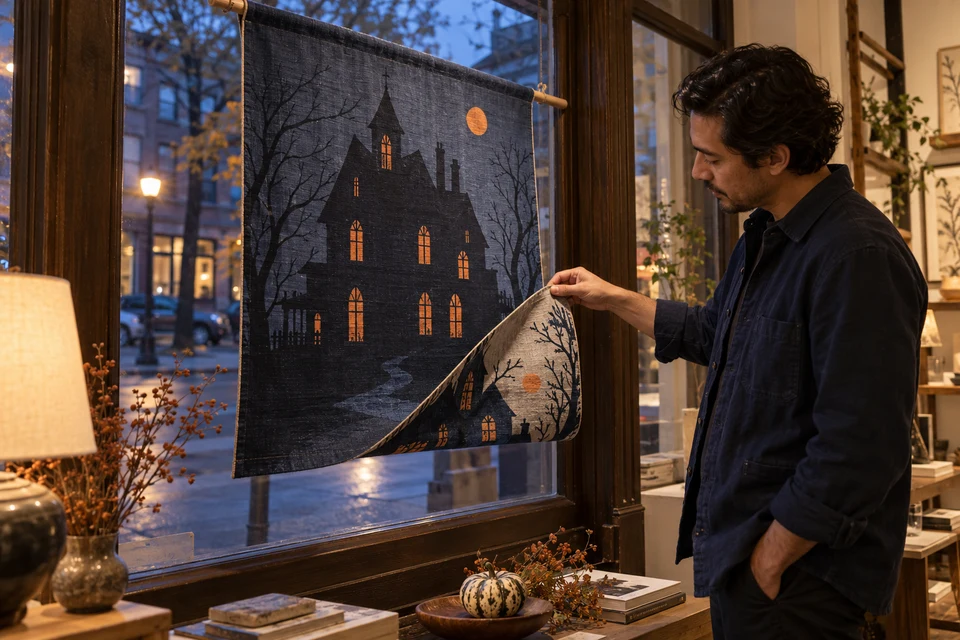
A decorative Halloween window textile is not just a wall hanging moved in front of glass. The street and room can both be viewing positions, and the brighter side changes between daytime and evening. A house silhouette that looks crisp against a wall may compete with the design on its reverse when backlit. The buying decision is how the two intended faces work together in the actual display, including which image belongs outside and what the construction allows viewers to see through it.
Give each viewing side its own artwork identity
Do not treat the reverse as an unspecified backing
Name the street-facing and room-facing designs in the brief. Decide whether they are identical, mirrored or deliberately different. A house with a tower on one side is a useful orientation reference even when there is no lettering. Mark the top edge and mounting sleeve on both drawings so reversing the textile does not accidentally turn one scene upside down or put its foreground at the header.
Use the artwork permission record for both designs and any supplied illustration. Approval of one face does not establish permission for a second image. Retain the final files and physical sample references together. Identify any image shown only as an editorial concept rather than an approved production artwork.
- Label inside, outside and top on both artwork files.
- Review each face as an independently identified design.
Compare complete constructions rather than isolated swatches
Two print samples do not show their interaction
Ask what the proposed construction actually contains: one decorated fabric, two joined faces or additional layers. Keep material identities and layer order explicit. Place the complete sample in front of the intended type of window and view it from each side. An added layer may change appearance, weight and drape, so it should not be approved solely because it hides an unwanted reverse image on a small sample.
The window-light motif review addresses legibility against light. This two-face brief adds the interaction between separate images. Record any visible ghosting and whether the buyer accepts it as part of the effect. Do not describe the textile as blackout, privacy protection or light blocking unless the intended claim has appropriate evidence.
- Record every layer in the sample being reviewed.
- Distinguish accepted visual transmission from unverified performance claims.
Review the street and room under their real lighting conditions
One favorable photograph is not a two-sided approval
View the hanging during representative daylight and with the room illuminated after daylight has reduced. Keep the display position, mounting and sample identity fixed between observations. Note what changes: the outline contrast, the visibility of the opposite scene or the apparent hue. Include wider views that show the window surround as well as close views of the textile, because the buying decision concerns a display rather than a swatch alone.
Use the remote sample review plan if another team is evaluating the display from photographs. Record the light conditions rather than automatically correcting all photos to the same brightness. A camera can conceal a faint second image or exaggerate contrast. Keep a physical review where the decision cannot be resolved reliably on screen.
- Retain daylight and evening views from both sides.
- Describe the viewing conditions and limits of the photographs.
Keep headers and joined edges consistent with the two-face brief
The mounting detail is visible from somewhere
Inspect the top sleeve, side seams and lower edge from inside and outside. Decide where joining stitches or closures may be visible and whether either face has a deliberate border. A simple rod-pocket construction may present differently on the reverse; show it rather than hiding it in the scene. Confirm the display hardware separately and avoid assuming that a garment-style loop or temporary photographic attachment is the final mounting system.
The sleeve-and-rod guide supports the dimensional record. Add the window's usable display area and operational clearances. The venue or installer should confirm mounting suitability and any site requirements. Keep the decorative textile clear of window operation and do not interpret a sample photograph as installation approval.
- Approve all four edges from both viewing directions.
- Separate textile construction from site-specific mounting acceptance.
Release the two faces as one traceable product
An inside/outside swap is a different delivered design
Make the approved face pairing part of the product identity. When several house or moon scenes are ordered, give the packing and inspection teams a paired reference rather than two unrelated folders of artwork. Check an opened sample pack to see which side is presented first and whether the mounting orientation is clear without adding marks to the visible design. Show the full supplied scope in buyer-facing images.
Apply the repeat-order specification process to the paired faces and layers. Obtain a fresh sample if the print route, backing or mounting edge changes. Confirm quantity and production timing for the actual construction. A generated editorial picture conveys the concept but cannot establish opacity, weather suitability, ready inventory or a guaranteed Halloween arrival.
- Keep face A, face B and layer order under one product reference.
- Reapprove construction changes that can alter either view.
Share the window dimensions, two viewing directions and desired artwork with FY Bedding. Ask for a complete joined sample for daylight and evening review, with the mounting edges visible, before approving the decorative window-textile order.