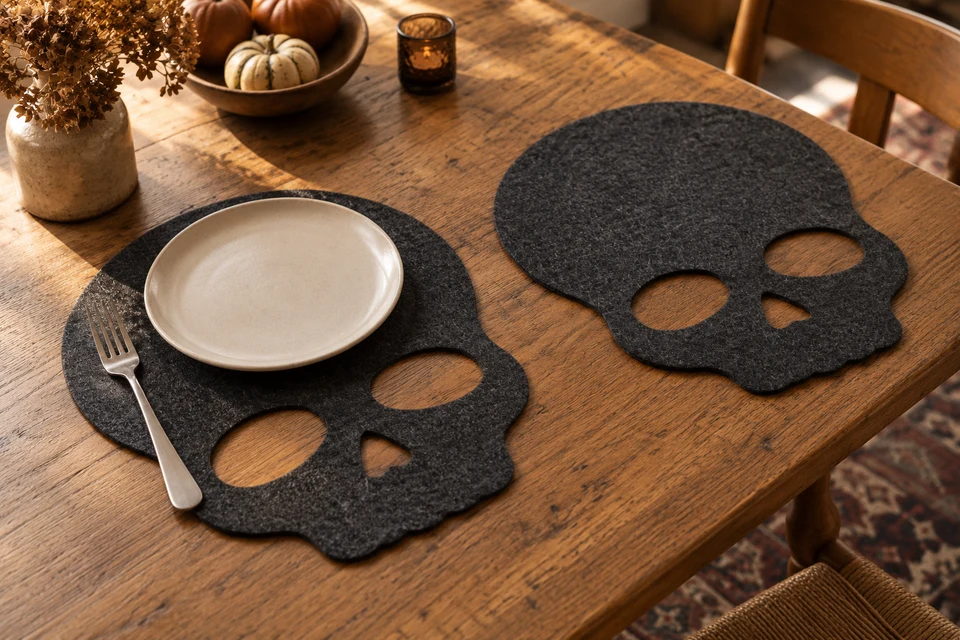
A skull-shaped placemat can look generous in an isolated photograph yet leave little solid textile beneath a real place setting. For B2B buying, approve the usable fabric area separately from the decorative outer dimensions. Eye sockets and a shaped chin are part of the design, not extra support for plates or utensils.
Map the tableware first
Use the actual plate and utensil arrangement
Begin with the intended plate diameter, bowl footprint and cutlery arrangement. Place those objects on a full-size outline of the proposed skull rather than estimating fit from its widest measurement. Mark the areas occupied by the plate base and by utensils. Decide whether the plate is meant to cover the forehead, sit centrally or deliberately reveal the eye cutouts.
The place-setting clearance guide provides the broader table-layout context. Here the additional decision is how much solid material remains after the face is cut out. If a fork bridges an eye opening in the desired arrangement, enlarge or move the solid zone, change the cutout or revise the stated setting. Do not quietly substitute a smaller plate just for the sales photograph unless that smaller setting is the actual product brief.
- Record plate and utensil sizes with the approved layout.
- Distinguish overall skull dimensions from usable solid zones.
Balance the skull outline and cutouts
Approve the negative space as carefully as the fabric
Review the eye, nose and mouth openings on a contrasting tabletop. Closely spaced cutouts may leave narrow bridges of felt that are difficult to keep tidy during handling. Instead of setting an arbitrary universal bridge width, ask for a production-representative cut sample and agree a measurable minimum for this particular material and design.
Try lifting the placemat from more than one edge, laying it back down and removing it from its proposed pack. Observe whether bridges twist, openings distort or the chin folds under. These are project handling observations, not a load or durability certification. Compare the design with flatness checks for quilted placemats while keeping the construction distinction clear: a cut felt edge is not a quilted bound corner and needs its own reference sample.
- Keep a full-size outline showing cutout positions and bridge widths.
- Inspect narrow connections after unpacking, not only before packing.
Write the felt and edge brief
Describe the material actually being quoted
Ask the supplier to identify the proposed fiber composition, nominal thickness, finished dimensions and cutting approach. Avoid treating the word felt as a complete material specification. Inspect the surface at ordinary viewing distance and close up, checking loose surface fibers, uneven thickness and the appearance of the cut edge around small curves. Record observations with photographs of an accepted and an unacceptable example if needed.
Lay several samples together to assess whether the skull profiles appear consistent enough for a set. If edge rubbing or repeated handling matters to the intended use, define the question and seek relevant evidence rather than borrowing a claim from another product. The contact-zone evidence guide explains how to keep a performance question tied to a material and use area. Do not describe this placemat as heatproof, nonslip or protective without suitable support.
- Require the actual proposed felt specification, not a generic swatch name.
- Agree the edge and surface appearance using physical samples.
Test the tabletop relationship
The open areas reveal the surface below
A black skull on dark wood may lose its eye detail, while the same shape on a pale table can look much more graphic. Photograph the sample on the main intended surface and one contrasting alternative. If the assortment is sold without a tablecloth, avoid relying on an unlisted underlay to make the design legible.
The principle differs from tablecloth opacity review: the openings intentionally expose the surface rather than accidentally showing through it. Check the full place setting at a seated angle, where the plate may obscure more of the skull than an overhead image suggests. Include neighboring settings and glassware in a trial for hospitality projects. A design that works alone may look crowded when repeated along a narrow table, even if each placemat meets its own dimensions.
- Approve at least one seated-angle view as well as an overhead view.
- State which tableware and underlays are styling props only.
Keep the silhouette intact in distribution
Choose a pack that supports the thin connections
Compare a flat pack with any proposed folded presentation using the actual placemat. After the agreed storage trial, remove it and lay it on the table without special steaming or pressing unless those steps are part of the customer instructions. Look especially at the chin, eye bridges and any pointed decoration. If the shape needs support, ask for a pack insert trial rather than assuming a heavier outer carton solves the issue.
Consult insert and fold-line contact review when choosing that support. Specify how multiple mats are separated, counted and oriented so small cutout pieces cannot be mistaken for supplied accessories. Confirm care wording, retail descriptions and any evidence needed for the destination market separately. Send FY Bedding the intended place-setting dimensions and full-size skull outline for a scoped development discussion; the silhouette alone is not enough for a reliable quote.
- Record the unpacking condition used for final appearance approval.
- Keep unsupported heat, slip and surface-protection claims out of copy.
Does the real plate-and-cutlery arrangement rest on the intended solid zones, and does the skull still read clearly from a seated position?