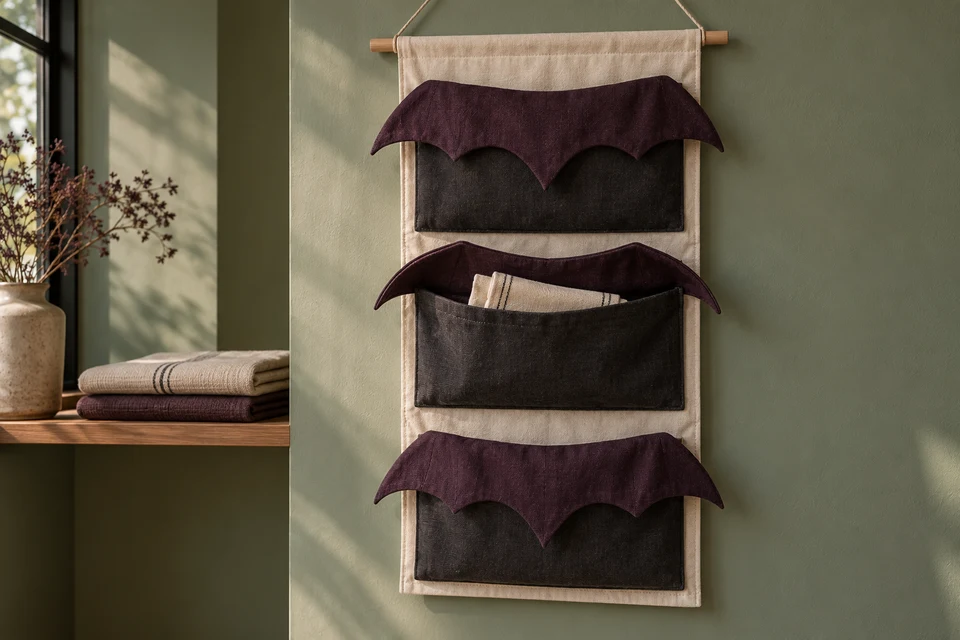
Bat-shaped flaps should reveal a usable pocket, not turn every retrieval into a struggle with decorative wings. A Halloween wall organizer can look orderly with all flaps closed while hiding narrow mouths, snagging corners or inadequate space between rows. The buyer should specify what the pockets hold and review the opening action on an installed sample. The textile panel and its mounting arrangement are separate approval scopes; decorative imagery is not evidence of a load rating.
Map contents before drawing the bat
Measure the item that passes through the mouth
List representative objects for each pocket and record their relevant dimensions. Include the shape that must pass through the opening, not just the part that rests inside. A folded card and a small boxed accessory may occupy similar volume but require different access. Decide whether pockets have identical roles or whether one row has a different purpose. Keep sharp, hot or otherwise unsuitable contents outside an unassessed decorative-storage proposal.
Put the content map in the technical brief with usable opening, depth and intended filled profile. These are not automatically the same as flat cut dimensions. Ask for a sample that uses the proposed lining and seams because their bulk changes the interior. A claim that the pocket fits a broad assortment should be limited to the combinations actually reviewed.
- Specify representative objects and their insertion route.
- Separate finished usable space from the cut-panel dimensions.
Draw the flap in both closed and open positions
Bat wings need room to move
Mark the flap connection edge, wing tips and the area that must clear the pocket mouth when lifted. Compare a hinged fabric flap with any removable or fastened alternative proposed by the maker. The silhouette should remain understandable, but decoration should not require the user to pull on a narrow wing tip to reach the contents. Decide where an ordinary hand is expected to grasp the flap and show that action in the sample review.
The seam record can identify the connection construction and finished edge. Review the reverse of the flap as well as its display face. If a closure component is added, specify its position and evaluate the complete assembly. A revised fastening may alter both access and the bat outline, so it should not be treated as an invisible purchasing substitution.
- Show the wing positions through the opening action.
- Approve the intended grasp area and connection edge.
Space the rows around occupied pockets
Empty flat panels hide conflicts
Hang the sample in the agreed orientation and place the representative contents inside. Open each flap in turn and check whether it collides with the pocket above, catches behind another flap or blocks the user's view of the mouth. Repeat the review with neighboring pockets occupied. An empty panel lying on a table cannot demonstrate the same relationships as a suspended panel with contents.
Keep these observations with the installed mock-up record, adapting it to the actual location. Identify the reference hardware and panel state. If the hanging textile bows or twists, ask the responsible maker and installer to assess the arrangement. Do not compensate with hidden pins for the approval photograph or describe an unassessed mounting arrangement as suitable for every wall.
- Review all rows with representative contents present.
- Record the real installed setup without hidden supports.
Separate panel construction from mounting approval
A hanging loop is a component, not a load claim
Identify whether the offer includes the panel alone, a dowel, a cord, hooks or other hardware. Ask how each supplied component connects and who is responsible for selecting the wall fixing. Keep the proposed display location and intended contents explicit. A photograph showing a dowel and a wall hook does not mean those items are included, nor does it establish that the combination has been assessed for the buyer's setting.
Use the claims evidence matrix to distinguish decorative storage from any asserted capacity or protective function. Request the relevant evaluation through the responsible parties before publishing a numerical capacity. Do not position the product as child-suitable merely because the bat motif is playful. The intended user, accessible components and complete installation need their own appropriate review.
- List textile and mounting inclusions separately.
- Keep unsupported capacity and suitability claims out of copy.
Approve delivery and replenishment as one version
Fold lines should not rewrite the wing silhouette
Trial the folded or rolled delivery form and open it before hanging the panel again. Look at wing creases, pocket-mouth shape and the spacing of the rows. Record any permitted smoothing or setup action without claiming a guaranteed recovery time. If rigid hardware ships with the textile, check how it is separated from decorated areas and how the customer identifies the correct assembly sequence.
The packaging checklist can capture the panel version, hardware count and instructions. Ask which minimums apply to the base fabric, bat-shaped pieces and different pocket sizes. Quote the approved occupied layout rather than a generic hanging rectangle. Confirm sample and production readiness before committing a seasonal delivery date, and reapprove any change that affects access or the supplied mounting scope.
- Recheck access after opening the proposed pack.
- Keep pocket layout, flap revision and hardware list together.
Give FY Bedding the intended contents, panel location and bat-flap concept. Request an installed, occupied sample with clearly itemized mounting scope. Approve access to every pocket and the unpacking sequence before releasing the Halloween organizer order.