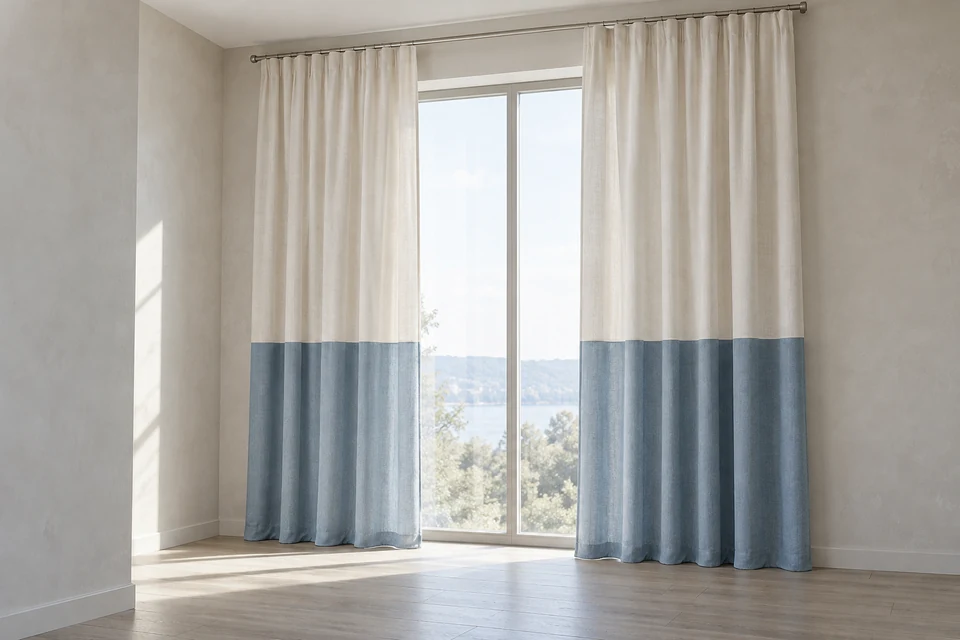
A color-block curtain made from joined fabrics needs a seam-position decision, not just an approved set of color swatches. The buyer is choosing how distinct body sections meet on a finished hanging panel and how that relationship continues across a pair. A printed color block or an attached decorative strip is another proposal and should be identified as such. This guide focuses on sewn body bands, not on a complete window survey or a light-control claim. Use the already established hardware and room requirements as inputs, then resolve the construction-specific questions that a full curtain specification or a loose fabric card may leave open.
Identify which fabrics form the panel body
Joined sections must be distinguishable from an applied decoration
Ask for a front and rear construction drawing that identifies every body section and the join between them. Give the sections stable references instead of describing only a dark lower part or pale top. Establish whether the proposed band replaces part of the panel body, lies over a continuous base or is printed onto one fabric. Those arrangements are not interchangeable offers. The component record should list the actual fabrics, threads and retained layers, while any separately specified lining remains clearly outside the body-band decision.
Request physical references for the proposed sections and confirm which aspects of their relationship are intended: a clear contrast, a tonal transition or another defined design direction. Ask the maker to disclose changes in material, finish or face orientation rather than obtaining a similar color by another unspecified fabric. The color-reference guide helps preserve accepted identities, but this approval also concerns how the fabrics meet. A coordinated swatch board does not demonstrate the finished join, and an attractive joined prototype does not by itself confirm the composition of each section.
- Name each body section and its actual construction.
- Distinguish a joined panel from print or applied trim.
- Keep body bands and any lining scope separate.
Set finished band position from a named datum
Use the sewn hanging line rather than the loose cut edge
Choose a measurement datum that belongs to the completed panel and the established hanging arrangement. State whether the band position is recorded from a finished top reference, another agreed panel landmark or the installed condition. Show the measurement path and identify the visible joining line. The general curtain brief holds hardware, overall size and room requirements; the color-block drawing adds a specific body relationship. Do not substitute a cut-piece length for the completed band location without explaining the construction and measurement basis.
Review a production-intent sewn panel in both the agreed flat state and the nominated hanging state. Observe where the join appears through the folds and decide which relationship the design owner expects. A horizontal join does not need to look like a drawn straight line in every photograph of folded fabric; the approval should describe the actual intended appearance. If the buyer wants a consistent installed height across adjacent curtains, define that decision explicitly. Record any adjustment made to the hanging arrangement during review so it cannot silently conceal a change in the band construction.
- Name the completed-panel datum and measurement path.
- Identify the visible seam line, not only the fabric cut.
- Retain flat and hanging references for different decisions.
Approve left-right and adjacent-panel relationships
A matching pair needs a stated pairing rule
Define what the buyer receives as a pair and whether the two panels use identical or deliberately different band arrangements. Label left and right where the room or design requires an orientation. Hang the proposed pair together on the nominated hardware and inspect the central meeting area as well as the outer sides. Decide whether joins should correspond across the pair, how a deliberate offset is represented and what changes are allowed between separate openings. A single panel cannot demonstrate a relationship that exists only when another panel stands beside it.
Do not borrow a generic repeat-matching instruction as the complete decision. The pattern-placement guide addresses repeats and product datums; here the controlling feature is a seam between named body sections. Build a pair record with panel references, section order and band landmarks. For different finished drops, ask for the proposed design adaptation rather than deciding after cutting whether the lower band becomes taller or the upper section changes. If several openings share a visible wall, review the intended relationship between them with the room owner before releasing their panel schedules.
- Specify identical, mirrored or deliberately offset pairs.
- Review the center meeting area and outside edges.
- State band adaptations for different finished drops.
Inspect the join under real viewing conditions
Seam approval includes the face, rear and folded junctions
Inspect the joined area on the face and rear of the actual panel. Record the proposed seam construction, thread appearance, any visible stitch line and the treatment where the join meets the side hems. Follow the entire joining route instead of selecting an easy center detail. The seam specification record can identify the construction, but the buyer must also approve the color-block junction in this product. Ask for the maker's intended finished sample where a showroom piece has been unusually hand pressed or otherwise prepared.
View the panel in the representative room's available daylight and artificial lighting, with the selected hanging folds in place. Note a visible seam shadow, local ridge, puckering observation or change in the apparent color relationship for the responsible owner to assess. These observations do not establish blackout, flame or other performance. If a seam becomes more prominent under one view, decide whether that is acceptable appearance or requires a revision; do not remove it digitally from approval photographs. Examine the same area again when the panel is moved to its ordinary open position, where folds may expose another part of the join.
- Inspect the full join and its side-hem intersections.
- Record preparation used for the presented sample.
- Keep appearance observations separate from performance evidence.
Review the joined care sample
Separate fabric results do not show their finished relationship
Obtain the proposed care information for the complete assembly and let the responsible technical owner define the relevant sample review. Keep section fabrics, seam construction and any body layer identifiable. After the agreed preparation, compare the same finished band landmarks and the paired hanging relationship. Record the observations as results for that sample and condition, not as a universal prediction. A previously accepted fabric swatch can remain a useful reference, but it does not demonstrate how the selected sections and seam present together after the offered care route.
Separate overall panel dimensions from the relationship at the band join. For example, a review may find that the total drop remains within the agreed decision while the seam appearance needs further work; do not combine those findings into a single unexplained pass. Ask whether exceptional pressing or rehanging was needed to recover the reference. If the maker proposes another section material to resolve a problem, reopen the joined sample and pair review rather than accepting an isolated replacement swatch. Record the accepted finished state in the construction brief so later viewers know which assembly was actually reviewed.
- Assess the identified joined assembly under its proposed care route.
- Separate overall dimensions from band and seam observations.
- Reopen the pair review after a body-fabric substitution.
Order the complete paired construction
Commercial comparisons should name every body section
Issue the released body-section list, finished band landmarks and panel pairing schedule with the established overall curtain requirements. Ask suppliers to state the actual sampling, material minimums and delivery scope for that construction. Identify whether the offer includes one panel, a matched pair or another agreed unit, and keep hardware or separately specified lining exclusions visible. Do not assume that two solid colors use the same commercial arrangement as a single-fabric curtain. A proposed alternative should show which section, join or pairing rule changes before it is considered comparable.
Agree how panels will be identified and kept in their intended pairs for receiving and installation. Preserve the joined reference with its label or panel code and the accepted hanging photographs. On a later order, compare the same section identities and finished seam landmarks rather than requesting the previous color names alone. Buyers can discuss a joined-band panel sample using a dimensioned pair drawing, or submit a sewn color-block curtain brief with the room inputs already defined. The curtain collection is a starting point for that conversation, not confirmation that a particular joined construction is available.
- Compare one panel, paired panels and excluded components explicitly.
- Keep pair identities with the receiving and installation record.
- Retain finished band references for later matching discussions.
Approve the sewn color-block body as a joined, hanging pair. Named section fabrics, finished seam landmarks, pair orientation and the reviewed care state must stay connected; color cards alone do not define that assembly.