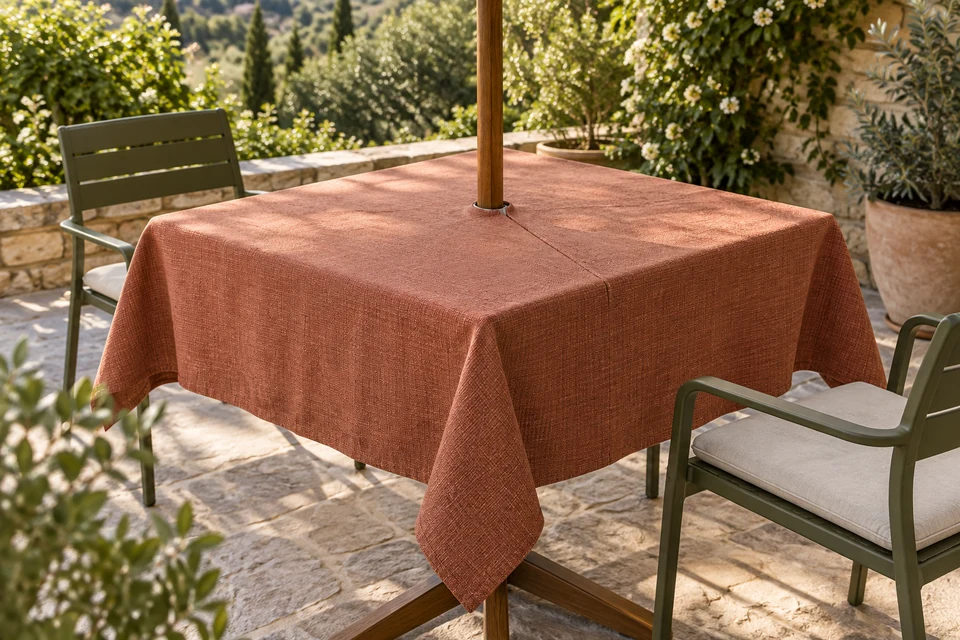
A patio tablecloth with a parasol opening is not simply an indoor cloth with a hole added. Pole position, textile access and the restaurant's permitted handling routine affect the buying decision. Terrace buyers need compatibility with an existing assembly; retail buyers need to explain the furniture fit. This guide concerns the textile opening. It does not provide parasol installation instructions, approve furniture alterations or establish wind stability or weather resistance.
Choose between a hole and an access line
Describe how the cloth reaches the pole position
A closed central opening and an opening connected to an outer edge are different constructions. The first surrounds the pole once fitted; the second gives the textile an access path that can be closed or overlapped according to the offered design. I Dream of France documents fabric-finished and ring-finished holes alongside a zipped-access option in its own customization service. This verifies that such choices exist, not that every option is suitable for a particular hotel or that FY supplies them.
Ask the property to decide which handling routes are permitted with its parasol and table. If a proposed cloth would require moving equipment in a way staff are not authorized to perform, stop that option and seek a compatible textile proposal. Do not solve the mismatch by improvising with structural hardware. A different fabric opening must remain a textile decision within the existing safe operating arrangement.
Request the complete opening and access line, including the reverse. A circular swatch cannot demonstrate the closure or its location on the laid-out cloth.
Map the textile center and the furniture
Do not assume all central openings share one geometry
Identify the actual tabletop shape, its opening, the pole position and the visible components around that point. Include any collar or furniture detail that changes the space available to the fabric. The cloth's intended center, the tabletop's center and the usable opening must be related explicitly. An extended table or another furniture variant may need a different drawing even when the catalog uses a familiar size name.
Keep overall dimensions and peripheral drop in the tablecloth fit review. Here, locate the opening within that presentation and show the access-line direction relative to seating and service. Do not dimension the hole while leaving orientation for the restaurant to invent.
Record the finished aperture, its edge treatment and the supplier's proposed allowance around the identified furniture. Ask the technical owner to define the appropriate fit rather than applying a universal hole diameter. Use the product brief to distinguish measured furniture details from provisional assumptions before a sample is cut.
- Identify the table, pole position and nearby furniture details.
- Dimension the textile opening from a defined cloth reference.
- Show the intended access-line direction.
Watch an ordinary service change
Approve the complete cloth through the authorized routine
Have authorized staff demonstrate the proposed cloth using the property's permitted method. Observe the whole sequence of placing, arranging and removing the textile without changing the parasol's approved setup to make the sample fit. Record where the access line sits and whether the finished opening rests as intended. If the demonstration cannot proceed within the approved operating arrangement, that is a compatibility question for the responsible team, not an invitation to force the sample into place.
Once arranged, review the central area with the planned dining setup. Look at visible gaps, raised closure bulk, binding and contact with the pole or collar. Compare before and after handling so an existing surface mark is not automatically attributed to the opening. Identify the exact proposed fastening rather than treating a zipper, overlap and another closure as commercially equivalent alternatives.
Keep perimeter accessories separate. The tablecloth-clip guide addresses edge contact, not central access, and neither review creates a wind rating. Consider the wider table-linen program when deciding whether the cloth is a practical service item or only an occasional display piece.
Separate opening fit from outdoor performance
Request evidence for the actual fabric and care route
A well-finished parasol opening does not establish resistance to sunlight, water, stains, mildew or repeated outdoor exposure. Ask which of those properties the project actually requires and what evidence supports the offered material. Do not transfer a branded outdoor fabric's claim to an unidentified cloth. Keep the construction, color and finish linked to the proposed evidence through the product testing plan.
Agree the cleaning route for the complete cloth, including binding, closure and any reinforcement, rather than reading instructions for the face fabric alone. Review an identified cared-for sample on the same table configuration. Note changes in the aperture, access-line alignment and the way the surrounding textile lies. Let the responsible technical team set acceptance criteria; a pleasant tabletop photograph cannot demonstrate continued service life.
Retail descriptions should explain compatibility and care without promising a universal fit. Hospitality buyers should also confirm storage between services and the condition checks required before reuse.
- Keep opening fit and exposure evidence as separate decisions.
- Evaluate the closure and reinforcement with the complete cloth.
Quote and pack the chosen configuration
Make the variant obvious before it reaches the terrace
Send the fabric direction, furniture drawing, opening construction, sizes, colors and quantities together. Ask whether different table shapes, custom aperture positions or fastening options change minimums and sampling cost. The minimum-order discussion is a useful framework, but a supplier must confirm its own proposed route. Do not assume that an unmodified stock cloth can be converted without a new finished-sample review.
Approve the fold and protective pack so the closure and finished opening are not hidden from the receiving check. Identify table compatibility and orientation in the item information without including unsupported performance badges. The packaging checklist helps keep the cloth reference, care information and carton quantities aligned. Plan delivery by venue or installation phase where variants are easily confused.
Share the furniture, handling needs and arrival date through a FY Bedding sourcing inquiry. Request a complete sample configuration, supply-feasibility confirmation and an approval-to-delivery sequence before committing quantities.
Choose the opening and access construction around the actual table and permitted service routine. Keep compatibility, care evidence, outdoor claims and furniture safety as distinct approval responsibilities.
Method references: I Dream of France central-hole and zipped-access options.