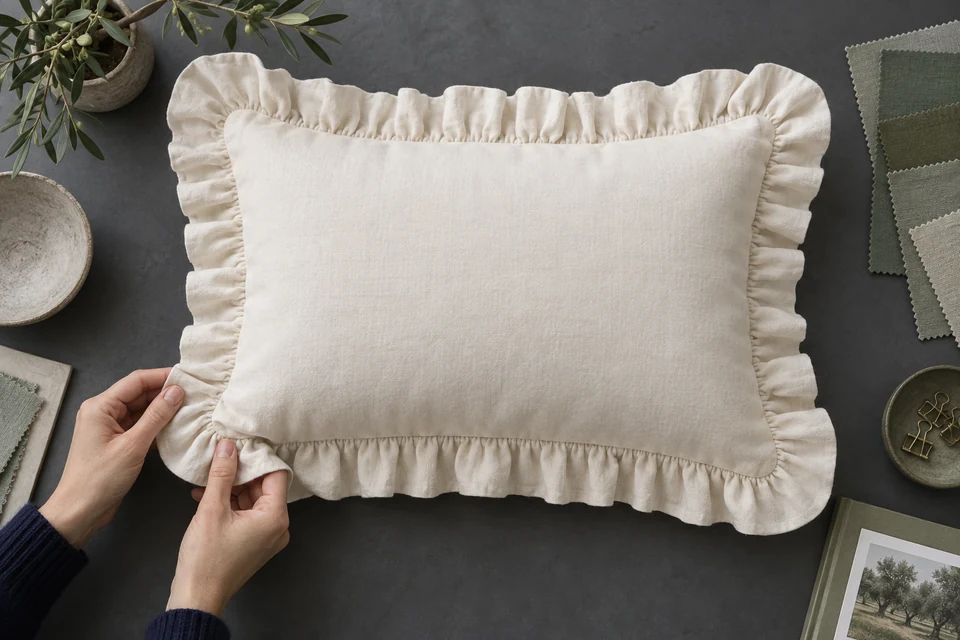
Ruffles change the outline of a cushion cover through gathered fabric rather than a fixed corded edge. Buyers need to define where fullness belongs, how it passes around corners and what the finished assembly should look like with its intended insert. A narrow swatch of gathered trim cannot establish the complete result. This guide focuses on ruffle distribution and presentation for an identified cover. Attachment strength, care durability and other performance requirements need separate evidence under the project's technical plan rather than being inferred from an attractive sample photograph.
Define the ruffle and the finished cover
Distinguish dimensions from visual fullness
Identify the cover body dimensions separately from the exposed ruffle width and overall decorative outline. Ask the technical owner to define the measurement points and the intended gathered construction. The technical pack should show which edges carry ruffles and whether any plain sections are deliberate. Without those distinctions, a quoted cushion size can describe the body in one offer and the outer trim in another, making nominally identical products difficult to compare fairly during sampling and purchasing.
Record the ruffle material, cutting direction, join locations and edge finish in the offered construction. Do not prescribe a universal gathering ratio without reviewing the actual fabric and desired effect. The buying brief can describe the visual target while leaving the technical team to propose a controlled construction for approval. A light cotton and a firmer woven material may require different development decisions to reproduce an intended outline, so matching an arithmetic ratio alone is not proof of matching appearance.
- Separate body and decorative dimensions.
- Identify every ruffled edge.
- Specify material and edge construction.
- Approve fullness through an actual sample.
Review gather distribution along straight edges
Establish a useful comparison reference
Inspect a complete straight section under normal lighting and identify the accepted distribution of gathers. Look for conspicuous bare intervals, crowded areas or changes near joins, recording observations against the sample identity. The sample approval record should preserve enough length to show the intended rhythm rather than only a carefully selected close-up. Keep the cover in the agreed state without manually redistributing every gather immediately before each photograph if that is not part of normal presentation.
Ask the design owner to distinguish intentional irregularity from workmanship departures. A soft gathered edge need not resemble a rigid geometric border, but the acceptance decision should still be understandable to the supplier and inspector. Use agreed comparison photographs and the physical reference, with written notes for important limits. Avoid vague instructions such as make it more luxurious, which provide no basis for deciding whether a revised sample has addressed the issue or simply introduced a different amount of fabric elsewhere around the perimeter.
- Review a complete straight section.
- Record joins and local fullness changes.
- Define intentional irregularity.
- Preserve physical and photographic references.
Resolve the corner transition
Check the junction rather than assuming symmetry
Request all corners on the production-intent cover and compare how the ruffle moves between adjacent edges. Identify crowding, twisting or unexpected flattening for the technical owner's assessment. Keep this separate from the piping construction review: a gathered fabric edge has different presentation questions from a corded border. Do not accept a corner simply because its seam is neat if the distribution of the surrounding ruffle does not match the approved design intention.
Where the design deliberately treats corners differently from straight edges, show that distinction in the construction record. Review corresponding corners using the same orientation and sample state, and record any planned asymmetry. A revised corner may affect the adjacent straight section, so compare the complete affected area rather than looking only at the junction. If several cover sizes are proposed, decide which need their own sample review instead of assuming a corner solution scales automatically with the body's length or width.
- Inspect every intended corner configuration.
- Separate ruffle and piping criteria.
- Document deliberate corner treatment.
- Recheck adjacent edges after a revision.
Evaluate the assembled cushion
Include the intended insert and care state
Fit the cover with the identified insert and observe the ruffle in the intended display position. The cover-and-insert approval establishes the underlying assembly; an overfilled or different insert can alter the way the seam and decorative edge are presented. Keep that combination constant when comparing ruffle revisions. A flat empty cover and a finished cushion answer different questions, so retain both views where they are needed for a clear approval decision.
If the project includes a care trial, compare the identified assembly or components under the agreed procedure and observation state. Record the resulting shape without assuming that the initial gathering pattern must remain visually identical under every treatment. The technical owner should define the applicable criteria and any required further evidence. Do not borrow a universal washing recommendation from the trim's fiber name. Keep care suitability, dimensional changes and decorative appearance as related but separately recorded decisions for the actual offered cover.
- Use the accepted insert reference.
- Review flat and assembled presentation.
- Keep comparison conditions consistent.
- Record the agreed care-state observations.
Release the ruffle reference for production
Make later comparisons meaningful
The final record should identify the cover body, ruffle construction, gathering distribution, corner treatment and accepted assembled appearance. Preserve the approved physical sample with enough information to distinguish it from earlier development versions. Include rejected options and concise reasons where they help explain the selected result. A supplier should not need to infer the final construction from a series of photographs in which fabric, insert and corner treatment changed at the same time.
For quotation and repeat orders, send the controlled sample references and intended use with the size range. Ask suppliers to identify proposed material or construction differences before treating an alternative as equivalent. If the ruffle fabric or body size changes, review the affected appearance and update the approval scope. This keeps the sourcing discussion focused on a reproducible decorative edge and the evidence still needed, rather than assuming that the word ruffled defines a complete specification or guarantees the same result from any offered trim.
- Release body and ruffle identities together.
- Preserve the accepted corner reference.
- Keep development versions distinguishable.
- Review material and size changes before repeats.
Approve ruffle fullness along straight edges and through corners on the actual assembled cushion, with dimensions, construction and care-state limits recorded separately from aesthetic language.