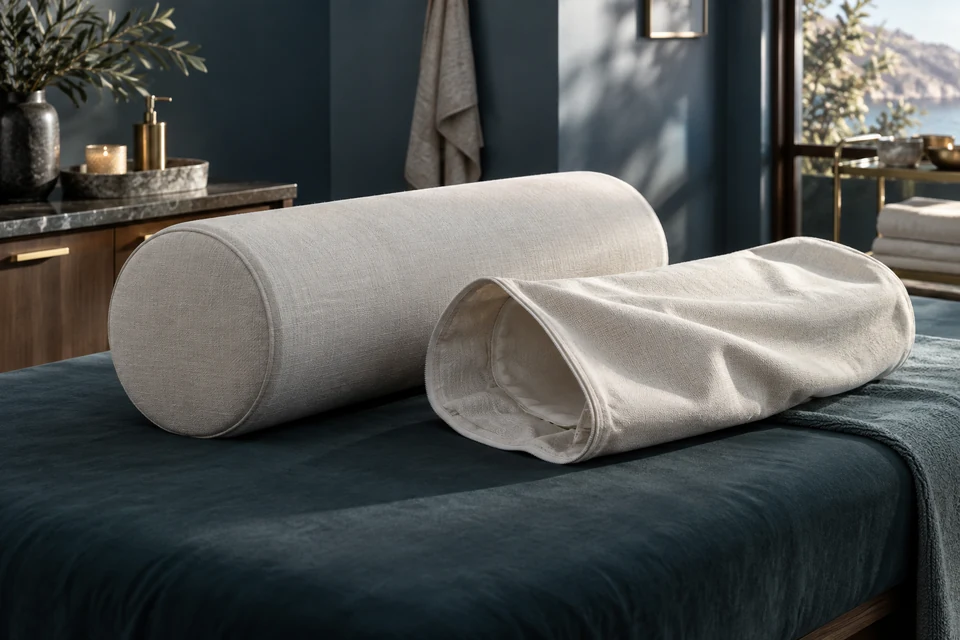
A removable spa bolster cover should be purchased against the actual bolster, not a general cylindrical cushion description. End-panel shape, finished length and opening access can make a similar-looking cover unsuitable for the operator's changeover routine. Buyers need a defined fit reference and a clear division between textile appearance and equipment-related decisions. This guide concerns the removable cover only. It does not establish a therapeutic benefit, hygiene barrier, equipment compatibility guarantee or permission to alter a bolster supplied for a particular treatment setup.
Identify the actual bolster
Keep shape and equipment references together
Ask the spa operator to identify the bolster model, outer material and permitted covering arrangement. Record the relevant manufacturer information before measuring or requesting samples. Some items that look cylindrical in photographs have different end shapes or compress differently during fitting. The spa linen brief should therefore identify the accessory separately from treatment sheets and towels. A common fabric selection does not establish a common pattern or an approved equipment application.
Record length and the defined cross-sectional measurement points on the actual reference. Explain whether dimensions describe the uncovered bolster, the finished cover or the desired assembled result. Keep those numbers distinct in the specification record. Where several models are used, assign a fit family only after the operator and supplier have reviewed the differences. Do not average measurements across dissimilar accessories simply to reduce the number of sample requests or create a more convenient ordering schedule.
- Identify the model and permitted covering arrangement.
- Define measurement points and sample condition.
- Separate bolster and cover dimensions.
- Validate each proposed fit family.
Define the end-panel construction
Review the assembled shape rather than a flat circle
Request a construction drawing showing the end panels, joining seams and opening location. Record any orientation needed to put the cover on correctly. A flat end-panel sample cannot show the seam's presentation once the cover is fitted around the full bolster. Connect the drawing to the technical pack, including which areas the operator expects to remain smooth and which construction details are intentionally visible on the accepted sample.
Fit a production-intent prototype on the identified reference and record gathered areas, twisting or an end panel that does not sit as intended. These are observations against the agreed appearance, not automatic evidence that the bolster or fabric is defective. If the supplier changes a seam or panel dimension, keep that revision identifiable. Review the complete cover again because a local correction at one end can change the usable length or the position of the opening elsewhere.
- Show end panels and opening on one drawing.
- Check the assembled prototype on the reference.
- Describe specific appearance findings.
- Recheck the full cover after pattern changes.
Check opening access with staff
Make removal and refitting observable
Have trained spa staff demonstrate the permitted removal and refitting routine without a guest present. Observe access to the opening, the sequence used and any point where staff must force the cover or distort the bolster. Follow the equipment provider's and property's instructions; a procurement trial is not permission to modify the accessory. The closure review can support a zipper specification where relevant, but it cannot independently authorize the complete covering arrangement.
Record the closure position when fitted and whether the operator can restore the accepted presentation consistently. Keep practical comments linked to the same prototype version rather than combining feedback from several similar covers. If access is difficult, ask the supplier and responsible operator to review the proposed correction together. A longer opening or different closure may affect other requirements, so it should not be accepted as a harmless workshop adjustment without documenting the revised construction and its scope.
- Observe the operator's permitted routine.
- Avoid forced fitting or equipment alteration.
- Record closure position when assembled.
- Coordinate revisions with the responsible operator.
Reassess after the intended care route
Preserve fit and condition evidence separately
Agree the relevant care assessment with the parties responsible for the product and spa operation. Identify the sample, procedure and measurements before comparing the post-care cover with the same bolster reference. The dimensional-stability framework helps organize that evidence without supplying a universal allowance. Do not infer continued fit merely because the cover still closes, or infer a hygiene outcome from a clean-looking photograph of the finished item.
Record changes in end presentation, opening access, seam condition and the operator's refitting observations. Separate a dimensional mismatch from a closure issue or a change in the bolster itself. Where a sample has been altered after the trial, label the alteration and request the appropriate repeat assessment. The approved reference should represent the proposed production construction, not a hand-adjusted cover whose actual dimensions and care history can no longer be reconstructed from the project file.
- Identify the care route and sample version.
- Repeat the same measurement references.
- Separate fit, closure and condition findings.
- Retain an unambiguous production-intent reference.
Release by verified fit family
Connect quantities to the property's actual accessories
Create an allocation record linking each released cover pattern to the relevant bolster references and locations. Record the operator's required rotation and replacement quantities without inventing a universal spare ratio. A shared color should not be the only identifier when two covers fit different accessories. Keep the accepted sample, drawing and care evidence together so receiving staff and future purchasers can understand what was approved and which substitutions require another review.
For a spa cover sourcing request, provide accessory photographs, defined measurements, permitted covering information and the intended changeover route. Ask for a prototype against that scope rather than an unconditional promise of universal fit. At reorder, confirm whether bolster models or operating requirements have changed before reusing the former pattern. The resulting purchasing decision should connect a real accessory, an approved textile construction and a repeatable operator routine without extending the evidence into unsupported treatment or barrier claims.
- Allocate quantities by verified fit family.
- Identify visually similar cover variants.
- Keep sample and operating references together.
- Review equipment changes before reordering.
Release the cover only when its end panels, opening and post-care fit have been reviewed on the identified bolster under the operator's permitted arrangement.