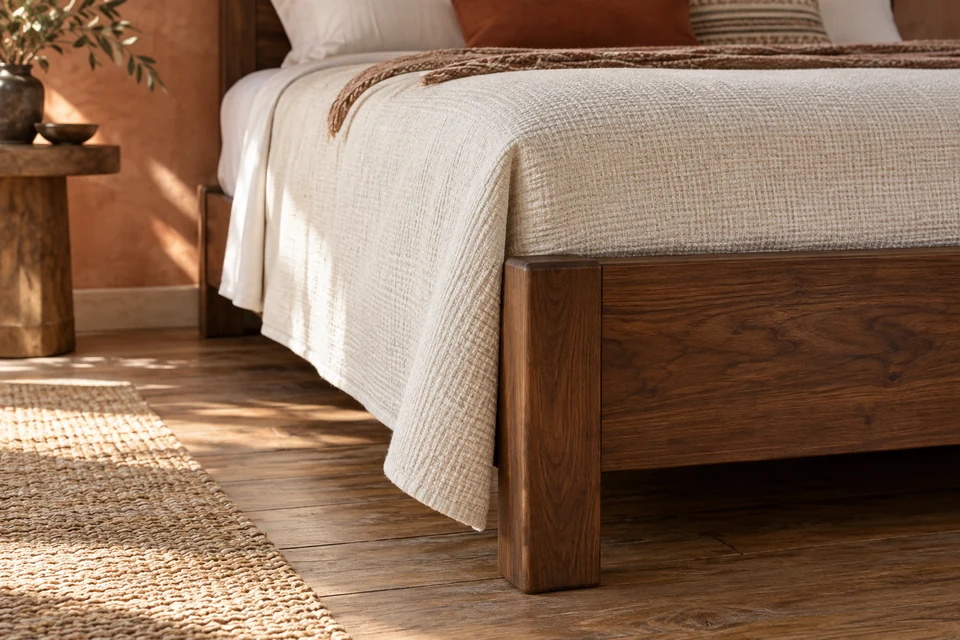
A conventional bedspread may gather against a footboard even when its overall size seems correct. A split-corner construction separates the hanging side and foot sections at a planned location. Whether it works depends on the actual frame. For hotel buyers, the question is where the opening belongs and how the cover should look during ordinary bed making. A furniture-specific sample answers that question better than a universal split depth.
Choose a top cover, not a base skirt
Give the supplier a clear product identity
State that the proposed item sits over the made bed and is removed or repositioned as part of the top-of-bed routine. A bed skirt dresses the base through a different arrangement; its dimensions and attachment decisions cannot be copied directly. The bed-skirt guide explains that separate product. Likewise, a decorative scalloped perimeter does not define a functional opening around a post.
Ask for a drawing of the supplier's actual corner option. Superior Custom Linens documents both continuous and split-corner treatments on a tailored bedcover, illustrating why the corner choice needs to be named explicitly. This is a construction example, not a standard fit or evidence of FY availability. Show whether each hanging section is independent, whether any overlap is intended and what the reverse looks like when the sections move apart.
Decide which beds need the feature. One split arrangement for every room can introduce visible openings where none were intended.
- Name the top-of-bed product and normal removal routine.
- Request the offered corner drawing, not only a style name.
Map the bed above and below the mattress
The post location matters as much as nominal bed size
Record the mattress stack in its dressed state, including any topper and the layers intended under the spread. Then identify the footboard, posts and rails relative to the top surface and mattress corners. Photographs should show the obstacle from above and from the side; a frontal room image can hide the exact point where fabric meets furniture. Treat estimated dimensions as unresolved information rather than allowing them to become cutting instructions.
Describe the desired coverage at the sides and foot separately. The spread may be intended to cover part of the frame, sit inside a footboard or fall outside it; those are different design decisions. Use a room mock-up record to capture the selected arrangement and its furniture reference. Do not prescribe moving, altering or removing structural parts to accommodate the textile.
For a four-poster bed, identify which posts affect the cover and show its head and foot orientation. The furniture label alone cannot establish the required openings.
Compare the open and overlapped corner
Make the visible junction a deliberate decision
Lay the finished sample on the named bed and let the side and foot sections fall naturally. Observe where the split begins, how its upper end sits relative to the mattress corner and whether the hanging edges meet, overlap or leave an intended gap. There is no universal geometry that resolves every footboard. Ask the fabricator to explain the chosen split location and finish against the measured furniture.
Review the junction from the entrance, bedside and foot of the bed without pinning it closed for photography. If an underlap is offered, inspect the extra layer and visible reverse as part of the actual sample. A hidden panel that looks effective from one angle may still need a different position in another frame. Record the preferred result in the dimensioned product brief, including which corner views control acceptance.
Keep decoration secondary to fit. A shaped perimeter needs its own scalloped-edge review. Show lining or edge changes on a revised finished corner rather than inferring their effect from a swatch.
- Observe the split without temporary pins or concealed styling.
- Review the upper split end and both hanging edges.
- Identify any intended overlap and visible reverse.
Try the room routine after care
A fitted photograph is only the beginning
Ask housekeeping to place, turn back, remove and refit the cover in the normal room sequence. Watch whether the staff can identify its orientation and whether the split must be repeatedly arranged around the post. Record extra handling as an observation, not a claimed time saving or a reason to improvise a fastening. The bed remains furniture governed by the property's operating instructions; the textile should work within that arrangement.
Agree the cleaning and evaluation conditions before assessing a cared-for sample. Repeat the same fit review and compare coverage, split position, edge appearance and the visible junction. The dimensional-stability guide supports the measurement plan. A decorative approval before care should not be presented as evidence that the post-care fit is already known.
Classify each concern: acceptable, needs revision, or unsuitable for this bed family. If mattress height changes, revisit fit even when width stays the same.
Order by frame family, not room count alone
Make variants understandable from quotation to unpacking
Group beds only where the measured furniture, mattress stack and accepted split arrangement are equivalent. Send the variant schedule, fabric direction, colors and quantities with the sample request. Ask whether different corner patterns, sizes or linings create separate minimums or development work; the MOQ cost-driver guide provides questions, not a promised minimum for this product.
Approve how each cover is folded and identified before final packing. Similar white or neutral spreads can be hard to distinguish once the split is hidden inside a fold. Carton labels should point to the accepted room or frame family, and delivery phases should preserve the required variant mix. Keep unconfirmed furniture dimensions out of a release-ready order even if the installation deadline is approaching.
Send FY Bedding photographs, the measured frame schedule, desired finish and arrival date through the project inquiry. Request a finished sample and confirmation of supply feasibility before committing room quantities.
- Separate frame variants before discussing minimum quantities.
- Pack and label the approved corner arrangement by room family.
Approve the split where it meets the actual frame, not against a generic bed size. Keep top coverage, side and foot drops, post-care fit and variant identity in one understandable room reference.
Method references: Superior Custom Linens tailored bedcover corner options.