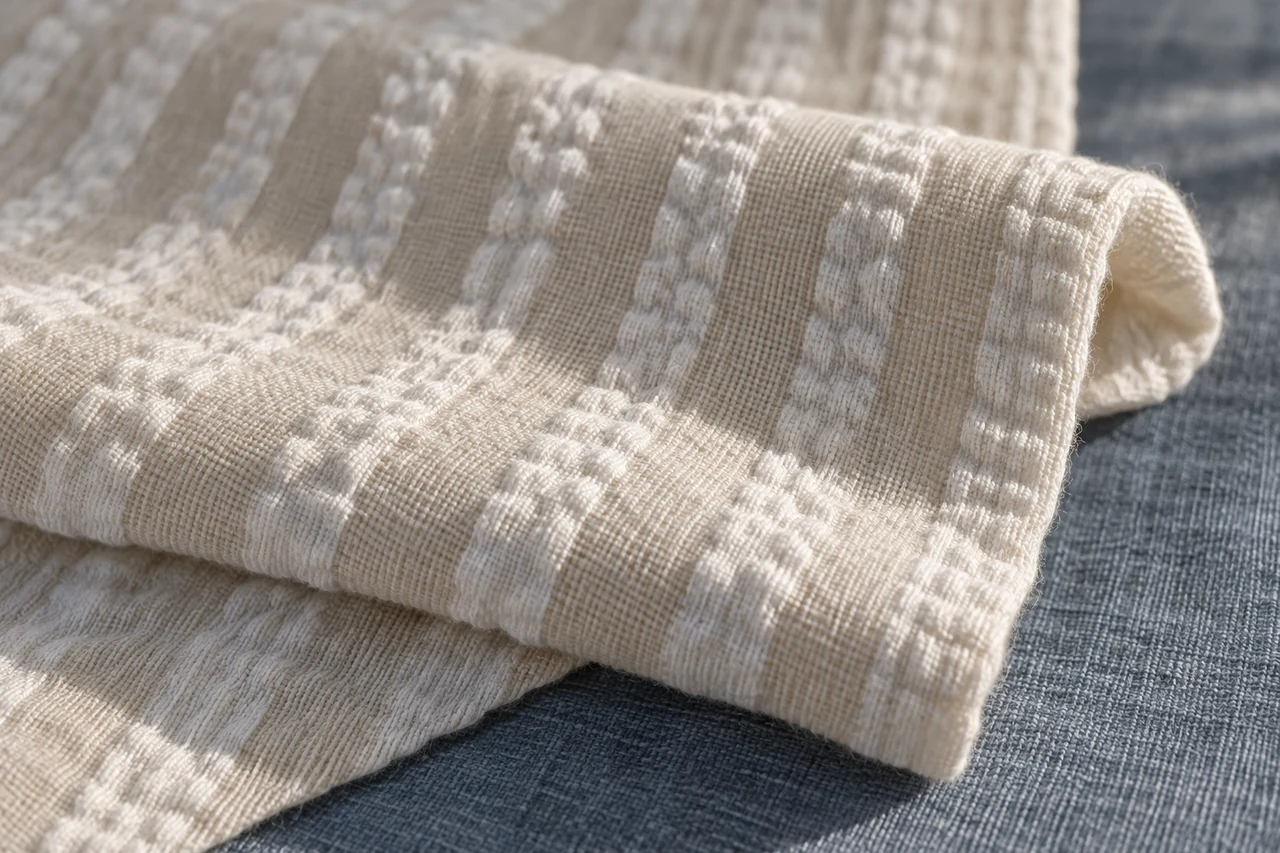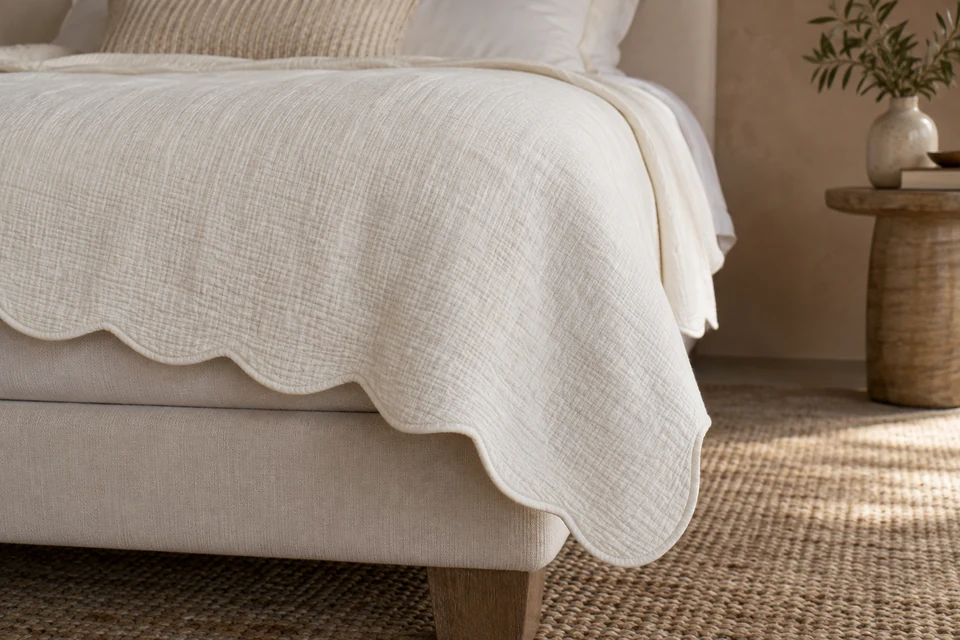
Scalloped bedspread edges need more than a general instruction to follow a decorative curve. Buyers should define the intended repeat, the way curves meet at corners and the appearance of the finished edge on the bed. A neat seam alone does not establish the accepted geometry. This review focuses on shape and presentation for the offered construction, with separate evidence needed for durability or other performance claims. The aim is to give the sample maker and inspector the same understandable reference before bulk quantities are ordered.
Define the curve in a controlled drawing
Name the reference points
Identify the intended scallop pattern with a drawing or approved template that shows the relevant curve boundaries. Ask the technical team to define how the repeat and depth are described and measured for the offered design. The technical pack should distinguish the nominal outer dimensions from the shape of the decorative edge. An overall width alone cannot tell a sample maker whether the buyer expects shallow repeated curves, deeper lobes or a particular transition at each corner.
Record which edges are scalloped and whether any straight sections are intentional. Identify the face, reverse and orientation of the finished product in the drawing so the pattern is not interpreted differently at the head, sides and foot. Use the specification record to keep the approved template and revision visible. Avoid relying on a cropped inspiration photograph that shows one attractive curve but provides no information about how the full perimeter is meant to be completed.
- Define repeat and depth reference points.
- Separate overall size from edge geometry.
- Identify scalloped and straight sections.
- Control template revision and product orientation.
Review the corner transition explicitly
Avoid leaving the junction to interpretation
Ask for a sample that includes a complete corner and enough adjacent edge to show the repeat approaching it from both directions. Record whether the design uses a centered lobe, a valley or another deliberate transition. The edge-finish inspection guide addresses related workmanship, but the geometry decision must identify the intended shape. Two neatly sewn corners may both look plausible while only one matches the buyer's design, so workmanship approval alone cannot resolve the difference.
Compare corresponding corners on the full sample and identify any deliberate asymmetry. Where the repeat cannot meet the proposed dimensions exactly, ask the design and technical owners to agree the transition rather than having production distribute an unexplained adjustment around the perimeter. Keep the selected solution in the drawing and physical reference. Do not assume that a corner accepted in one bedspread size automatically establishes the repeat arrangement for every larger or smaller variant in the range without reviewing how the shape is carried through.
- Review complete corner-and-edge samples.
- Name the intended corner transition.
- Record deliberate asymmetry.
- Resolve repeat adjustments by size.
Observe the finished curve on the intended fabric
Keep cutting and sewing effects visible
Use the actual offered material and edge construction for the approval sample. Compare the drawn curve with the finished shape after the normal production process, noting visible waviness, flattening or other departures for the technical owner's assessment. The sample approval record should identify what was cut and sewn, not merely attach a paper pattern as proof of the finished result. A drawing can define intent, but it cannot demonstrate how the chosen material and construction present that shape.
Review the face and reverse of the edge under useful lighting. Keep the product in the agreed state without pulling the perimeter taut to make the curve appear smoother. Where an adjustment is proposed, record whether it changes the template, sewing treatment or another defined component. Compare the revised sample against the same acceptance basis. Do not accept an undocumented finishing intervention simply because it improves a single photograph; the process must be identified and suitable for reproducing the selected result in the intended production workflow.
- Use the offered fabric and edge treatment.
- Compare finished shape with the template.
- Inspect both face and reverse.
- Record the process behind a revised result.
Check flat and made-bed presentation
Keep drop and geometry separate
Lay the sample flat using the agreed method, then place it on the intended bed configuration. Observe how the scallops hang along the sides and around the foot corners. The mock-up room record should identify mattress dimensions and dressing arrangement where the product is intended for hospitality use. A curve that looks balanced on a flat table can present differently when part of the perimeter turns around a bed corner or falls against an upholstered base.
Record the accepted relationship between the decorative shape and the visible drop without using styling to conceal a mismatch. Overall dimensions remain subject to the dimensional plan; a decorative edge does not remove the need to define where length and width are measured. If care-state appearance is part of the project requirement, compare identified samples under the approved procedure and record that state. Do not mix a processed display reference with an untreated production sample without explaining the comparison basis.
- Review flat and made-bed views.
- Identify the intended bed configuration.
- Define measurement points for overall size.
- Keep care-state comparisons explicit.
Release the shape with its physical reference
Protect the decision across variants
The approval package should include the controlled drawing, curve template where used, size-specific transition decision and finished sample identity. Add photographs that show the complete edge and useful corner details rather than only a tightly cropped decorative view. State any accepted variation through the technical owner's agreed criteria, without inventing a universal tolerance for every scalloped construction. Keep outstanding revisions visible so an attractive prototype is not mistaken for unconditional approval of a production configuration that still needs adjustment.
For quotation, provide the relevant size range, material direction and edge geometry together. Ask suppliers to identify sampling questions or differences in the offered construction before comparing commercial proposals. On repeat orders, confirm that the current pattern and physical reference still represent the released design. If a material or size change affects the curve presentation, review the affected variant rather than borrowing acceptance from an unrelated sample. The sourcing conversation should make the intended finished perimeter reproducible, not reduce it to the single word scalloped.
- Release drawing and finished-sample identities together.
- Include complete and close corner views.
- Define any accepted variation explicitly.
- Reassess geometry after material or size changes.
Approve scalloped bedspread edges as a defined curve-and-corner system on the actual finished material, with clear size references and made-bed presentation rather than a decorative description alone.