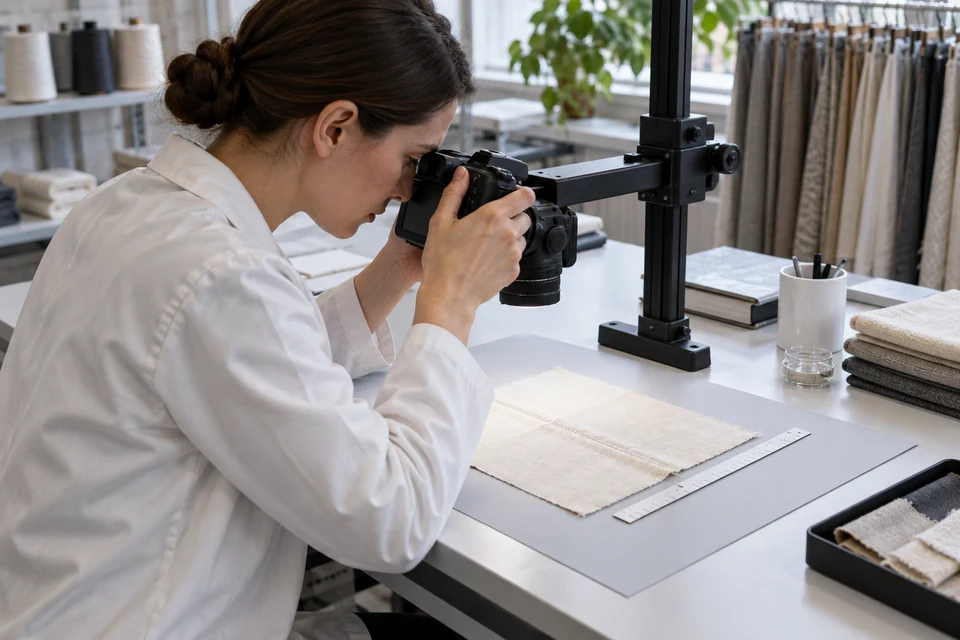
A scale beside a textile in a photograph can help a remote reviewer understand the size of an observed feature, but only if the image makes the relationship clear. Perspective, a raised surface or a scale placed away from the relevant plane can create a misleading impression. Procurement should define the intended use of inspection photographs before treating them as dimensional evidence. This guide concerns photographic context and its limits; it does not replace a validated measurement method, instrument control or the inspector's recorded physical observations.
Define what the photograph must explain
Separate location from measurement
Start with the inspection question: where is the feature, what does it look like and does the reviewer need approximate size context or a formal measurement result? An overall view and a close detail may answer different parts of that question. The image identification record connects the views to the inspected item. A correctly named file is useful, but naming alone does not make the scale position or camera angle suitable for the conclusion being requested.
State which conclusions remain dependent on the physical measurement record. A photograph may support discussion of a seam opening or stain location without being adequate to determine acceptance against a tight dimensional tolerance. Link the image to the specified characteristic and method rather than inviting reviewers to invent measurements from a screen. This distinction protects both buyer and supplier from treating a visually persuasive image as more precise evidence than the capture conditions and reference actually justify.
- Identify the question each view answers.
- Separate size context from formal measurement.
- Link images to the specified characteristic.
- State limitations before remote review.
Place the reference beside the relevant plane
Show its relationship to the feature
Ask the inspection owner to define an appropriate scale or reference for the intended record. Position it so the image shows how it relates to the feature, without covering the observation or altering the textile's normal state. A reference lying on the table while the feature sits on a raised fold should not be presented as if both occupy the same plane. Record the setup honestly, especially when a filled or curved product prevents a simple flat comparison without changing the condition under inspection.
Keep the relevant scale markings visible and the reference identity understandable in the original evidence file. Do not substitute a coin, hand or arbitrary familiar object where the project requires a defined dimensional reference. Use the inspection instruction to record the chosen approach and any cases that need a different view. The objective is not to make every textile look flat, but to make the relationship between the reference and observed surface clear enough for the intended limited interpretation.
- Use the reference specified by the owner.
- Keep the feature visible and unaltered.
- Disclose differences in surface height.
- Avoid undefined everyday-object scales.
Control viewing angle and framing
Make perspective limitations visible
Capture a useful overall view before moving closer to the feature. Where the agreed method calls for a near-perpendicular view, align the camera accordingly and confirm that the relevant area and reference remain in focus. Do not infer that a photograph is suitable merely because a ruler is present. An oblique view may be useful for showing raised texture, but it should be identified as such rather than used interchangeably with a view intended to support a flat dimensional comparison.
For a product with curved, soft or layered surfaces, obtain the views needed to explain the shape without forcing it into an artificial state. The sample record should identify the handling or positioning used during capture. Avoid stretching a seam, compressing a filled item or moving a defect just to place it neatly beside the reference unless that action belongs to the approved inspection method and is clearly documented in the evidence provided to the reviewer.
- Capture overall location and close detail.
- Use the agreed camera relationship.
- Identify intentionally oblique views.
- Disclose positioning and handling actions.
Preserve the original evidence
Keep helpful annotations separate
Retain the original image with its sample or lot reference and the relevant observation record. If an annotated copy is needed, preserve it as a derivative rather than replacing the original. Identify arrows, boxes or explanatory marks as annotations so they cannot be confused with features physically present on the textile. The traceability record should connect both files to the same inspected population and keep the capture identity available when a later reviewer asks for context.
Avoid resizing, cropping or perspective correction that obscures the reference relationship in the only retained evidence. A close crop may be useful for discussion, but keep the wider frame that shows the setup. Do not digitally remove marks, alter color or reconstruct missing scale details in an inspection record. If the original capture is inadequate, request a new photograph or a physical review through the project process rather than improving the image in a way that changes what it appears to prove.
- Retain the original full frame.
- Label annotated copies clearly.
- Keep sample and lot links intact.
- Recapture inadequate evidence without reconstruction.
Decide whether the evidence supports release
Escalate uncertainty to the right method
Ask the reviewer to state whether the photograph answers the intended question or whether additional physical measurements are needed. Use the dimensional acceptance record for the applicable product criteria rather than estimating a new tolerance from pixels. If the scale and feature are not in a usable relationship, record that limitation and obtain suitable evidence. A tight schedule does not turn an ambiguous photograph into a reliable basis for rejecting or accepting an entire lot.
Close the observation with the actual evidence and decision owner identified. Where the photograph provides context only, say so in the report and retain the separate measurement result where required. Share the capture expectations with the supplier before inspection so remote review does not repeatedly fail for preventable reasons. A sourcing discussion can include examples of the required views, but those examples should illustrate a method rather than imply that every future product can be accepted from the same angle or a single image.
- Confirm whether the intended question is answered.
- Use the applicable physical acceptance method.
- Request better evidence when geometry is unclear.
- Record the decision owner and evidence limits.
A visible scale is not enough: the reference, feature plane, camera relationship and original evidence must support the specific conclusion, with formal measurements retained where the acceptance method requires them.
Method references: OJP photography guidance: general scale geometry only, not a textile acceptance standard.