A wedge pillow cover must fit a three-dimensional slope, not simply a length and width. Replacement-cover programs are particularly vulnerable to errors when the core is sourced elsewhere or its shape has changed between orders. Build the specification from the actual retained core, define the removal route and approve the finished fit without making medical or therapeutic claims about the product.
Identify the core before measuring the cover
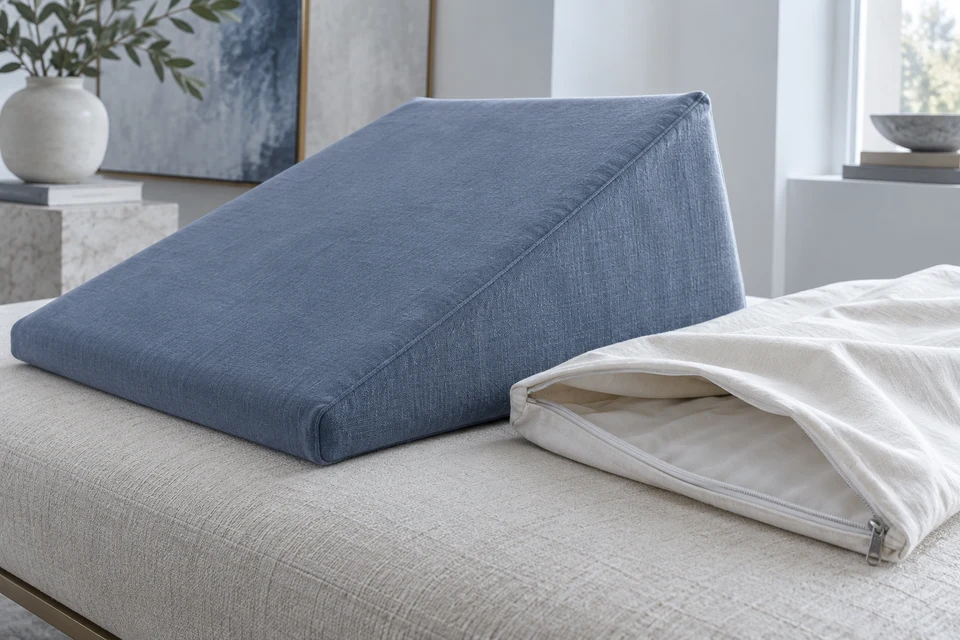
Record the triangular side profile
Obtain the core model reference and a physical sample where possible. Record base length, width, high-end height, low-end shape and any rounded corners. Distinguish a true triangular profile from a wedge with a flattened upper section or a shaped surface. Two cores with the same bounding dimensions can require different cover patterns. Include side and end photographs with the measurement locations clearly identified.
State whether the cover is intended for one named core or an approved family of cores. If several versions must fit, test them separately; do not silently expand a single-core approval into a universal compatibility claim. The size-set sample process provides a useful way to document each combination and the version accepted by the buyer.
- Record the core reference and its measured condition.
- Identify rounded edges and flattened sections in the profile.
Translate the slope into finished panels
Define the fit the customer should see
Decide whether the intended appearance is close-fitting, softly relaxed or deliberately loose. Specify the top, base, high end and triangular sides as separate pattern references where appropriate. A flat cutting width alone does not show whether the seam will follow the slope or rotate toward the face. Ask for photographs of all sides with the cover fitted in its intended orientation.
Compare fabric stretch and recovery through actual samples rather than assuming any knitted fabric will fit. A woven and a stretch cover may need different patterns and seam allowances. Include the chosen material and sewing details in the construction specification. Keep the final pattern tied to the core reference, because a change of core supplier can invalidate an apparently unchanged cover size.
- Mark the intended top and base in the development record.
- Review seam placement at the thin end and tall end.
Approve the insertion route
Avoid forcing the core through a short gap
Select the zipper or other opening position by trying the actual assembly. Record the usable opening length after end stops and seam finishing. Check whether the core can be inserted and removed without excessive bending, dragging or pressure on the closure. A zipper that spans one visible side may still leave a restricted turn at the thick end of the wedge.
Inspect the inside for fabric catches, rough seam ends and exposed closure components. Record the zipper type, pull and guards using the zipper component checklist. If the core has its own protective inner cover, perform the trial with that layer present. Do not remove a specified inner layer merely to make the outer replacement cover fit.
- Test removal as well as first insertion.
- Record any required orientation sequence in the pack instructions.
Refit after the proposed care procedure
Evaluate the empty cover and assembled result
Agree the intended cleaning route for the replacement cover and retain an untreated comparison sample. Measure the empty cover before and after the trial, then refit it to the same identified core. Record changes in seam alignment, closure effort and the appearance of the sloping face. A cover may meet a flat measurement target yet no longer follow the core neatly at its low end.
The dimensional stability guide helps structure the record, but the final decision should include the actual refitting check. Keep the core's own care limitations separate from the removable cover's instructions. Do not suggest that a washable cover makes the entire pillow washable, and do not attach health-benefit claims to this procurement approval.
- Use the same core for comparative fitting photographs.
- Keep cover care and core care as separate instructions.
Protect compatibility in replacement stock
Make the sales description specific
Label the replacement unit with the approved compatibility reference and distinguish cover-only supply from an insert-included pillow. Record colour, orientation and size variants clearly enough for a distributor to select the correct replacement. If the original pillow changes, review whether the replacement remains valid before using the same product code. Keep outdated compatibility references out of new packaging.
Use the traceability checklist to link the cover batch to the approved pattern and material revision. Ask for quantities and minimums by compatible core size, not merely a combined total. Share the retained core measurements, desired fit, closure position and sales-unit wording with FY Bedding so sampling can establish the actual scope before a bulk quotation is finalized.
- Keep a fitted reference sample with the approved core.
- Confirm the replacement pack does not imply an included pillow.
Match the cover to an identified core, then approve the slope, insertion route and post-care refit. A flat size match alone is not compatibility evidence.