New terry towels can release some loose fiber, but uncontrolled lint creates laundry load, guest complaints, surface change and premature replacement. Buyers should distinguish normal initial release from continuing construction or processing weakness by using defined specimens, care cycles, conditioned mass and observed service behavior.
Map where towel lint can originate
Review fiber type and length, yarn construction, pile height and density, shearing, ground stability, finishing, cutting, sewing and initial washing. Loose surface fiber, broken loops and fabric abrasion may look similar in a dryer filter but require different corrective action. Record whether the issue appears before care, during early cycles or throughout service.
Pair the analysis with the terry loop pull-strength guide. Lint mass alone does not show whether loops are releasing from the ground or loose fibers are being cleared from the surface. Inspect the towel structure and retained debris together.
Define the laundering and collection procedure
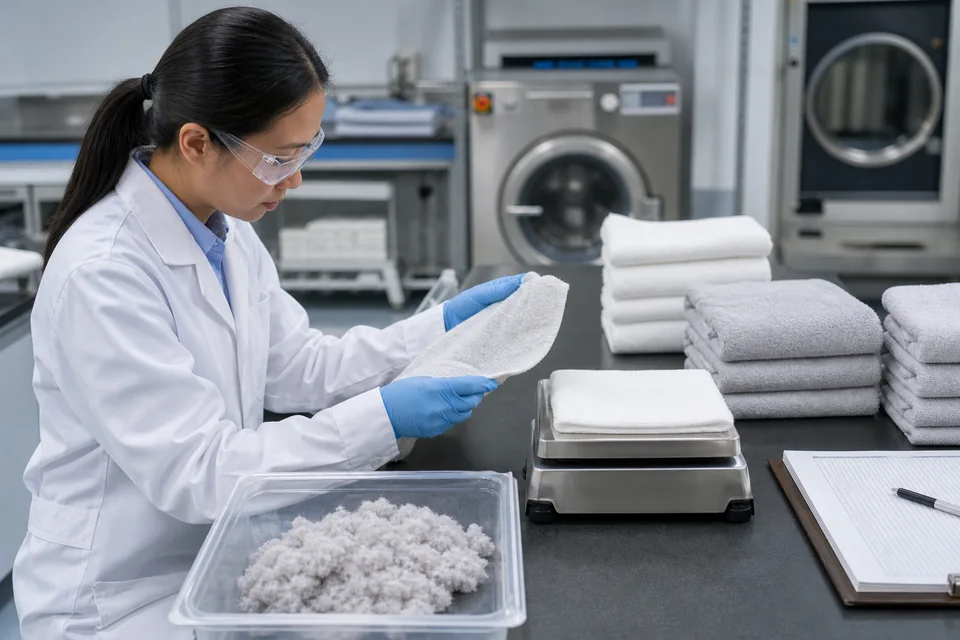
Specify sample quantity, initial conditioning, machine, load, detergent, temperature, extraction, drying, filter preparation and cycle count. Keep mixed loads controlled because lint transfer from another product can distort findings. Clean equipment and collection areas between comparisons according to the agreed laboratory or laundry procedure.
Align testing with the hotel linen care route. A gentle laboratory wash may not represent commercial extraction and tumble conditions, while an overloaded or overheated trial may create a failure unrelated to normal operations. Record actual conditions for every cycle.
Measure wash loss on conditioned samples
Condition and weigh clean, dry towels before and after defined cycles using consistent equipment and precision. Report change relative to the same identified specimens and note any repairs or rejected pieces. Do not weigh warm or unevenly dried towels, because remaining moisture can obscure the material loss being investigated.
Combine mass change with the towel absorbency evaluation. A construction should not be optimized for one number while losing service performance. Review pile fullness, hand, drying time, shrinkage and absorbency beside wash loss to understand the complete operating result.
Inspect surface change and lint transfer
Examine face and back under consistent light for thin areas, fuzz, pulled loops, uneven shearing, pills and edge damage. Compare light and dark contact fabrics where lint transfer is a service concern. Photograph the same marked regions across cycles rather than using unrelated towels for before-and-after claims.
Build observations into the product testing plan with clear decisions and sample identity. If an external method is required, confirm the applicable specimen and reporting basis with the laboratory. Avoid inventing an internal lint score that suppliers and buyers interpret differently.
Control production and monitor early service
Approve production-representative towels after the planned initial wash route. Verify yarn, construction, pile, shearing and finishing on bulk lots, then inspect packed goods for loose surface contamination. Keep shades and constructions separated during the trial so one variant does not hide another's performance.
Launch with structured laundry and housekeeping feedback. Use the pool towel procurement guide when sunscreen, outdoor use or high-turnover collection adds abrasion and soil. Track lint, rewash, surface thinning and retirement together before changing construction or care.
Evaluate lint using identified towels, repeatable laundry conditions, conditioned mass and surface evidence. Connect laboratory results with actual service before changing yarn, construction or care.