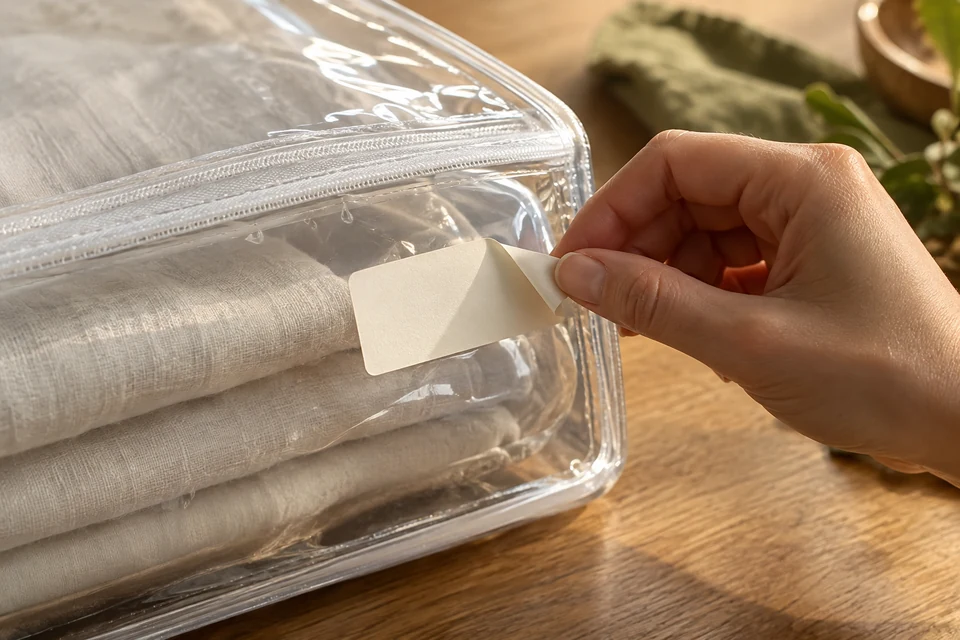
A reusable bedding pouch may arrive with a temporary retail label that the customer is expected to remove. Clean removal is a property of the label, the actual pack surface and the conditions of use together, not a promise established by the word removable on a purchasing line. Buyers should approve that combination before bulk labeling. This guide concerns temporary adhesive labels on reusable packs, rather than carton sealing tape, mandatory product labeling or an unsupported claim about packaging sustainability.
Define the label's purpose
Separate temporary information from information that must remain
Identify why the label is present, who applies it and when removal is intended. A temporary promotion, store identifier and permanent product panel may have different requirements. Keep those purposes separate in the packaging copy record. Do not make required information removable merely to achieve a cleaner appearance; the relevant market and product requirements need their own competent review.
Record whether the empty pouch is intended for storage, repeated packing or another stated use. That intended function determines which surfaces and closures should remain intact after label removal. Avoid equating reusable with any specific environmental benefit. Procurement should approve the physical function and keep any sustainability claim within the project's separate evidence process rather than inferring one from the presence of a zipper.
- State the temporary label's purpose.
- Identify application and intended removal stages.
- Separate information that must remain available.
- Define the pack's intended continued use.
Identify the complete label construction
Match it to the actual packaging surface
Obtain the label material and adhesive reference from the supplier, including any print or coating relevant to removal. Identify the pouch material, finish, colour and the specific panel receiving the label. Avery Dennison describes removable labeling as a construction-selection and testing problem involving both the label and substrate. That supports testing the actual combination; it does not approve a generic adhesive for every bedding pack.
Use the production-intent surface, not a convenient smooth test panel. A seam, curved area or textured panel may differ from the flat part originally sampled. Connect the selected pouch to the repacking and storage-bag review. Keep any supplier recommendation scoped to the identified materials and conditions, and obtain a new review when those inputs change.
- Record label material and adhesive identity.
- Identify the receiving panel and finish.
- Use the actual production-intent pouch.
- Keep supplier recommendations scoped to that combination.
Agree an application and removal trial
Record the conditions rather than guessing a pass level
Ask the label supplier and packaging team to agree a practical trial covering application, expected holding conditions and intended removal. Record sample identities and the time between application and observation. Do not assume that a label removed immediately represents a pack stored before sale. Keep any additional conditioning clearly identified rather than treating it as an unrecorded part of a normal-use demonstration.
Observe label tearing, adhesive residue, visible marks, surface damage or closure interference if present. Inspect the pouch in consistent light before and after removal. The photo evidence record should connect those views to the same sample. Do not use solvents, heat or scraping to make the result appear clean unless an explicitly approved consumer-use route requires and supports such treatment.
- Agree realistic application and holding conditions.
- Record when removal was assessed.
- Inspect both label and pouch condition.
- Preserve the untreated result of the agreed trial.
Compare a revised combination
Avoid changing several unidentified variables
If removal is unsuitable, compare a different label construction or an approved placement change with the packaging and label suppliers. Recheck whether the label remains serviceable during its intended temporary use; easy removal alone is insufficient if it falls away prematurely. Keep the revision tied to the artwork and material version record, even where the visible wording has not changed.
Review any altered panel location against packing, product visibility and the pouch closure. The window-pack presentation review can identify conflicts with the view of the folded bedding. Do not cover another information panel or a defect with the relocated label. Record both the reason for revision and the new evidence needed before release. Define the purchasing outcome in more detail than clean or not clean. The buyer may need a label that stays readable through the intended retail period and then leaves the specified pouch panel acceptable for its continued function. Record both observations against the same sample. If the face material tears while the adhesive remains, or the pouch surface changes while the label comes away intact, those are different outcomes requiring supplier review. This distinction helps compare a proposed revision without assuming that a single photograph of a lifted corner captures the full label-and-pack decision.
- Compare an identified revision.
- Check temporary retention as well as removal.
- Review the new location against pack functions.
- Preserve reasons and evidence for the change.
Freeze the approved application
Keep substitutions visible in future pack orders
The final record should identify label construction, pouch revision, placement, application conditions and the approved removal observation. Include the limits of the trial rather than promising residue-free removal under every possible storage condition. Carry the selected materials into the reorder specification, with a clear rule that a visually similar label or pouch is not an automatic substitute.
Ask packout staff to check the approved location and component identity using a physical reference. If the retailer changes the temporary label or adds another one, reassess that application separately. Share the real pouch sample and intended label use with the sourcing team early, so the packaging proposal includes the removal requirement before stock is ordered and labels are applied in bulk.
- Record the approved construction and placement.
- State the limits of the observed result.
- Control label and pouch substitutions.
- Review added retailer labels separately.
Approve clean removal on the actual reusable pack under identified application and holding conditions; do not infer compatibility from a removable adhesive description alone.
Method references: Avery Dennison removable label construction guidance.