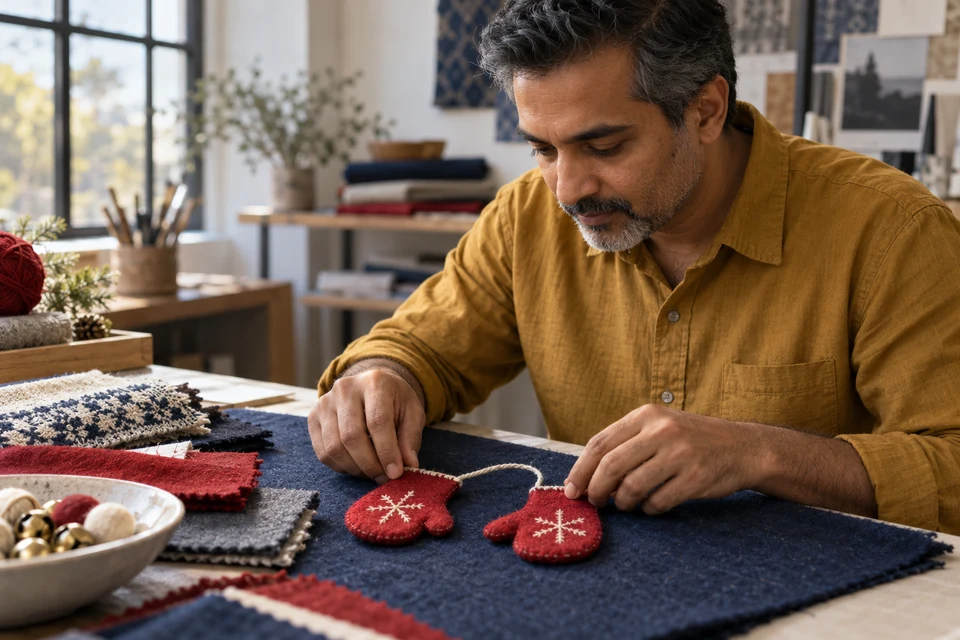
Miniature felt mittens can be sold as paired Christmas ornaments without functioning as wearable hand coverings. That distinction should be explicit from the start. Their visual identity depends on a thumb projection and the small gap beside it; the set identity depends on how the two shapes face one another and connect. A buyer who orders two red pieces without a pairing convention may receive a different composition from the one approved in the design reference.
Define the ornamental silhouette
The thumb gap is a controlled negative space
Draw the cuff, main body, thumb tip and inward gap with clear front orientation. Identify the finished dimensions in the relaxed flat condition. Ask for a cut sample and a finished-edge sample because a small gap may narrow after stitching or layered assembly. Decide whether the shape is single-layer, doubled or lightly padded, and do not infer that construction from the apparent thickness in a photograph.
Include the silhouette in the technical specification pack. Keep the decorative scope visible in the product name and description. These miniature pieces are not hand-size samples, and their dimensions should not be interpreted as wearable fit. If the buyer wants a functional mitten as a separate product, it needs its own brief rather than an enlarged version of this ornament approval.
- Name the thumb gap as well as the outer contour.
- Separate decorative dimensions from wearable sizing.
Control the mirrored pair before adding a cord
Two identical cutouts may not form the intended facing arrangement
Place both finished shapes flat in the proposed retail orientation and identify whether the thumbs face inward or outward. Record whether the pieces are mirrored, identical but reversible, or decorated differently on their fronts. A plain felt sample can conceal this distinction until embroidery or a contrasting cuff is added. Confirm the pair convention before approving any one-sided decoration.
Use the visual approval record to retain the complete pair rather than only the more attractive single piece. Identify left and right in the development documents where needed. If the set is intentionally mismatched in color or motif, state the exact combination. Avoid using assorted as a substitute for a defined pairing rule when the retail image shows a specific two-piece composition.
- Record inward- or outward-facing thumbs.
- Approve the complete decorated pair, not one interchangeable-looking piece.
Review the finished edge around the thumb notch
The smallest curve can change the recognizable outline
Inspect the inward curve and thumb tip on both pieces. Ask the maker to show the proposed edge treatment in the actual material and layer combination. Compare the finished notch with the cut reference without stretching it open. If the design is too small to preserve the intended gap, discuss a revised silhouette or simpler construction rather than accepting an indistinct shape and sharpening it digitally in the listing image.
Record the edge route through the seam and stitch reference. Check whether a contrasting stitch or cuff changes the apparent thumb length. Revisions should be compared as a pair because one altered piece can make the two sides visually uneven. Keep appearance observations separate from claims about attachment strength or suitability for a particular user group, which require their own appropriate evidence.
- Inspect the notch in its ordinary unstretched condition.
- Review silhouette corrections on both pieces together.
Map the connecting and hanging arrangement
A shared cord is a separate component decision
State whether the mittens share a connecting cord, hang independently or are supplied unattached. Identify the connection point on each cuff and the intended distance between the pieces in display. Ask for the connection detail before it is concealed by decorative trim. Confirm which side faces forward when the pair hangs naturally; a reversed connection can turn one mitten away even though its flat shape was correctly mirrored.
Use the buyer resources to track the complete component scope and relevant evidence questions. Keep decorative use explicit and do not imply toy, infant or wearable suitability. If a cord length or attachment changes, repeat the paired hanging view. The visual relationship of the two pieces belongs to the assembly approval, not merely to the dimensions of the individual felt shapes.
- Identify each cuff connection and intended displayed separation.
- Review natural hanging direction after a cord change.
Count pairs and pieces separately in the pack
The purchasing unit must match the retail unit
State whether one ordered unit means one mitten, one pair or a larger mixed set. List cords and any supplied accessories separately where needed. Trial the actual pack so the two shapes remain associated and the thumb orientation is understandable on opening. If a temporary tie holds the pair in place, identify it as packing material rather than allowing it to be mistaken for a permanent part of the ornament.
Use the pack review framework to document the initial and arranged views. Request quantities and prices using the same unit convention, and confirm minimums for each color pairing. A quote for individual pieces cannot be compared directly with a finished paired-set quote without reconciling assembly and pack scope. Confirm sample and dispatch planning after those details are settled.
- Write ordered pairs and total pieces as separate counts.
- Identify temporary restraints and permanent connecting cords clearly.
Give FY Bedding a mirrored silhouette pair, the intended thumb direction and cord arrangement. Request finished-notch samples and a packed pair. Approve the complete retail unit and its counting convention before placing the miniature ornament order.