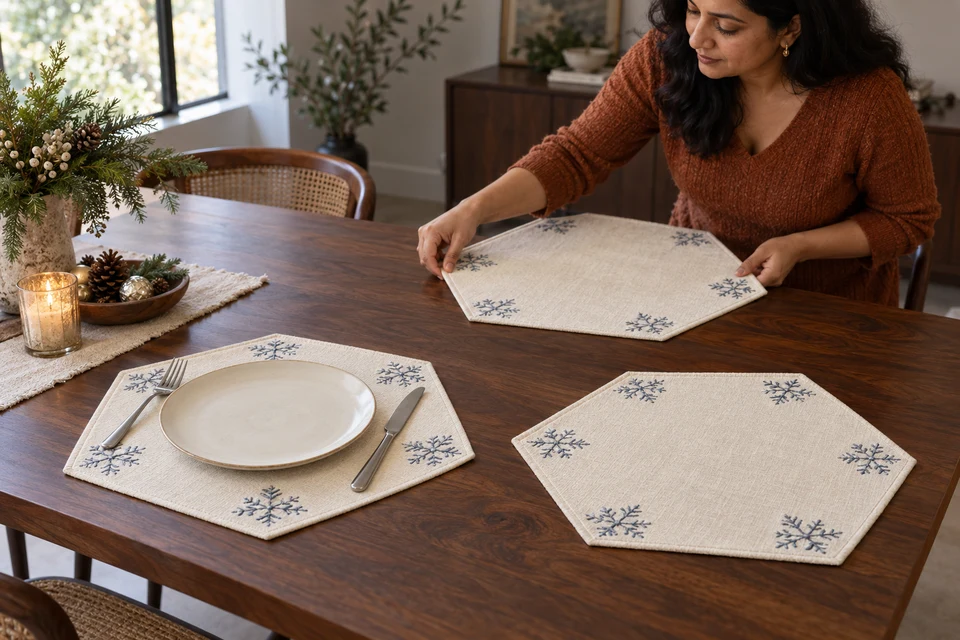
A six-sided snowflake placemat brings a Christmas motif into the shape of the table setting itself. Its points can face the diner or run along the table edge, and that small rotation changes the usable area around the plate and the spacing to the next setting. Buyers should not approve the product from a single maximum-width measurement. The practical decision is how the finished hexagon, embroidery and intended tableware work together on the tables where the range will be used or displayed.
Specify the hexagon without relying on the word diameter
Across points and across flats describe different spans
Provide a dimensioned outline showing the intended six sides and their orientation. Identify measurements across opposing points and across opposing flat edges. State whether the outline is a regular hexagon or a deliberately elongated shape. A supplier can produce a neat six-sided mat that does not match the buyer's imagined footprint if the drawing and measurement references are missing.
Use the technical-pack guide to record finished rather than cutting dimensions. Show binding or hem allowance separately. Identify the point intended to face the diner if that is part of the display concept. Avoid assuming that a nominal width used for a rectangular placemat describes an equivalent usable setting on the hexagon.
- Record across-points and across-flats dimensions.
- Show the intended diner-facing orientation on the finished outline.
Place the actual plate and cutlery on the proposed shape
The outermost points do not support the entire setting
Trial the proposed mat with representative plates, cutlery and any other items intended to sit on it. Compare the point-forward and flat-edge-forward orientations. Observe whether a cutlery position lands near a narrowing corner or whether the plate leaves little visible ground for the embroidery. Do not move the setting unnaturally inward just to keep every item inside a photograph.
The place-setting clearance guide supports the complete tableware review. This hexagonal brief adds a rotating footprint, so retain both trial orientations before choosing one. If the mat is decorative beneath a plate only, state that scope clearly instead of implying that it necessarily accommodates the whole service setting.
- Compare both useful orientations with the same tableware.
- State whether the product supports a plate-only or complete setting layout.
Locate the snowflakes after the usable area is agreed
Visible embroidery and stable tableware are separate goals
Place the motif boundaries on the finished hexagon drawing, including any tips that approach the edge treatment. Decide whether the snowflakes belong at all six points, selected corners or the center. A central motif may be intentionally hidden by the plate; a corner arrangement may remain visible but need more clear ground. Avoid moving functional tableware to rescue a decoration layout that has not been reviewed together with the setting.
Use the sewn embroidery approval for the actual ground and thread combination. Inspect raised areas where tableware may rest and ask for the appropriate review for the intended use. Do not infer heat protection or stain resistance from embroidery, quilting or fabric thickness. Those are separate claims requiring appropriate evidence.
- Approve motif visibility with the plate in its ordinary position.
- Separate appearance from any claimed protective performance.
Check a row of settings rather than one isolated mat
Points can change the rhythm and clearance between diners
Lay out the intended number of settings on the actual or representative table. Look at gaps between adjacent points, the relationship to the table edge and the room left for shared items. A layout that looks generous on a large showroom table can become crowded on a narrower dining table. Record the table dimensions and setting count used for approval rather than presenting the arrangement as universally suitable.
Refer to the Christmas table-linen capsule review when the mats are sold with runners or napkins. Keep the hexagon orientation consistent in the reference arrangement unless a deliberate alternating layout is intended. Review any companion pieces at the same time so their edges do not conceal the snowflake points that define the product.
- Record table size, setting count and spacing in the sample arrangement.
- Review companion runners and napkins in the same layout.
Inspect six corners and the packed set before release
A consistent outline should survive the intended handling
Compare the points, edge turns and finished flatness across the sample set. Record the chosen construction and inspect the reverse as well as the face. Ask how the finished mats will be evaluated under their intended care conditions. If the sample changes shape after the agreed trial, revisit both its dimensions and the setting layout rather than assessing the alteration only as a cosmetic issue.
Use the placemat corner and flatness review where quilting is part of the proposal. Check the number and orientation of mats in the retail pack and confirm quantities by approved variant. The generated editorial image is not a dimensional template, test result or confirmed inventory. Obtain a physical sample and current supply plan before committing the Christmas range.
- Review all six corners across more than one sample piece.
- Recheck the setting layout after any agreed care or packing trial.
Send FY Bedding the table dimensions, representative place setting and preferred snowflake arrangement. Request a dimensioned hexagon and a complete setting trial, then approve the orientation, embroidery placement and pack count as one coordinated Christmas product.