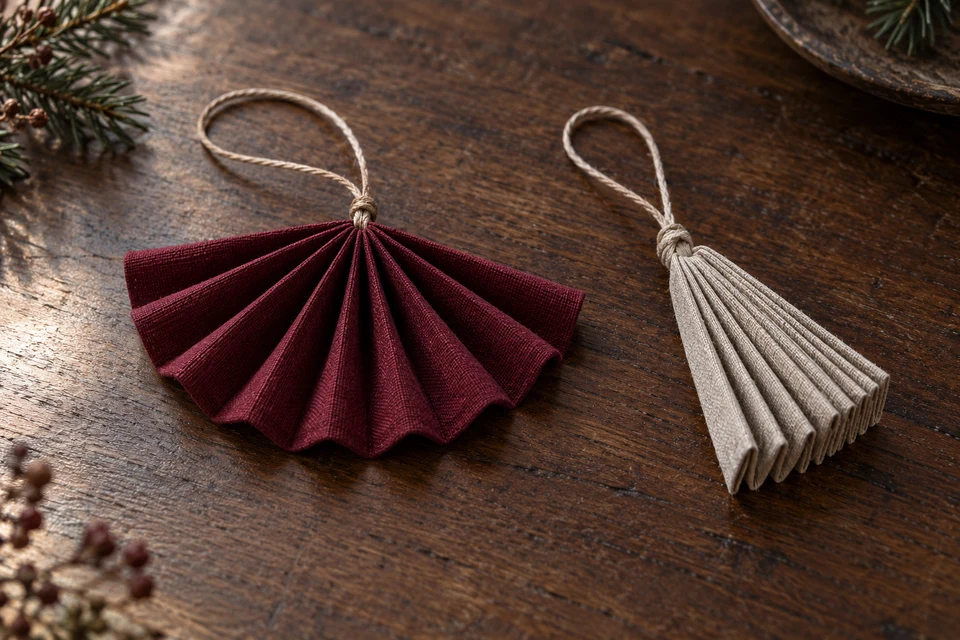
Pleated textile fans offer a different Christmas ornament profile from fabric balls, folded stars or linked garlands. Their character comes from repeated folds spreading around one pivot. Small changes in fold depth, edge treatment and the final opening condition can change the silhouette noticeably. A purchasing brief should explain whether the fan is permanently fixed open, supplied closed for setup or intended to move. Do not leave that functional distinction to a styled photograph or assume the product is a hand-held fan.
Define the approved open and closed states
A maximum width is only meaningful at a stated angle
Draw the fan in its intended display condition and identify the pivot, outside edge and two terminal folds. State the opening angle or use an agreed physical reference that makes the intended spread clear. Record the measuring condition rather than pulling the fan to its widest possible span. A loosely opened sample and a fixed semicircle should not be compared as if their width measurements describe the same product.
Keep the open view and any closed view in the technical specification pack. Confirm whether the ornament is flat or has an intentional depth. If the supplier proposes a revised fold count to achieve the visual spread, review that change before accepting the outer dimension. Ask how the selected state will be maintained without relying on a temporary prop that is absent from the supplied ornament.
- State fixed-open versus setup-from-closed supply.
- Measure width only in the agreed opening condition.
Approve the pleat sequence across the whole piece
The first and last folds deserve attention
Request a flat material sample, a partly folded development piece and a finished fan where practical. Follow the fold direction from one end to the other. Decide whether both terminal edges should face the same way and whether a contrasting reverse may show. An even-looking center can conceal an unusually wide final fold or a rough terminal edge. Record the accepted sequence rather than approving only the front silhouette.
Use the construction reference method for any sewn edge and fold-holding detail. Ask how the actual cloth and edge finish affect the compact folded stack. A thicker substituted fabric may change the pivot and terminal folds even when the cutting dimensions are unchanged. Treat such a substitution as a material-and-construction revision, not a color-only approval, and request a new complete fan for comparison.
- Trace fold direction and inspect both terminal edges.
- Recheck the folded stack after changing fabric or edge finish.
Review the pivot without hiding it behind trim
The gathering point organizes the entire ornament
Ask the maker to show the pivot before decorative wrapping is applied and again in its finished form. Identify what holds the folds together and where a hanging loop connects, if included. Compare the two sides for unwanted twisting or a spread that favors one side. Keep the connection description specific to the proposed materials; an attractive tied bundle does not establish a tested attachment strength.
Organize any evidence requests through the buyer resources and the actual intended display use. State whether the fan is a decorative article rather than a toy or wearable accessory. If the loop or pivot construction changes, review the resulting hanging orientation as well as the connection itself. A smaller wrap may expose more fabric but also alter the visible opening, so the revision should be assessed on the assembled ornament.
- Retain unfinished and finished pivot views.
- Connect loop approval to the actual display orientation.
Check color through the folded structure
A flat swatch cannot show every visible surface
Open the fan under ordinary light and examine the alternating illuminated and shaded folds. Confirm whether the same color appears on both faces and whether a reverse fabric or edge treatment is intentionally visible. Compare the proposed color family as assembled ornaments rather than assuming that matching flat swatches will produce matching visual weight. A dark fabric can make fold depth look different without any actual construction change.
Use the retail photography approval record to preserve an ordinary front and oblique view. Avoid digitally straightening every fold into a perfectly mechanical pattern if the approved product has a softer textile character. Clearly separate editorial concept imagery from the actual sample images used to authorize merchandise. Confirm whether a coordinated set contains identical fans or deliberately different sizes, colors and opening conditions.
- Compare colors as folded finished pieces.
- List the exact composition of any mixed ornament set.
Trial the shipping state and setup sequence
Opening instructions should match what is supplied
Pack the ornament in its agreed open or closed state and review it after unpacking. If the buyer must spread the folds, define the simple setup action and the stopping point. Check that temporary restraints are identifiable and that opening does not require guessing which terminal edge belongs at the front. Photograph the initial condition and the ordinary prepared display separately rather than concealing setup work in a finished lifestyle image.
Retain that comparison using the pack review framework. Ask for minimums and costs for each fabric, fold construction and set composition. Confirm the sample sequence and feasible dispatch plan before making seasonal commitments. A larger fan needs a renewed pivot and folded-stack review; increasing the outer radius alone does not demonstrate that the same pack or connection remains appropriate.
- Document the opening step and intended stopping point.
- Reapprove pivot, stack and pack for each size.
Give FY Bedding the intended opening condition, fabric direction and set composition. Request a fold-sequence sample, an exposed-pivot reference and a complete packed ornament. Approve the terminal edges and setup action as carefully as the finished fan silhouette.