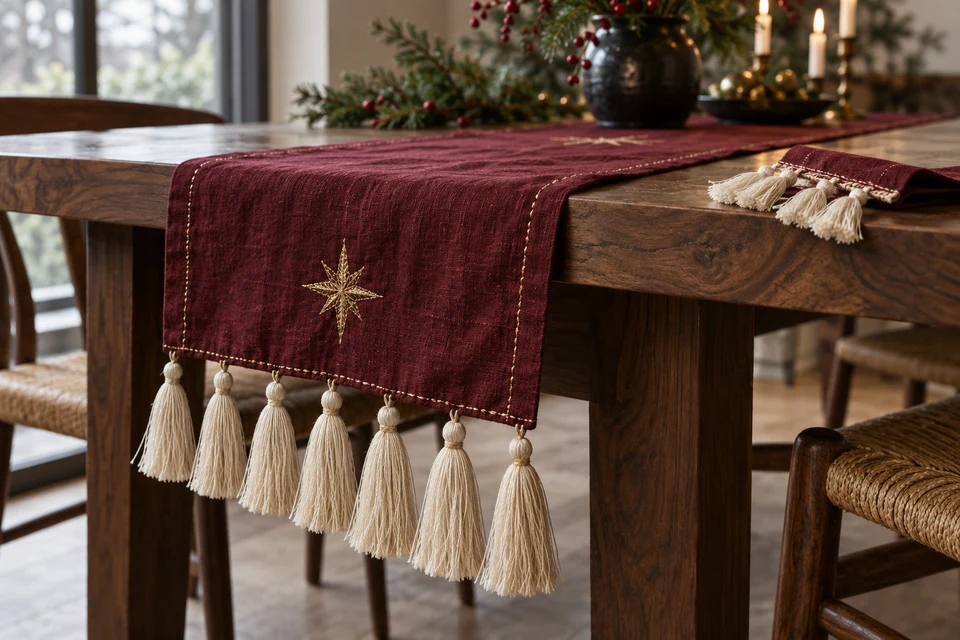
Long tassels can give a Christmas table runner a distinctive end treatment, but they also complicate an apparently simple dimension. Does the quoted length describe the fabric body, the body plus both tassel projections or a relaxed measurement with the trim lying in an unspecified direction? A buyer needs those quantities separated before comparing offers. This article focuses on that measurement and supply decision; attachment inspection remains a related but distinct review, not a substitute for defining what the dimensions mean.
Write separate body and trim dimensions
One overall number is not enough for a tasselled runner
Identify the finished fabric body from one end seam or edge to the other. Record the trim projection at each end separately, with a drawing showing the measurement direction and resting condition. If an overall length is also useful, label it clearly as including both projections. Do not add unstated stretching or straighten the tassels differently each time the sample is measured. Keep width and any side trim independent from the length description.
Put the dimension convention in the technical specification pack. Ask each supplier to quote against the same convention. An offer with a shorter body and longer tassels is not equivalent to one with more fabric merely because the maximum end-to-end measurement matches. This distinction should remain visible in purchase documents and retail information, especially when customers select a runner for a known table.
- Record fabric-body length and each end projection separately.
- Label any combined measurement as inclusive of trim.
Map tassel count and distribution at both ends
The two ends form a coordinated pair
Draw the location of individual tassels or the continuous trim arrangement along each end. Identify whether the center and outer positions differ and whether both ends are intended to match. Compare the complete runner laid flat rather than reviewing one detached trim sample. A consistent tassel component does not guarantee an evenly distributed finished end, and a deliberate asymmetry should be specified rather than discovered after delivery.
Use the existing fringe and tassel attachment inspection guide for the connection-specific checks. Keep that work separate from this placement map. When a tassel count changes, re-evaluate the spacing and the overall visual weight at the end. Do not approve a reduced-count alternative solely because the individual tassel length remains the same; it is a different presentation and may change the commercial description.
- Specify count, spacing convention and end-to-end matching.
- Review count changes as design changes, not invisible substitutions.
Review where the body ends on the actual table
A trim drop is not the same as a fabric drop
Place the sample on the intended representative table and identify the fabric body's end relative to the table edge. Then observe where the tassels fall. A runner whose body barely reaches the edge can look different from one with a generous fabric drop even when the tassel tips finish at the same height. Record the table dimensions and placement used in the review so that the comparison can be repeated.
Retain the accepted side and end views in the retail image approval record. Avoid pulling the trim into a longer or more symmetrical arrangement solely for a listing photograph. If the runner is offered in several body lengths, check each intended table relationship. Do not use a dramatic styled drop to imply that the same appearance will occur on every customer's table.
- Record fabric drop and tassel drop as different observations.
- Keep representative table dimensions with the approval images.
State whether the trim is removable or permanent
Care scope follows the complete construction
Confirm whether tassels remain attached during the proposed care process or are removed by the user. If removable, describe the connection and inventory all pieces. If permanent, discuss care for the assembled runner rather than relying only on the base-fabric description. Ask for the evidence appropriate to the actual materials and intended market before finalizing care wording. A detachable styling sample does not establish that production trim is removable.
Use the buyer resources to track unresolved material and care questions. Compare the agreed appearance before and after any specified sample assessment, including tassel alignment and the body edge. Keep observed results distinct from broad claims about resistance to tangling, shrinkage or color change. Any change to cord, wrapping yarn or attachment should be evaluated in the finished trim system, even when the runner body stays unchanged.
- Declare removable versus permanent trim in the supply scope.
- Approve care wording for the actual assembled materials.
Protect the end arrangement in the retail pack
A tidy pack must still make the dimensions understandable
Trial the intended fold with both trimmed ends present. Check whether tassels are tucked, wrapped separately or displayed at the front, and whether temporary restraints are easy to identify. Open the pack and document the unadjusted end arrangement before combing or smoothing it. If preparation is expected for display, describe the simple action without promising an unverified recovery time or a maintenance-free appearance.
Use the packing comparison method to retain the sample sequence. Request prices and minimums for the specified body size, tassel count and attachment type. Confirm the sample approvals and feasible dispatch plan before seasonal retail commitments. A revised pack must not silently change the body measurement shown to customers or hide a trim substitution that would have altered the original comparison.
- Review both trimmed ends after opening the actual pack.
- Keep the body-and-trim measurement convention on commercial records.
Provide FY Bedding with separate body dimensions, tassel projections and an end-placement map. Request a complete sample on a representative table and in the proposed pack. Compare quotations only after every offer uses the same measurement, trim-count and care conventions.