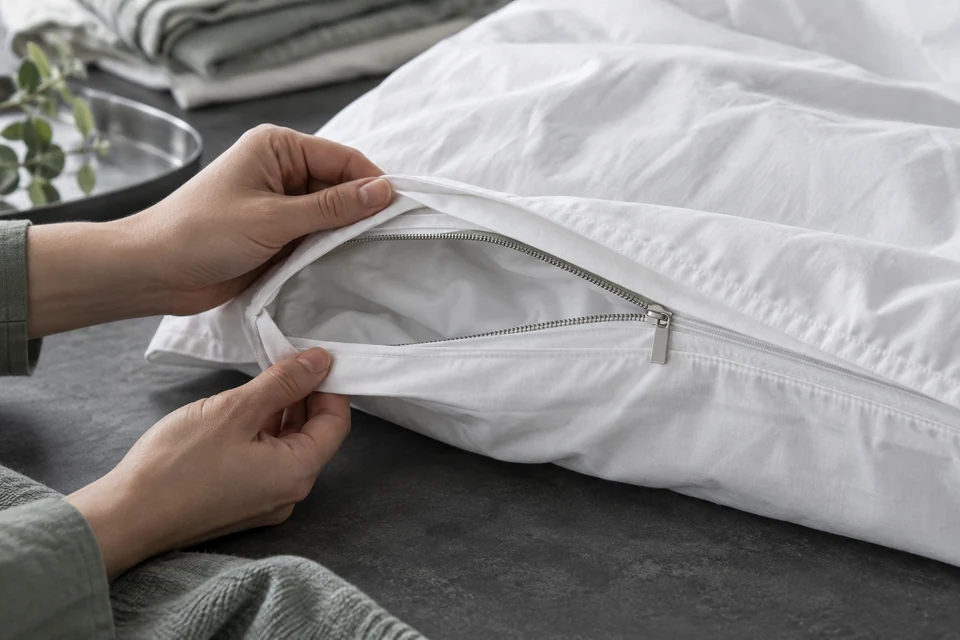
A concealed zipper can operate correctly as a loose component and still catch surrounding fabric after it is sewn into a duvet cover. The finished opening therefore needs its own trial using the intended material, flap and insert arrangement. Buyers should distinguish normal operation from a demonstration in which an experienced sample maker continually holds fabric away from the slider. This guide concerns observable fabric clearance during the approved use sequence. It does not set a universal operating force, prove zipper durability or recommend forcing a caught closure.
Identify the finished opening
Keep component and installation references together
Record the zipper assembly, opening location, flap construction and seam references on the actual cover. The component approval remains necessary, but it cannot alone establish how nearby textile behaves after installation. Identify any lining, seam allowance or internal material close to the travel path. A purchasing brief that specifies only zipper length and color may leave the sample maker to choose details that determine the finished interface the user must operate every day.
Use the technical pack to distinguish the intended concealed appearance from the space required for normal movement. Ask the technical owner to define the relevant construction points rather than invent a universal clearance from a photograph. Keep the production-intent fabric and finish in the sample, because a substitute material used for speed may behave differently around the closure. Record every deviation in the prototype so preliminary observations are not later mistaken for approval of the offered bulk construction.
- Identify zipper and flap construction.
- Map material near the travel path.
- Use the production-intent fabric.
- Record prototype deviations explicitly.
Agree the normal opening sequence
Observe without coached workarounds
Ask the operator or buyer to demonstrate the intended opening and closing routine under the agreed safe handling method. Begin with the cover in the defined state and record any positioning required before movement starts. The sample trial record should distinguish ordinary preparation from special assistance introduced to make a difficult sample operate. If the slider meets resistance or catches fabric, stop the trial and have the responsible technical person assess it rather than pulling harder.
Observe where surrounding material approaches the slider and whether the problem occurs consistently at an identifiable section. Record the direction of travel and relevant sample orientation. A successful pass after someone manually clears the entire path does not establish that the original routine works as intended. Keep the observation factual and avoid assigning a cause before reviewing the construction. The issue may require a revised flap or sewing arrangement, but that decision belongs to the technical review rather than an improvised alteration during the demonstration.
- Use the agreed normal sequence.
- Disclose assistance during operation.
- Stop when fabric catches or resistance appears.
- Record the location and travel direction.
Compare empty and intended assembled states
Keep the insert relationship controlled
Review the cover empty where that is relevant, then with the identified insert in its intended position. The insert specification should remain constant during comparisons so an undersized demonstration insert does not conceal a fit-related interaction. Document whether internal material moves toward the opening during normal preparation. Do not interpret a convenient empty-cover trial as proof of the assembled result if users normally operate the closure after placing the duvet inside.
Check that any retention ties or other internal features are used according to the approved instruction. Keep their role separate from zipper clearance; an orientation or retention aid should not become an undocumented tool for holding the opening away from the insert. If the intended assembly cannot be demonstrated without a workaround, record that limitation and request a revised sample. The buyer needs an honest view of the complete operation rather than a sequence tailored solely to make the photographed prototype appear trouble-free.
- Identify and hold the insert constant.
- Review the relevant empty and assembled states.
- Use internal features only as intended.
- Record workarounds rather than hiding them.
Review revisions and care state
Retest the changed interface
When the technical team proposes a change, identify the revised sample and the exact construction feature affected. Compare it using the same agreed sequence and preserve the earlier observation. The sewing specification should carry the accepted revision so production does not reproduce the earlier arrangement with a different explanation. Avoid changing zipper, fabric and insert simultaneously unless the complete new combination is explicitly being reviewed as a separate proposed product configuration.
Where a care trial is required, operate the identified sample after the agreed preparation and record that state with the result. Keep the observation separate from formal durability or strength evidence. A limited sequence that shows no catching cannot establish a lifetime of trouble-free use. If the buyer requires repeated-cycle performance, ask the technical owner to define suitable evaluation and acceptance criteria before testing. Do not invent an arbitrary cycle count merely to make the approval document look more technical or decisive.
- Identify the exact revised construction.
- Retain the earlier observation record.
- Repeat under comparable conditions.
- Keep limited trials separate from durability claims.
Release a reproducible opening
Give production and users the same reference
The final decision should identify the cover, zipper, flap, insert relationship and accepted operating sequence. Link useful overall and detail views through the inspection image record. State any limitations or outstanding performance evidence explicitly. A photograph of a closed zipper can support appearance review, but it cannot show the clearance throughout travel, so the approval package should retain the actual observations made during operation rather than rely on the final static view alone.
On repeat orders, review changes that affect the opening interface even when the nominal zipper specification remains unchanged. A different material finish or sewing treatment may deserve another assembled trial. Share the normal user sequence when requesting sourcing support so proposals can be assessed against the real operation. Release the selected construction only when the buyer and supplier understand the same accepted arrangement, the evidence that supports it and any separate questions still awaiting technical review before the affected quantity proceeds.
- Release the complete opening configuration.
- Preserve operating observations and detail views.
- Reassess changes near the travel path.
- Keep unresolved performance questions visible.
Approve concealed zipper clearance on the finished duvet-cover assembly through its normal operation; never force a caught closure or substitute a staged successful pass for a documented construction review.