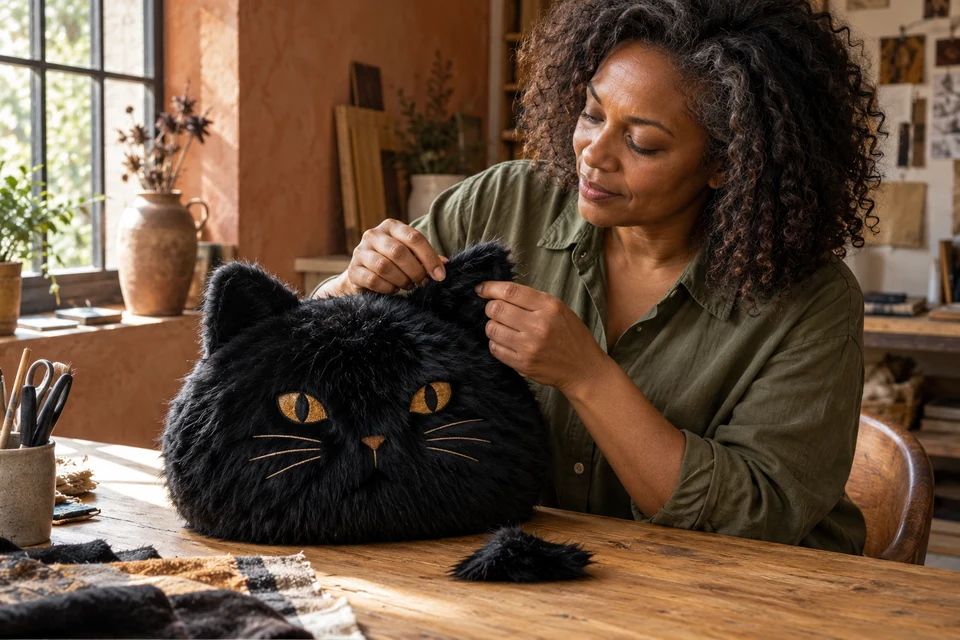
A black cat cushion can have the correct outline on paper and still lose its expression when long fibers cover the eyes. The procurement decision is not simply whether the fabric feels soft. Buyers need to approve how pile, embroidery and filled shape work together, then communicate an appearance standard that survives ordinary unpacking. Treat the cat face as a finished textile assembly, not a flat graphic pasted onto a generic cushion specification.
Choose the visible pile before the silhouette
Compare samples at ordinary viewing distance
Request small swatches of the proposed face fabric, but do not make the final selection from touch alone. Place the candidate embroidery over each swatch and view it from the distance expected in a retail display. Long black fibers may make a small amber eye difficult to read even when the thread color is correct. A shorter pile or a larger eye could solve the problem without adding more decorative components.
Record the direction in which the fur is laid on the face and ears. The product specification pack should show this direction on the cut panels, alongside the proposed pile material and backing. Ask the supplier to identify what the quotation actually covers rather than treating all fabrics called faux fur as interchangeable.
- Keep the chosen fabric and embroidered trial together.
- Check the face both close up and at display distance.
Give the ears a repeatable appearance
Judge the filled shape rather than a cut panel
Two triangular pieces do not guarantee two readable ears. Seam bulk, trapped fibers and the distribution of filling all affect the finished points. Ask for a front and side view of the filled sample resting without support. Note whether the ears stand as intended or collapse into the rounded head. Avoid asking production to imitate a photograph that has been held up or digitally reshaped.
Separate an outline defect from a grooming difference. The team should know whether brushing the fibers away from a seam is an agreed finishing operation or an unplanned rescue. The insert-to-cover review is useful when the design uses a removable insert; a fully stuffed shaped cushion needs its own filling and closure definition.
- Photograph the cushion resting freely, including both ear profiles.
- Identify any finishing action needed to reproduce the approved appearance.
Keep facial details attached to the right reference
Embroidery and loose trims are different proposals
Decide whether eyes, nose and whiskers are embroidered, sewn appliques or separate attached parts. These options should not share one vague approval note. Review the actual reverse side of a decorated panel before assembly so backing, thread tails and seam paths can be understood. A striking face on the outside does not establish that the unseen construction matches the purchase brief.
Use the embroidery backing review for the supporting construction questions. Request the evidence appropriate to the intended market and user, especially if any supplier proposes detachable trims. A playful Halloween face does not establish toy suitability, child suitability or a safety classification. Keep unsupported suitability language out of the sales description.
- Name the construction method for each facial feature.
- Retain an unfinished decorated panel as well as the completed sample.
Open the proposed retail pack
Check what the buyer will actually see
Pack a sample using the intended folding or compression method, then open it according to the proposed customer instructions. Record pile flattening, ear creases and the visibility of the eyes without immediately styling everything for a photograph. Agree whether simple hand smoothing is reasonable and how the result is to be shown. Do not describe a recovery time as proven until an appropriate trial has supplied that evidence.
The compression packaging review can help structure the trial. Include the final reverse fabric and closure, because their bulk changes the packed shape. Keep the unopened pack, the immediate opening view and the agreed presentation view linked to one sample so marketing and inspection do not approve different objects.
- Review immediate unpacking before preparing a styled image.
- Use the actual proposed pack and complete cushion construction.
Price a defined cat rather than a generic cushion
Make substitutions visible before production
A comparable quotation names the face fabric, pile direction, facial construction, reverse, filling or insert scope, closure and retail pack. Ask separately about custom embroidery setup and minimums for the chosen fabric. A stock black fabric proposal and a custom-developed black pile proposal may have different commercial conditions; request confirmation instead of assuming a minimum or price.
Use the quotation comparison checklist to capture exclusions. Set a sample approval milestone before committing the seasonal collection to a launch date. If the supplier changes pile length, backing or eye construction, reopen the face review. The retained sample should include ordinary front and side views, not only a professionally groomed hero photograph.
- Confirm MOQ and sampling terms for the exact components.
- Require a renewed appearance review after a pile or feature substitution.
Send FY Bedding the intended cushion size, cat-face concept, user and retail pack. Request a finished development sample with its fabric and embroidery references, then approve the ordinary resting and unpacked appearance before discussing bulk release.