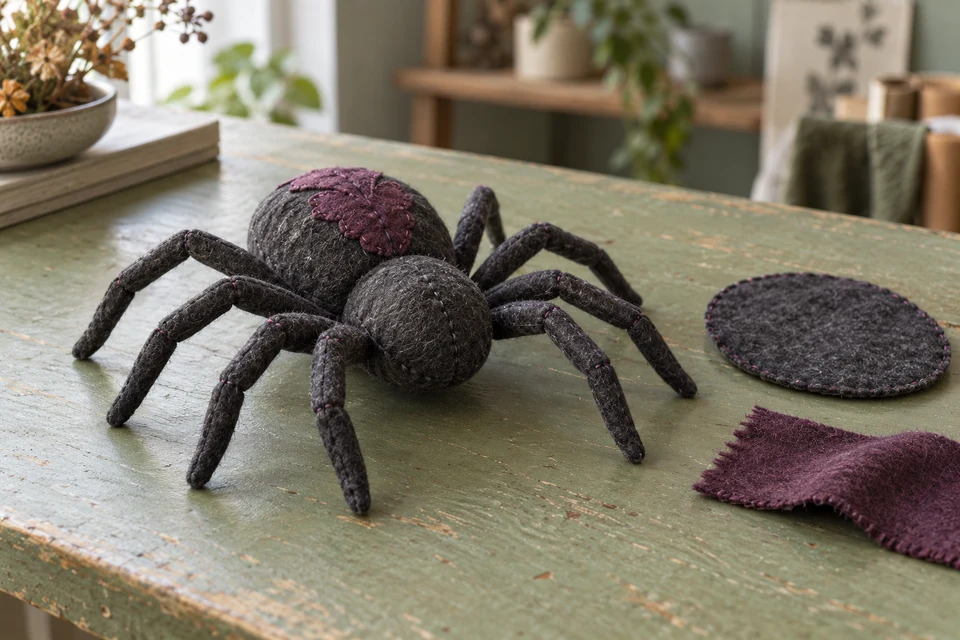
An eight-legged felt spider needs a repeatable display pose, not just an attractive top-view drawing. Four legs can disappear beneath a soft body, overlap their neighbors or fold underneath in the retail pack. Before a Halloween decoration is ordered, the buyer should identify the intended standing, resting or hanging presentation and decide which parts of that appearance the product itself must maintain. The illustration is a design reference, not evidence of a stocked or tested item.
Draw eight attachment positions
Count legs at the body, not just at the tips
Prepare a top-view map with four leg attachment positions on each side of the body. Give each position a clear reference from front to back. This makes it possible to distinguish a missing component from two correctly attached legs that happen to overlap. Show whether the legs are individual pieces, paired strips passing beneath the body or another proposed construction. Ask the supplier to confirm that construction before treating the drawing as an approved manufacturing instruction.
Include the map in the textile development brief. Record the body length, width and the overall spread separately. A single overall width can look correct even when one side reaches much farther than the other. Keep intentionally unequal front and rear legs identifiable; an expressive silhouette does not need to be perfectly symmetrical, but production needs to know which differences are deliberate.
- Identify all eight origins and tips.
- Separate body dimensions from the complete displayed footprint.
Choose what supports the pose
A styled photograph can hide the real construction
Compare the sample resting freely with the same sample arranged for a catalogue photograph. Remove hidden pins, supports and temporary adhesive before making the buying decision. If the design depends on a display support, specify that support and its inclusion rather than presenting the ornament as self-supporting. A wall-mounted version and a tabletop version should not inherit the same approval simply because both use the same felt body.
Ask whether the proposed legs contain any internal component and how that component is enclosed. Do not infer bendability, attachment strength or suitability for children from a soft exterior. The product evidence plan can record the intended user and the assessment needed for the actual construction. Visual approval should remain a statement about the chosen sample's appearance, not a broad safety or lifetime claim.
- Observe the unassisted pose before styling.
- Disclose internal components and supplied supports.
Review junctions from above and below
The underside explains how the silhouette is made
Request an unfinished attachment sample or clear access to the underside before the body is closed. Locate each leg join and compare it with the position map. Look for an unintended crowded cluster, a visible exposed edge or a leg attached in the wrong direction. A neat upper surface alone cannot show whether all eight positions have been assembled as specified.
Document the proposed join in the seam and stitch record, keeping the observable workmanship reference separate from any required technical attachment assessment. Review the complete ornament after a change to the join: moving a stitch line may alter the visible leg length or pull the body off center. Ask for a new assembled comparison when the supporting construction changes, not merely a close-up of the repaired area.
- Retain one underside reference tied to the finished sample.
- Recheck the full pose after changing a junction.
Open the proposed retail pack
Leg recovery is part of presentation approval
Trial the actual carton or retail tray with the finished decoration inside. Record which legs fold over the body, which lie beneath it and whether the pack keeps neighboring pieces from tangling. Open the pack without first grooming the ornament for the camera. Photograph the immediate condition and then the result of any simple arrangement that the buyer agrees is reasonable for the customer.
Use the packaging trial framework to define the sample identity and handling conditions. This does not supply a guaranteed recovery time for felt or a universal folding method. If several minutes of careful reshaping are necessary, decide openly whether that experience suits the retail offer. Redesigning the tray may be preferable to approving an image that ordinary unpacking cannot reproduce.
- Keep immediate and arranged views distinct.
- Record the exact pack and any permitted customer action.
Buy defined variants and complete units
Body color alone does not identify the order
Give each ordered variant its body material, leg construction, attachment map, displayed size and pack reference. If a range includes several body colors, check that the same leg material is actually proposed for each. Ask about minimums and sample charges against that component list. Do not assume the minimum for a standard felt color also applies to a new shaped or supported leg.
The component control guide helps preserve these relationships. At packout, verify complete eight-leg units rather than merely counting bodies. Confirm the approved version, quantities and production readiness before agreeing a shipping plan. No seasonal arrival promise follows from a small product size. Keep any decorative display props outside the supplied scope unless the quotation explicitly includes them.
- Check complete ornaments before counting selling packs.
- Reopen approval when leg material or support changes.
Send FY Bedding the desired spider footprint, display method and eight-position drawing. Request a construction proposal, an unassisted finished sample and a real pack-opening review. Release the specific approved ornament and evidence scope, not an unsupported promise inferred from a styled Halloween scene.