A soft tombstone-shaped panel can be developed as an indoor seasonal merchandising accessory without treating it as an outdoor sign, a weighted doorstop or a toy. The textile face supplies the silhouette; a declared support arrangement supplies the intended resting pose. Buyers should separate those functions in the brief. Otherwise a sample may look convincing only because of a hidden prop, while the quoted product lacks the parts or assembly instructions used to create that photograph.
Define the textile panel independently
The outline must remain recognizable without its stand
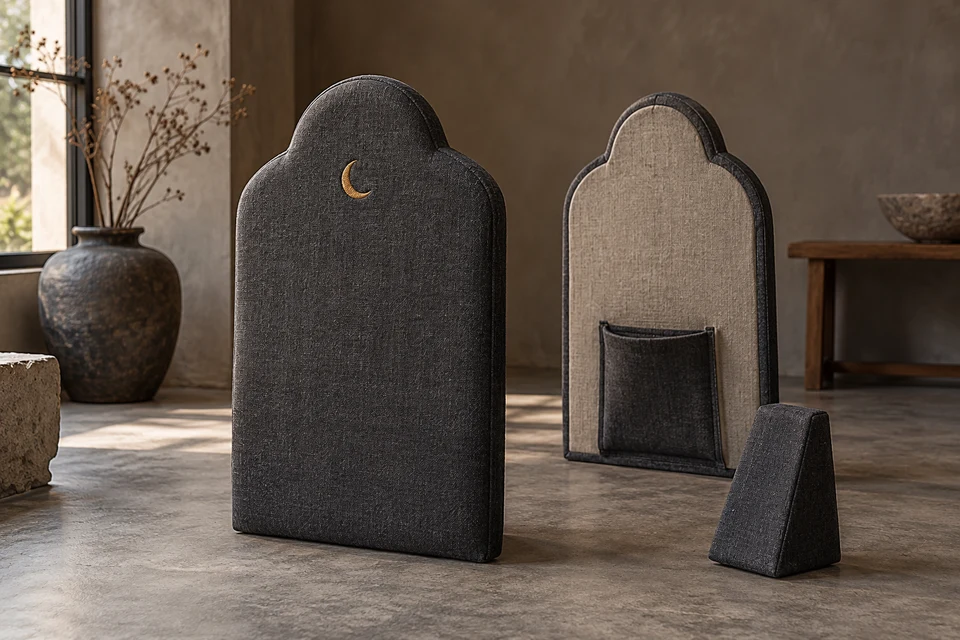
Provide a front outline showing the upper curve, shoulders, side edges and lower baseline. State the finished dimensions and whether the front is padded, flat or shaped through a separate internal component. Review the panel by itself on a table before reviewing it upright. This makes it easier to distinguish the sewn silhouette from an appearance created by bending the support or leaning the panel against a wall.
Put the outline and component scope in the product specification pack. Identify any embroidered motif, applied patch or lettering as a separate decoration decision. A quiet crescent sample does not authorize additional wording or artwork in production. Ask the supplier to describe the offered fabric and internal construction rather than inferring them from a stone-like color or a textured editorial image.
- Approve the unsupported panel outline first.
- Keep decoration and internal construction explicitly scoped.
List the support as a supplied component
A hidden sample-room prop cannot become an assumption
Ask what holds the display in its intended position and whether that component is integral, removable or supplied separately. Record its material description, shape and relationship to the panel. If the concept uses a rear pocket, identify the support's insertion direction and how the buyer knows it is seated correctly. Include all necessary pieces in the sample inventory and quotation, not merely in the styled photograph.
Use the buyer preparation checklist to separate the textile product from any fixture provided by a retailer or installer. Confirm whether the support can be removed for storage and whether the shell and support require different care. Do not describe the item as freestanding across all conditions because it remained upright once on a studio table. Define the intended surface and pose, then agree the relevant checks for that use.
- Inventory every supplied support and connection piece.
- State the intended display surface and assembly condition.
Inspect the rear pocket and its connection
Front appearance does not reveal the support interface
Request a rear view with the support removed, partly inserted and fully seated. Examine whether the pocket position allows the intended panel angle and whether its opening is accessible without distorting the front. Ask the maker to explain the proposed connection and reinforcement. Keep the accepted result tied to the actual panel and support combination rather than prescribing a generic pocket dimension detached from those parts.
Record the junction with the seam and stitch specification. Compare the front before and after assembly for visible pulling, an altered lower edge or a changed upper curve. If the pocket is moved to improve the resting pose, review the whole display again. A localized sewing correction may change how the support sits and how the padded face presents from the customer's viewpoint.
- Review the pocket at three stages of insertion.
- Check the front again after changing a rear connection.
Approve the ordinary merchandising view
The rear and side still matter in an indoor display
Set the complete sample on the intended type of surface and photograph it from the front, side and rear without hidden assistance. Decide whether customers can see the support and whether that appearance is acceptable. State if the product is intended for a sheltered indoor setting only. Do not broaden the listing to outdoor exposure, door holding or other functional uses without a separate brief and supporting evidence.
Retain the accepted views in the retail image approval record. Keep any installation or use limitations with the product information rather than relying on an image to communicate them. Editorial illustrations are useful for discussing the construction, but they do not prove that a proposed support is stable or that a finished item has passed a defined assessment. Those questions belong to the actual sample and its agreed review.
- Photograph the complete display without concealed props.
- Keep indoor decorative scope distinct from functional claims.
Pack the panel and support as one understandable set
Storage convenience depends on clear reassembly
Trial the proposed pack with the panel, support and any instructions or temporary restraints. Check whether the face is folded, the support presses into the padding or the pocket opening becomes hard to identify. Open the pack and assemble the item using only the supplied parts. Document the immediate condition and the final ordinary display pose, including any simple smoothing action expected of the buyer.
Use the packing review method to preserve that comparison. Ask for minimum quantities and cost changes for panel size, decoration and support type separately. Confirm sample timing and dispatch feasibility before seasonal merchandising commitments. A taller version should receive a new assembled review; carrying over the same support without checking the changed panel is not an adequate size approval.
- Test reassembly from the actual complete pack.
- Reapprove the panel-support pairing for each size.
Share the panel outline, intended indoor surface and required supplied parts with FY Bedding. Request separate front, rear-pocket and fully assembled samples or views, followed by a complete-pack trial. Approve the textile face and its support as a documented pairing rather than as a styled photograph alone.