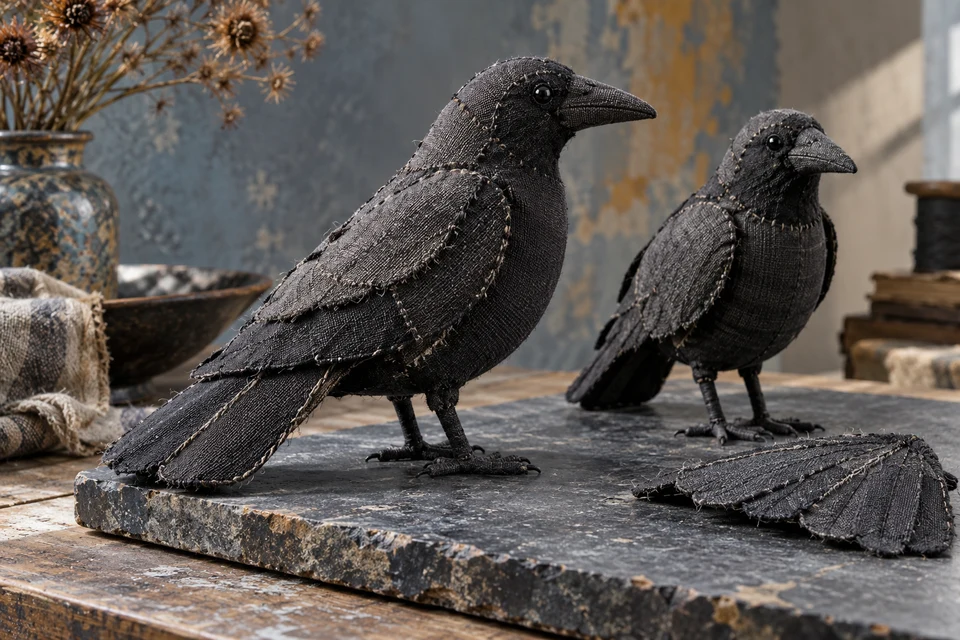
A textile crow decoration combines a recognizable side profile with a physical display construction. A long beak, rounded body and broad tail can look convincing on a drawing yet change after sewing and filling. Any supporting feet or internal frame introduce another supply decision. Buyers should identify those elements rather than describing the entire object as soft fabric by assumption. The purchasing brief should remain decorative unless another use and the associated requirements are explicitly reviewed.
Establish a side-profile reference
Overall length does not explain the bird's proportions
Draw the body axis and mark the head, beak tip, chest and tail end. Record the overall dimensions alongside the beak and tail projections from named landmarks. Decide which side is the main display view and whether both sides should be equivalent. A short body with an extended tail can share the same total length as a fuller body with a shorter tail, while looking like a different design.
Keep the profile drawing in the technical pack. Ask for a preliminary shell or construction model that shows the relation of those parts before final trim is applied. Identify any stylized departure from a natural bird as a deliberate design choice. Do not use the editorial image as an exact manufacturing pattern or imply that every visible construction detail is already available from a supplier.
- Measure beak and tail projections from named body landmarks.
- State the main profile and whether the reverse should match.
Review the beak and tail in their finished state
Soft projections need their own construction decision
Ask how the beak is formed, attached and supported, and whether the tail is flat, layered or filled. Review each projection without a hidden hand holding it at an ideal angle. Compare the two sides for twisting and check the junction where the beak meets the head. A correction that makes the tip more pointed may also change the head silhouette or the visible seam, so examine the full profile after adjustment.
Use the seam construction reference to record the accepted joins. Keep any hard or non-textile component declared in the bill of materials. A cloth-covered projection is not necessarily an all-soft one. Ask for appropriate evidence for the actual decorative article and intended market rather than converting a realistic-looking beak into an unsupported safety or durability claim.
- Inspect projections in their ordinary unsupported state.
- Declare concealed materials instead of assuming all-soft construction.
Decide how the wing layers meet the body
Separate feathers can be visual texture without being loose parts
Identify the wing panel and any overlapping feather-like pieces on a layer drawing. State where they are attached and which edges remain visually free. Compare the wing from the front, side and rear so that a dimensional detail does not accidentally cover the tail or distort the body outline. Ask the maker to show the attachment before it is concealed by another layer where that is necessary to understand the proposal.
Retain the ordinary texture in the retail image approval record. Distinguish deliberate raw-edge styling from an unresolved finishing choice, and define the accepted appearance using a physical reference. Do not remove the textile character through retouching or treat a deliberately distressed surface as permission for uncontrolled loose components. Any material or layer-count change should return to the assembled profile review.
- Map visible free edges and actual attachment areas.
- Recheck the tail and body outline after changing wing layers.
Declare the support that creates the resting pose
Feet, base and internal frame are not interchangeable descriptions
List the actual support arrangement: a resting underside, attached feet, a separate base or another identified construction. State whether it is integral or removable and how the crow is intended to sit on the agreed display surface. If the concept image includes wrapped feet, do not assume their internal material. Ask the supplier to describe the offered assembly and include it in the quotation and component inventory.
Use the buyer preparation resources to record installation and evidence questions. View the complete sample from front, side and rear without concealed props. Avoid claims about stability on every surface or outdoor suitability unless those uses have been separately specified and supported. A taller or heavier variant needs another pose-and-support review; preserving the same decorative fabric does not preserve the behavior of the whole object.
- Identify all support components and their supply status.
- Review the complete pose on the intended display surface.
Protect the profile through the packing sequence
The beak and tail should remain identifiable after unpacking
Trial the proposed pack with the complete support and all decorative layers present. Note whether the beak is pressed against the tail of another item or whether the wing edges become trapped. Open the pack and document the initial silhouette before any adjustment. If a removable base or simple assembly step is part of the offer, confirm that the buyer can identify the supplied parts without reconstructing an undocumented sample-room arrangement.
The packing comparison method provides a useful record. Quote the actual body, projection, support and pack combination, and confirm the sampling sequence before a seasonal commitment. A cheaper nesting arrangement may change the condition of projecting parts, so compare that alternative physically. Do not authorize a revised pack solely from its estimated carton count or an attractive final display photograph.
- Observe the profile before reshaping after unpacking.
- Review nested packing with the actual projecting components.
Share a side-profile drawing and declared support scope with FY Bedding. Request beak, tail and wing construction references plus a complete resting sample. Approve the ordinary pose and unpacked profile before finalizing the crow decoration assortment.