A hotel bed runner appears simple, but its purchasing specification has to connect a visual design with real bed sizes, repeatable sewing, housekeeping handling and replacement-stock control. A drawing that states only a nominal width and color does not show where the runner should sit, how far it should extend, which face is presented, whether an interlining is included or how the approved look survives folding, storage and care. This guide organizes those decisions into a buyer-reviewable route from bed and room mapping through finished dimensions, construction, mock-up approval, housekeeping trials and lot-linked inspection. It does not prescribe one runner size, drop, fabric, laundering method, defect limit or service-life expectation. Those choices depend on the hotel's bed matrix, design brief, operating method, textile construction and buyer-approved care process. The objective is a controlled product definition and a practical room trial, not a general claim that one design is suitable for every property or operating environment.
Map each runner SKU to the bed, room and intended use
Begin with the actual presentation context instead of a generic bed label
Create a bed matrix that identifies the property, room type, bed configuration, mattress width and length, visible top-of-bed layers and the runner SKU proposed for that setting. Use the measurable fields in the hotel bedding specification sheet and the naming discipline in the hotel bed-linen size standardization guide. Keep operational bed codes separate from informal names such as king or twin because those labels may cover different physical dimensions. State whether the runner is intended for a standard guest-room setup, a joined-bed arrangement, an extra bed, a suite styling variation or photography only. If one SKU serves several beds, record every covered configuration and the evidence used to approve the shared size.
Define the runner's role before selecting materials or dimensions. It may be a removable decorative layer, a color cue within a room concept or a coordinated component for a specific top-of-bed presentation. That role does not automatically make it a blanket, protective cover or sleeping layer. Lock the approved face, reverse, color direction, pattern orientation and placement reference through the color and material board workflow. Record nearby surfaces that matter to the review, such as a white duvet cover, upholstered headboard or bed skirt, without implying that a visual sample proves colorfastness or transfer performance. Any functional or chemical question requires its own scoped evidence and decision owner.
- List property, room type, bed configuration and measured bed dimensions by SKU.
- State the runner's intended presentation role and any uses outside scope.
- Identify the approved face, direction, color and placement reference.
- Document every bed configuration covered when one runner SKU is shared.
Specify finished size, placement and visible alignment
Translate the room concept into measurements the sample room and factory can reproduce
Dimension the runner in its finished, approved condition and state how it is oriented on the bed. Record finished length and width, the placement line relative to a stable bed reference, intended overhang or no-overhang arrangement, and the relationship to visible mattress or duvet edges. Avoid treating a styled photograph as a scale drawing. Measure the actual mock-up bed and note compression, rounded corners, thick duvet loft or bed-skirt features that change the visual drop. Where the runner covers several bed widths, compare the proposed presentation on each physical configuration. The buyer should set project tolerances and measurement conditions rather than importing an unsupported universal allowance from another textile program.
Add direction-sensitive details to the dimension sheet: face direction toward the head or foot, pattern repeat position, centerline, stripe or border alignment, and any asymmetric motif. Use the planning principles in the pattern-repeat placement guide when cutting position influences what the guest sees. Include a flat technical sketch and a bed-placement view with controlled reference points. If the construction includes a shaped end, rounded corner or decorative border, dimension it separately instead of hiding it inside the overall length. Require sample measurements and placement photographs to use the same revision so a visually approved runner cannot later be paired with an obsolete measurement table.
- Measure finished length and width under the buyer-approved condition.
- Define placement from stable bed references rather than from a styled photograph.
- Control face direction, centerline, border and pattern-repeat position.
- Evaluate shared runner sizes on every bed configuration they are meant to cover.
Control face, backing, interlining and edge construction
Make the approved appearance traceable to materials and sewing details
Build a component-level specification for the face fabric, backing, optional interlining or padding, sewing thread, labels and any decorative trim. Assign each component a controlled material code, color reference and approved source status in the bedding BOM control process. State whether the runner is reversible and, if not, define how the correct face is identified without a visible distraction in the room. Describe the intended body, drape and edge profile through an approved sample rather than an adjective alone. If interlining is used, record its coverage and how it is restrained; if it is omitted, do not let production add a substitute merely to change handle or pressing behavior.
Specify edge and corner construction with seam type, seam position, stitch appearance, turn method, topstitching where applicable and treatment of raw edges. The seam and stitch specification guide provides a useful structure for recording these decisions without inventing a stitch density for this project. Identify acceptable face-side and reverse-side appearance, including corner bulk, edge waviness, puckering, needle marks, skipped stitches and exposed filling or lining. Place and attach the care or identity label according to the approved artwork and position record in the hotel bedding care-label guide. A label approval confirms controlled content and placement; it does not by itself validate a care process or legal suitability in every market.
- List face, backing, optional interlining, thread, label and trim by controlled code.
- Define reversibility, correct-face identification and directional construction.
- Document seam, edge, corner, topstitch and raw-edge treatments.
- Approve label artwork, attachment and position as separate controlled details.
Run a mock-up room and housekeeping handling trial
Test whether the approved runner can be placed, removed and controlled consistently
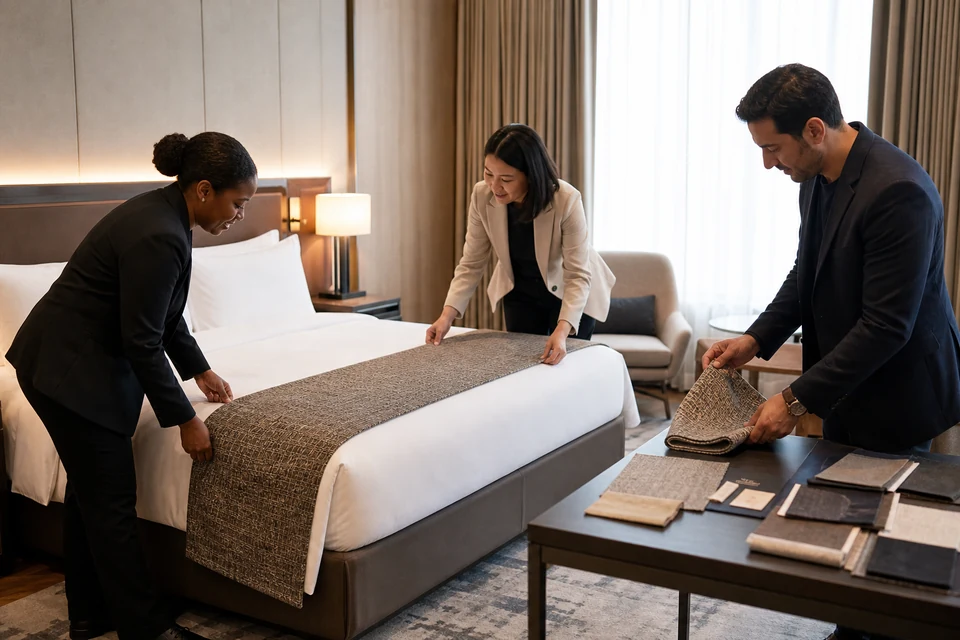
Review the development sample in a representative room using the record structure in the hotel mock-up room approval guide. Photograph the runner flat and installed from controlled viewpoints, and record the bed configuration, underlying bedding, room-lighting condition, sample revision and participant roles. Inspect centering, drop, directional presentation, edge behavior and the relationship to other approved textiles. Note whether observations concern the runner itself or variation in the bed setup. Approval should identify the exact sample and all accepted amendments; a verbal comment such as make it slightly longer is not a production instruction until it is converted into a revised dimension and rechecked.
Ask housekeeping representatives to remove, carry, store, unfold and place the runner using the property's intended routine. Observe handling points, orientation cues, tendency to twist or slide, fold memory, corner response and consistency across repeated setups. The hotel bed-making time trial can frame an operational comparison, but this runner trial should not impose a universal time target or claim labor savings from a small demonstration. Record the actual trial method and any training or room conditions that influenced it. Agree how clean stock, used stock, out-of-service pieces and different sizes will remain distinguishable, drawing on the linen sorting and size-marker plan where identification is needed.
- Identify the exact sample, room, bed setup, lighting and review participants.
- Record installed alignment and distinguish product issues from setup variation.
- Observe removal, carrying, storage, unfolding, orientation and repeated placement.
- Convert every accepted trial change into a controlled specification revision.
Inspect production, control pack identity and release replacement stock
Keep the approved runner connected to its lot, room use and future reorder
Define inspection characteristics from the approved specification and sample: SKU identity, finished dimensions, face and direction, shade group, motif placement, layer presence, seam and corner workmanship, label position and installed appearance where required. Select units across relevant production lots, colors and packing groups using the buyer-approved plan; do not choose only the easiest top pieces. Use the bedding final-inspection checklist as an evidence framework while retaining runner-specific criteria. Record actual measurements, sample source, observation and disposition. A visually acceptable unit cannot compensate for a wrong component or size, and a passed sample should not silently release an unexamined lot with a different material or construction revision.
Pack runners under controlled SKU, color, size, quantity and orientation instructions so housekeeping or property receiving teams can identify them without opening unrelated stock. Align carton and barcode fields through the packaging and carton approval workflow, and retain a sealed reference or traceable production sample for later comparison. Reorder records should identify the approved specification, sample, BOM, artwork and known change triggers rather than relying on a photograph from the opening. If fabric, backing, interlining, size or care instruction changes, route the proposal through documented review before production. Hotel teams developing a bed-runner program can contact FY Bedding with their bed matrix, room concept and housekeeping method for a project-specific sample and evidence discussion.
- Inspect identity, dimensions, direction, layers, workmanship, shade and labels.
- Spread samples across relevant lots, colors and packing groups.
- Control unit and carton identity for property receiving and replacement stock.
- Carry the approved sample, BOM and change triggers into every reorder.
Choose one proposed runner SKU and trace it from a measured bed and placement drawing through the approved material and construction sample, mock-up photographs, housekeeping handling record, production inspection and correctly identified replacement pack.