A quilted coverlet can meet its overall dimensions and still look off-center when placed on the intended bed. A motif may sit unevenly between the side drops, or its most prominent lines may disappear beneath pillows. Procurement should approve pattern placement in the made-bed arrangement as well as on a flat sample. This guide addresses the visual position of quilting on a coverlet. It does not substitute for stitch-continuity inspection or claim that a decorative pattern alone establishes fill stability or durability.
Define the visual reference on the bed
Identify what the buyer expects to be centered
Ask the design team to identify the feature that controls visual placement: a central motif, a repeated geometry, a border or another specified reference. Avoid the instruction center the pattern without naming what is centered against which part of the bed. The tech-pack guide supports a clear placement drawing. Record whether the reference is the mattress top, the complete coverlet or the visible area remaining after the bed is dressed.
Identify the intended mattress dimensions, depth and pillow arrangement. A coverlet used on different bed variants may present its quilting differently even when the textile is unchanged. Use the mock-up room record to connect the placement decision with the actual bed configuration. Keep deliberate asymmetry visible in the approval rather than requiring later inspectors to guess whether an unequal motif position is a design choice or a production error.
- Name the controlling motif or visual feature.
- Define its reference area on the bed.
- Record mattress and pillow arrangements.
- Document intentional asymmetry explicitly.
Relate the flat construction to the made position
Keep dimensions and placement separate
Review the coverlet flat to identify its centerline, finished edges and the position of the selected motif. Record the relevant measurement method and approved tolerance through the technical team rather than borrowing a general dimensional allowance. The dimensional planning guide explains the broader size framework. Overall length and width acceptance does not automatically establish acceptable motif placement within those dimensions, so both characteristics need their own records.
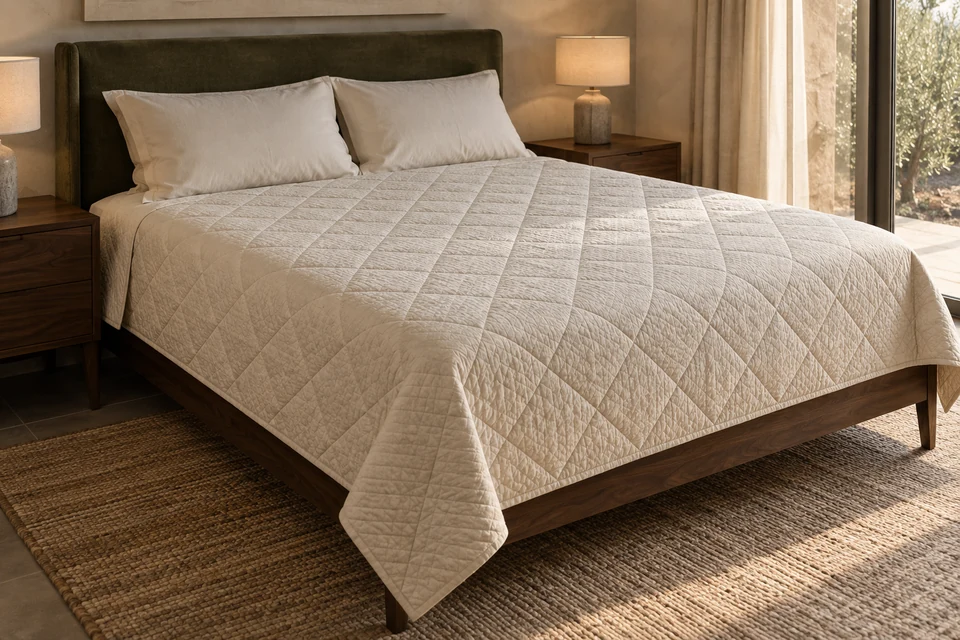
Place the sample on the intended bed using an agreed dressing method and compare the visible result with the flat measurements. If the coverlet is shifted to make a motif appear centered, record the resulting side and foot drops rather than hiding the adjustment. An attractive central view can mask unequal coverage. The sample should demonstrate whether the specified construction can deliver the intended combination of visual centering and practical coverage without relying on unrecorded styling.
- Measure the motif position on the flat coverlet.
- Keep placement criteria separate from overall size.
- Use a repeatable bed-dressing method.
- Record drop changes caused by repositioning.
Review repeat boundaries and edge presentation
Distinguish quilting from printed-pattern matching
For repeated quilting, examine how the geometry meets the side and foot edges in the approved arrangement. The buyer may accept partial motifs at an edge, but that boundary should be illustrated rather than left to a general statement about symmetry. The pattern-placement guide offers related thinking; printed fabric alignment and the position of sewn quilting remain different construction questions with their own references and production controls.
Inspect both oblique room views and a useful centered view of the made bed. A pattern that appears aligned from one angle may reveal an unexpected boundary elsewhere, especially when a border is intended to remain visible. Keep lighting consistent enough to show the stitching without using dramatic shadows as the only evidence. Photographs support appearance approval, while the written construction and placement record remain necessary for reproducing the result on later samples and repeat orders.
- Define acceptable partial motifs at edges.
- Keep quilting and printed-pattern references distinct.
- Review central and oblique room viewpoints.
- Preserve measurements alongside visual evidence.
Compare the intended care state
Recheck the presentation after the agreed process
If the coverlet is intended for a hotel care route, review the same identified sample after the agreed process and recovery condition. Record overall dimensions and motif position again using the same reference points. Do not presume that every change in appearance is a quilting-placement error; the textile's condition and the bed-dressing method may also differ. Keep the before-and-after evidence sufficient for the technical team to distinguish those possibilities without relying on memory.
Use the wash-trial framework to retain actual process details and scope. Assess stitch continuity and other construction requirements separately, using the quilting continuity guide where relevant. A visually centered result does not prove that every stitch is intact, while an intact seam does not establish the intended design presentation. Both findings should remain visible in the purchasing decision.
- Reuse the same sample and reference points.
- Record the actual care and recovery conditions.
- Distinguish dimensional change from placement error.
- Keep continuity and presentation as separate checks.
Release the placement by product variant
Make the approved presentation reproducible
The final approval should link the coverlet construction, placement drawing, bed variant and agreed dressing view. State which sizes share the same placement logic and which need a separate sample. A design scaled from one size may require a different edge treatment on another, so do not infer complete size coverage from a single attractive bed photograph. Keep unresolved variants on hold until the responsible design and technical reviewers agree their acceptance references.
Send the intended bed sizes, motif drawing and desired visible borders in a coverlet development inquiry. Ask for a complete made-bed comparison rather than only a quilting swatch. The broader quilting-pattern guide addresses construction considerations, while this approval records visual positioning. A useful release allows another team to place the correct coverlet on the correct bed and reproduce the agreed presentation without inventing a new styling arrangement.
- Link construction and bed-variant references.
- Review size-specific placement boundaries.
- Hold unresolved variants separately.
- Retain the agreed made-bed presentation.
Approve coverlet pattern centering from the flat placement record and the intended made-bed view, with edge coverage, care condition and size-variant limits visible.