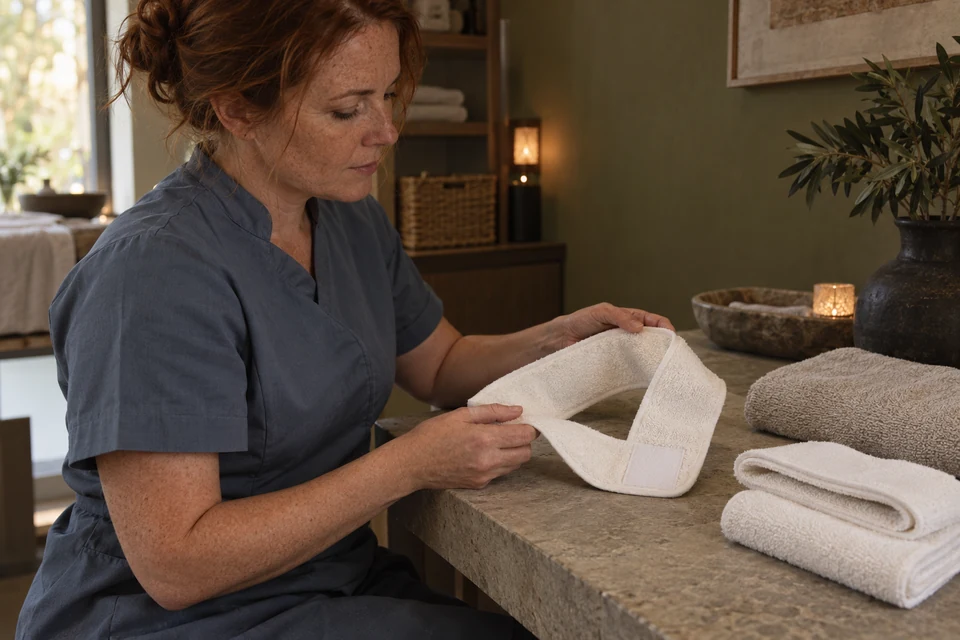
A terry headband used during a spa service has a different task from a towel folded on a treatment trolley. It should support the property's agreed hair-control routine while allowing staff to fit, remove and process it consistently. An attractive product photograph cannot show the useful adjustment range, exposed closure surfaces or how the textile looks after the planned care route. Procurement should ask the spa team to define the service context before selecting the material and construction. This is a buying and usability guide, not a medical, hygiene-certification or treatment-efficacy claim, and a sample trial cannot establish suitability for every guest.
Ask the spa team for a service brief
Start with the task, not a one-size label
Identify the services for which the headband is proposed and the property-approved method of positioning it. Clarify whether it is reusable, supplied to a guest for retention, or managed under another defined service policy. Record how staff store clean pieces, fit them and remove used pieces from circulation. Link the accessory to the spa-linen program without treating every small terry item as interchangeable towel stock. The operational owner should decide the care and use route, not the purchasing team alone.
Ask what staff find difficult with the current item: limited closure reach, excessive bulk, hair contact, unclear clean-stock identification or poor appearance after processing. Avoid diagnosing a problem from a single complaint or assuming all guests need the same adjustment. Translate the agreed concerns into observable sample questions. If the property wants an assurance beyond normal fit and handling, route it to the appropriate professional and evidence plan. Do not use soothing product language to imply prevention of irritation or suitability for a clinical purpose.
- Name the actual services and use policy.
- Identify the owner of fit, care and stock handling.
- Turn observed difficulties into specific trial questions.
- Keep medical and hygiene assurances outside an informal sample review.
Specify the band and adjustment zone
Separate finished size from usable closure range
Record finished band length and width, textile construction, edge finish and the complete closure arrangement. Define the intended overlap and which surfaces are exposed in the accepted fitted positions. A nominal overall length is not the same as the useful adjustment range. Ask the maker to show that range on the production-intent sample and explain the method used to describe it. The technical pack should show the construction rather than rely on an elastic or adjustable marketing label.
For a hook-and-loop proposal, examine whether unused hook areas remain exposed at the positions the spa expects to use. Review hair and neighboring-textile contact without inventing a universal closure rule. The exposed-hook review provides related questions about contact, but the headband's fitted condition must be assessed independently. Do not change closure length, edge binding and band width simultaneously during comparison; otherwise the team cannot identify which revision resolved or introduced a problem.
- Specify overall dimensions and the closure construction.
- Describe the useful fitted range separately.
- Inspect exposed surfaces at relevant fitted positions.
- Compare revisions with clear records of what changed.
Evaluate terry in its real role
Hand, edge bulk and surface are separate decisions
Compare offered textiles using identified samples and recorded preparation. State fiber composition and construction from supplier documentation rather than infer them from softness. Examine the pile, ground, edge binding and reverse where the band contacts the guest. The terry-construction guide helps organize the supplier's description. A towel's advertised weight or absorbency does not, by itself, establish the most useful band thickness or finished shape for this accessory.
Ask the therapist team to review how the band sits near the service area and whether its thickness interferes with the agreed routine. Keep those observations distinct from laboratory or comfort claims. Where lint, surface transfer or another performance concern matters, define an appropriate evidence request before treating a visual trial as proof. If a prototype uses a readily available terry that will not be used in production, mark it as a pattern trial only and arrange approval of the actual material before the construction is released.
- Identify the offered material and preparation.
- Examine binding and reverse contact surfaces.
- Separate service observations from technical performance claims.
- Do not release bulk from a substitute-material pattern trial.
Run a controlled staff trial
Record handling without overstating guest coverage
Use the property's approved trial method with suitable consenting participants and staff supervision. Record sample identity, relevant fitted positions, adjustment steps and removal observations. Staff should not pull harder or improvise a new positioning method merely to make an undersized sample appear workable. Keep the sample comparison scorecard focused on agreed criteria, with space for problems and prompting required rather than a score that hides differences in the conditions used.
If the item will be reused, process the trial pieces through the intended documented care route before repeating the handling review. The care-trial record can link appearance, dimensions and closure observations to that actual process. Examine curling, edge condition and closure handling in the conditioned state. A successful demonstration does not justify an indefinite durability claim. Any changed textile or closure should reopen the affected trial questions instead of inheriting approval solely because the replacement has a similar color.
- Use the spa's approved and supervised trial method.
- Record adjustment and removal observations honestly.
- Repeat relevant checks after the intended care route.
- Reopen affected questions after material or closure changes.
Buy the service-ready unit
Packing and replacement planning should match the use policy
State whether an ordered unit is one band, a pair, a service kit or a labeled retail pack. Confirm how delivered pieces will be identified and prepared before entering the spa's clean-stock routine. Estimate quantities from the defined service demand and turnaround assumptions, not an invented universal replacement percentage. Where several accessories share the same terry, ask whether minimum quantities or material booking can genuinely be coordinated while preserving each item's different pattern and closure requirements.
Retain the accepted production-intent band and the fit and care records. The reorder-control guide is useful for recording the material, band pattern and closure revision together. A repeat offer should be reviewed if the usable adjustment or processing route changes. Buyers can submit an accessory brief with the spa's service policy, requested construction, sample questions and quantities. The proposal should be assessed on that scope, without assuming a specific minimum or delivery promise before the supply route is confirmed.
- Define the ordered and delivered unit.
- Calculate quantities from stated service assumptions.
- Retain fit and care evidence with the pattern revision.
- Recheck adjustment changes before accepting repeat stock.
Select a spa headband from a service-specific review of its usable adjustment, contact surfaces, staff handling and intended care route. Neither a one-size label nor a soft swatch completes that decision.