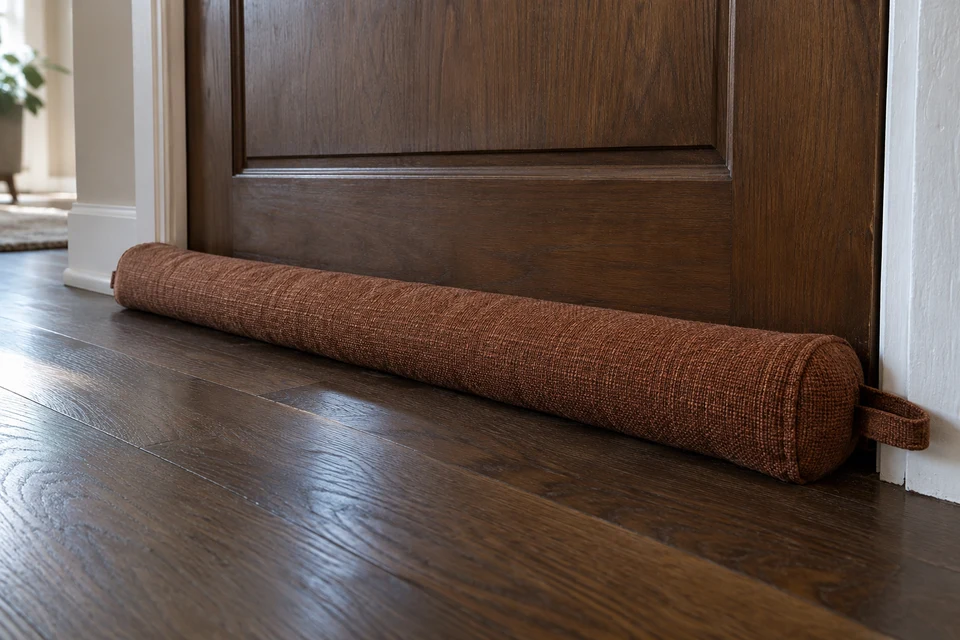
A textile draft stopper can be offered as a simple filled tube, a shaped decorative object or a removable outer cover with a separate inner bag. Those constructions are not interchangeable. Buyers need to specify where the product will sit, how it will be moved and what claims are intended. This guide concerns a loose textile accessory for an ordinary interior-door setting. It is not a substitute for door seals, fire protection, ventilation design or an approved exit arrangement.
Match the door and the available footprint
Length must be considered with movement
Measure the intended door width and the usable floor space at its base. Decide whether the accessory sits on one side only and where it will be placed when the door is opened. Record nearby thresholds, rugs and skirting that affect the shape of the contact area. A long tube that looks suitable against a closed door may become an obstruction when moved. The site owner should approve the placement and ordinary removal routine.
Add a top and side view to the technical brief. State the finished length and profile under an agreed unloaded condition, without pulling the fabric taut. Do not size a product for a fire door or required exit route without appropriate specialist approval. Avoid an instruction that encourages users to block ventilation or prevent a door from operating as intended. The procurement record should describe a bounded setting and a removable accessory rather than promising that it is suitable for every doorway.
- Record the storage position when the door opens.
- Keep door operation and access unobstructed.
Specify fill and containment separately
Weight does not identify the filling material
Ask the supplier to identify the proposed filling, its containment layers and the closure method. A heavy sample does not reveal whether it contains one material or a mixture. If the product uses an inner bag, list its fabric and seams separately from the decorative shell. If the shell is permanently filled, document how its final opening is closed. The component record should make these identities visible before sampling.
Agree how the technical owner will evaluate fill containment and any intended handling. Inspect the sample for visible leakage, loose particles or exposed closure parts, but do not treat the absence of a visible problem as proof of long-term performance. Keep intended users and foreseeable handling in the evidence review, especially for shaped products that could be mistaken for toys. Do not invent a safe fill weight or claim that a natural-looking fill is inherently harmless. Ask for material information and scoped evidence for the actual assembly.
- Name the fill and inner containment.
- Do not infer material identity from weight.
Review the floor-contact profile
A straight outline can hide uneven filling
Lay the sample in the intended position and observe whether its profile is continuous or has pronounced empty areas. Check the end shapes and the transition into any handle. Photograph the complete length rather than only a close crop of the fabric. If the buyer wants a consistent cylindrical appearance, use a defined reference and measurement condition; if an intentionally soft irregular profile is acceptable, record that instead of leaving inspectors to guess.
Review the shell at the floor-contact area for exposed labels, hard closure parts or bulky seams. Use the seam brief to identify where those junctions belong. Where the buyer proposes a removable cover, demonstrate removal and refitting without releasing the filling. A revised shell fabric or inner liner may alter the finished profile, so compare the complete assembly after changes. Appearance and fit approval should not be extended into sound-reduction or thermal-performance claims without a relevant evaluation.
- View the complete length on the intended surface.
- Keep hard parts away from unreviewed contact locations.
Define handling and care realistically
A loop should have an explicit purpose
If a short loop or handle is included, decide whether it is intended for carrying, storage or decoration. Ask the technical owner to define any attachment evaluation needed for the filled weight and intended action. Do not assume that a loop copied from a light textile product is suitable for a heavier filled tube. Review the ordinary lift-and-store routine without dragging the sample over surfaces in a way the product was not designed to tolerate.
Separate care of the outer fabric from care of the filled assembly. A washable cover does not imply that the complete stopper can be immersed or machine washed. Record the approved care proposal and test scope through the evidence plan. If a removable cover is specified, retain a reassembled reference after the care trial. The repacking workflow can inform the handling record, but the stopper's own weight, shape and containment must remain the basis of approval.
- Assign a purpose to each loop.
- Keep cover care distinct from filled-product care.
Keep commercial claims narrower than the nickname
Draft stopper is a product description, not a measured result
List the intended claims before approving packaging or ecommerce copy. A product name should not silently become a promise of a specific energy saving, sound reduction or fire resistance. Where the buyer wants measurable claims, commission an appropriate scoped assessment through a qualified specialist and connect the evidence to the exact product and use conditions. Otherwise describe the construction, dimensions and intended placement without numerical performance promises.
Use the claim evidence matrix to keep copy and documentation aligned. For the quotation, distinguish shell-only, inner-bag and complete-filled supply, including pack weight and final assembly responsibility. Send FY Bedding the door setting, proposed profile, material preferences and intended claims for a feasibility discussion. Final release should identify both the approved product and the limits of the review, so a later decorative variation cannot be sold under evidence that belongs to another construction.
- Review every measurable marketing claim.
- Quote complete-filled and cover-only versions separately.
Confirm placement, fill identity, containment, floor contact and removal before release. Do not convert a decorative product name into an unverified energy, acoustic or safety promise.