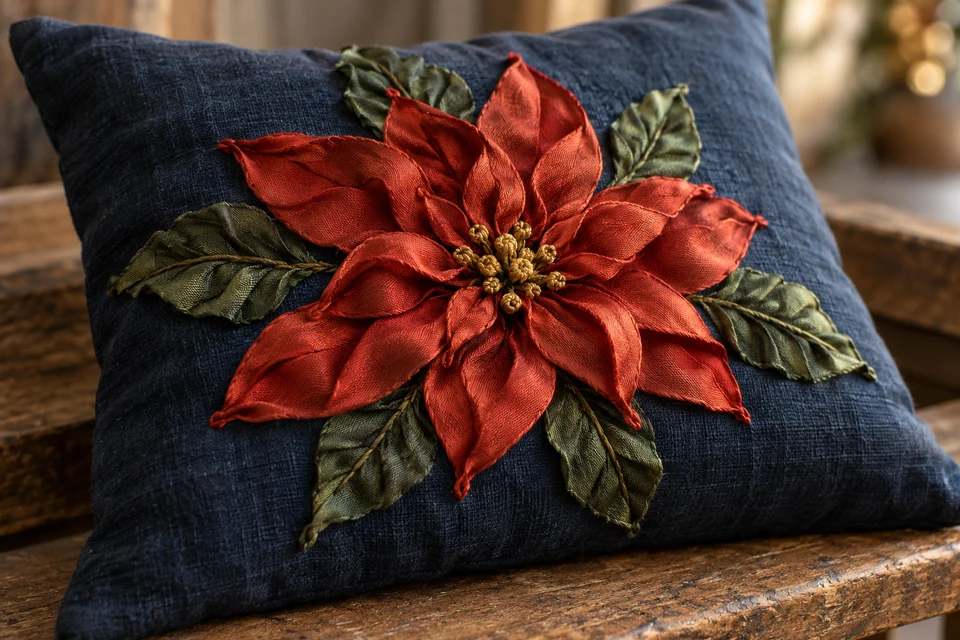
Ribbon embroidery gives a Christmas poinsettia cushion a different surface from flat thread embroidery or cut-fabric applique. The ribbon can turn, fold and rise above the ground, so the same outline can produce a shallow graphic flower or a much more dimensional one. Buyers should describe that intended relief before accepting a sample. A pleasing front photograph alone does not establish the ribbon construction, its reverse treatment or the appearance after the cushion has spent time in its proposed retail pack.
Name the decoration route rather than buying by appearance alone
Ribbon embroidery and layered applique are different offers
Ask how the proposed petals are formed and attached. Record whether ribbon passes through the ground, is folded and secured on the surface, or is supplied as separate shaped pieces. Identify the ribbon material and width, ground fabric and any supporting layer. An alternative construction can be useful, but it should not be described as the same product merely because its outline resembles the reference flower.
Use the applique construction guide when comparing a cut-fabric alternative. Keep the two development routes separately named in quotations and samples. The buyer may choose either, but the accepted appearance and bill of materials should agree. Do not infer handwork, fiber composition or a manufacturing location from the style of the decoration.
- Identify how each petal is formed and secured.
- Keep ribbon and cut-fabric alternatives separately quoted and approved.
Approve the flower in profile as well as from above
Loop height changes shadow and apparent petal width
View a sewn sample straight on and at a low angle. Record the intended petal folds, visible ribbon edges and degree of relief. Show which overlaps are deliberate and where the center should remain visible. A tightly flattened petal and an open loop can occupy the same artwork boundary while casting very different shadows. Retain a physical reference when words such as soft, dimensional or full are insufficient.
The embroidery approval process supports the sewn reference. Add profile photographs and identify any petal that requires a specific turn or fold. Avoid using a ruler to press the petals flat while measuring their appearance. Separate the footprint on the cushion face from the raised profile so each can be reviewed without disguising the other.
- Retain front and low-angle reference views.
- Describe footprint and relief as separate sample decisions.
Review the petals on the nominated filled cushion
Curvature can open some loops and compress others
Fit the proposed insert and allow the cushion to settle naturally. Observe the outer petals near the curved sides and the flower center on the front. Decide how much surrounding ground the design needs and whether any raised part approaches the seam. If the offer is cover-only, identify the styling insert used in the review rather than implying that all customer inserts will produce the same effect.
Use the insert-to-cover approval to hold the filling condition constant. Compare a flat sewn cover and its filled state before moving the motif or altering loop size. For a range of cushion dimensions, decide whether the flower remains constant or scales. A larger ribbon width is not automatically equivalent to enlarging the original embroidery geometry.
- Keep insert identity fixed when comparing sample revisions.
- Approve flower scale and surrounding ground for every cover size.
Inspect attachment points and the reverse without overclaiming
A decorative photograph is not durability evidence
Request access to the reverse of the decorated cover before it is finally closed or lined, where the construction permits. Record attachment points, thread ends, ribbon tails and the proposed backing or cover layer. Ask how the finished article will be assessed for the intended decorative use and care. Do not declare a petal secure simply because it stands neatly in a photograph or survives informal handling once.
The reverse-side embroidery review gives a useful record structure. Any requested tests should identify the actual ground, ribbon and construction sampled. Keep care instructions subject to appropriate evidence. A claim for a flat embroidered fabric or another cushion does not automatically cover raised ribbon loops and their attachment route.
- Record the hidden tails, backing and attachment treatment.
- Keep visual approval separate from any required performance evidence.
Choose packaging that preserves the agreed presentation
Judge the reopened product, not only the packed dimensions
Place the sample in the proposed retail and transport pack with the intended insert state. Record the fold or stack position relative to the flower. Reopen it after the agreed packing trial and compare the petals with the retained reference. Note whether recovery requires hand shaping and whether that action is acceptable for the customer or retail team. Do not silently restyle every petal before taking the acceptance photograph.
Consult the compression-packaging review if reduced pack volume is proposed. Confirm the resulting construction, quantity and packaging assumptions before order release. The generated image is a concept illustration, not evidence of supplied ribbon, finished durability or available inventory. A seasonal launch plan still needs an agreed sample schedule and confirmed production capacity for that order.
- Record the appearance before any post-pack hand shaping.
- Approve any required unpacking action and communicate it accurately.
Send FY Bedding the poinsettia layout, desired ribbon relief and cushion dimensions. Request front, profile, filled and reverse views of the sewn sample, followed by a packed-and-reopened comparison before the Christmas cushion order is released.