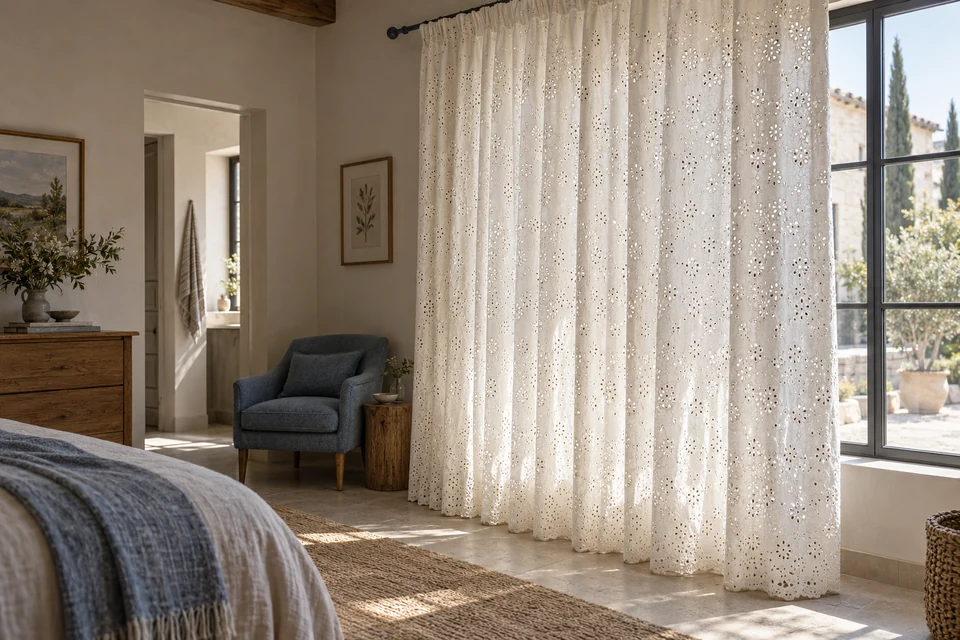
Broderie anglaise curtain cloth uses an embroidered openwork appearance that needs to be reviewed as part of the complete hanging panel. In this guide, eyelet refers to the decorative holes in that textile, not metal rings in a curtain heading. Confusing those meanings can send a buyer toward the wrong construction before sampling starts. A close-up may show appealing stitching, but it cannot establish how the motif, background fabric and panel width will look at an actual window. This procurement brief addresses that visual and construction decision. It does not establish privacy, blackout, fire or acoustic performance.
Name the openwork separately from the heading
Avoid a misleading eyelet specification
Identify the proposed embroidered textile and give its base fabric, thread, motif and color references. State the intended heading independently: an accepted pocket, tape or other actual arrangement. A metal-ring heading can be specified separately if needed, but it is not the openwork technique discussed here. The grommet guide addresses that different interface; it should not replace a description of the embroidered cloth. Keep supplier searches and quotations precise enough to distinguish the two meanings.
Ask whether openwork appears across the panel, only in borders or in another defined layout. Review the proposed production route and the full available textile rather than assuming every small motif can be scaled or moved freely. The embroidery approval record provides related identity fields, but an ornamental curtain requires its own full-panel design. H&M's broderie anglaise curtain example is a product-category reference only; it supplies no technical result, specification or availability for a FY Bedding project.
- Describe embroidered holes and motif placement.
- Specify the heading as a separate feature.
- Keep reference products apart from the offered version.
Review the finished holes and embroidery edges
An intended opening differs from damaged ground cloth
Inspect the sample face and reverse around the decorative openings. Identify the accepted stitched outline, visible loose ends and any unintended damage to the surrounding cloth. Let the responsible technical owner define the workmanship criteria and relevant evidence; this article offers no universal hole size, stitch count or test threshold. The reverse-side embroidery review supplies related checks where supporting materials are used, but it does not prove the condition of a different finished panel.
Request views that show complete motifs as well as close details, with locations connected to the sample identity. A macro image of one clean opening should not conceal unfinished areas elsewhere in the panel. Record defects separately from the deliberate openwork so the supplier cannot dismiss a broken ground yarn as part of the decorative design. If the maker revises the motif, supporting process or thread, review the relevant finished areas again. A color-only approval does not authorize an altered embroidered edge.
- Inspect intended openings from both faces.
- Separate decorative holes from unwanted damage.
- Review complete motifs and located details.
Put the panel in the intended window arrangement
Openwork changes the visual relationship to the background
Hang an identified full sample using the proposed heading and the room owner's accepted arrangement. View it against the actual background in relevant daylight and artificial light, noting how the motif is read both close up and from an ordinary room position. The sheer-panel planning guide addresses broader transparent-cloth questions; this review owns how embroidered openings and the ground textile form a particular visible pattern. It must not turn a room observation into a universal privacy or light-transmission claim.
Check the panel open, drawn and gathered as the intended use permits. Decide whether the design remains understandable within the actual folds and whether a border becomes obscured by the heading or return. If another layer is proposed, review the layers together but identify each included component separately. A liner can change the visible openwork character, so it should not be introduced after visual approval merely to solve an unsupported performance expectation. Refer any required technical function to its proper evidence and specialist owner.
- Review the full panel under stated room conditions.
- Observe the motif in intended folds and positions.
- Do not infer technical performance from the window view.
Map borders and matched panel contents
A pair needs a deliberate layout relationship
Record where motifs and borders land at side hems, the upper finish and the lower edge. Define which fabric direction is intended and how offered sizes use the layout. The repeat-placement record can connect the textile design to finished panel boundaries. Do not assume the face can be rotated to reduce consumption without changing the pattern. If a supplier needs a join for a requested width, place it visibly in the proposal before approving a complete uninterrupted design.
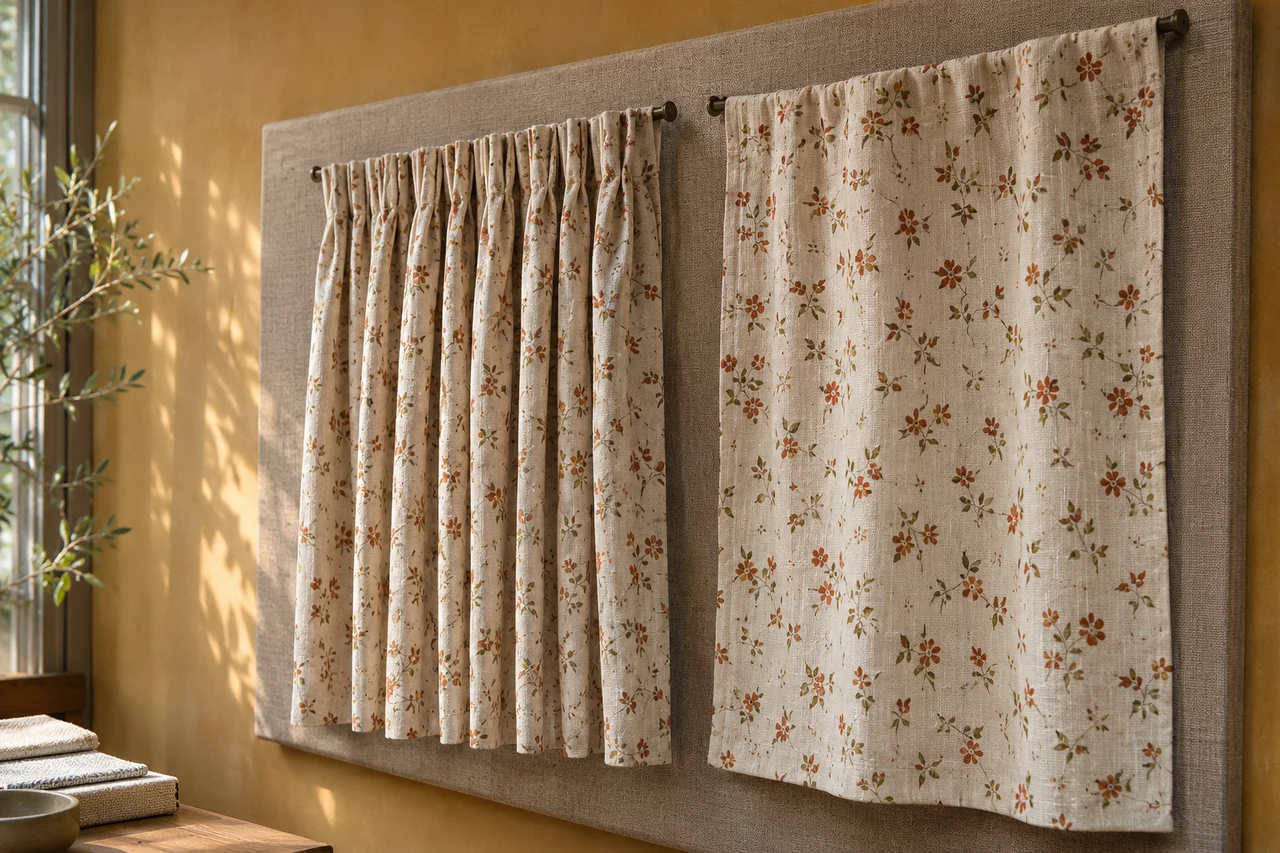
State whether the sold unit is one panel or a pair, and whether paired panels are identical, mirrored or intentionally different. Review that actual arrangement at the window. Keep any valance or additional layer excluded unless named as supplied. The contents reconciliation guide helps align order quantities and consumer images. A photograph showing two panels should not quietly stand for a one-panel purchase, and an accepted single-panel detail does not complete pair matching.
- Map borders at every finished edge.
- Approve direction and proposed joins.
- Identify single, identical-pair or mirrored-pair contents.
Connect care and finish with the chosen appearance
Recheck the openwork in the complete sewn panel
Confirm the proposed care information and relevant technical assessment for the offered panel construction. Inspect the embroidered openings, seams, border relationship and hanging appearance in the resulting documented state. The dimensional evidence guide provides related questions without setting a generic curtain allowance. Record whether exceptional pressing, stretching or arrangement is needed to restore the reference. The buyer should not approve a recovery method that customers or property staff will never be instructed or equipped to use.
Review final quotes against the accepted textile, motif layout, heading, dimensions, paired contents and finishing requirements. Confirm actual minima and any development or evidence work rather than treating ornamental openwork as a standard interchangeable cloth. Buyers can submit an embroidered-curtain brief with a complete window view and an explicit distinction between openwork and heading hardware. Availability and suitability of the supply route remain conditional. Keep the finished layout and evidence references available for any later textile substitution, even where the substitute has a similar white-on-white appearance.
- Recheck embroidery and hang after stated care.
- Disclose exceptional recovery work.
- Quote the complete layout and panel unit.
Specify broderie anglaise as embroidered openwork, independently of heading hardware. Approve finished openings, motif direction, the actual window arrangement and complete panel contents without inventing privacy or other technical performance.
Method references: H&M Home: Example of broderie anglaise curtain lengths.