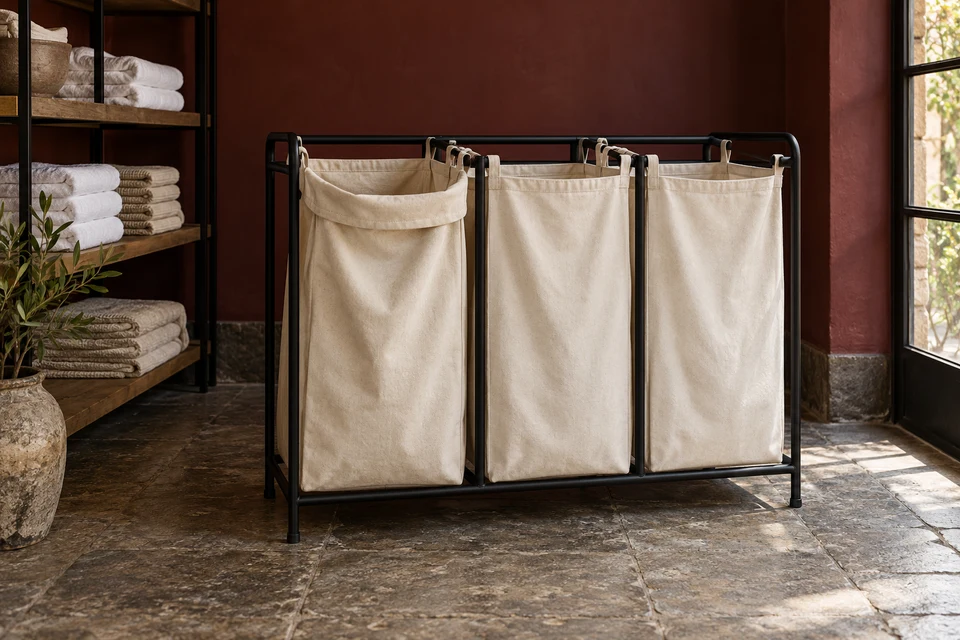
A multi-compartment laundry sorter is a system of bags and a frame, not a collection of identical sacks unless the design actually makes them identical. For hotel or residential-project buyers, each compartment needs a defined position, attachment route and removal action. Approving one loose bag without its frame can miss the problems that staff encounter when the bags are installed side by side.
Map the frame before specifying the bags
Identify which dimensions belong to each compartment
Record the exact frame reference and draw its compartments from the operating side. Name the left, centre and right positions or use another unambiguous scheme. Measure the relevant internal spaces, support rails and attachment points, noting any obstruction that reduces usable clearance. Do not rely only on the frame's external width, because that measurement does not describe each bag's available space.
If the compartments differ, create separate bag references instead of describing them as a generic set. Even apparently equal spaces may have different attachment access at the outer sides. The tech-pack guide provides a structure for the frame drawing and bag schedule. Keep the actual frame available for sample review, or agree a verified representation that preserves all relevant interfaces.
- Define the viewing direction for position names.
- Record compartment dimensions and attachment locations separately.
Approve the bag-to-frame connection
Make installation possible without distorting the bag
Specify the attachment method, spacing and finished dimensions of loops, tabs or sleeves. Install every bag at the same time and inspect how the mouths sit relative to the rails. Look for twisted loops, a rim pulled across the opening or a bag that only fits when its neighbour is removed. Record which attachments are intended to be released during normal removal and which remain in place.
Do not silently substitute a different fastening method because it looks similar in a photograph. The change may alter installation and handling. Use the supplier change-control guide to keep the frame interface under approval. If the proposed connection includes hardware or a claimed load capacity, have the appropriate reviewer establish the required evidence for that complete arrangement rather than inferring it from fabric weight.
- Install the full set before signing off any individual position.
- Photograph the attachment from the operating and reverse sides.
Test the lift-out path for each compartment
A bag must leave the frame, not merely hang inside it
Agree the intended handling conditions and representative contents with the operations team. Follow the normal removal sequence for each position and observe the route past rails, adjacent bags and nearby equipment. Check whether the handles can be reached and whether the mouth can pass through the available clearance. Do not approve an overloaded handling demonstration or invent a universal safe carrying weight.
Keep removal observations distinct from static fit. A bag can hang neatly while being awkward to detach when in use. The single-container liner guide addresses a related but narrower problem; a sorter requires all compartments to be assessed together. Record any operational restriction clearly and have the responsible team decide whether it is acceptable before the design is released.
- Review every compartment with adjacent bags installed.
- Document the agreed handling conditions and any two-step removal action.
Check the interface after care
A small dimensional change can affect several attachment points
Establish the intended cleaning procedure for the exact bag construction, including handles and closures. After the agreed care sequence and conditioning, reinstall the bags in their assigned positions. Check loop spacing, hanging depth, mouth shape and clearance from the floor or base rails. Measure without stretching the attachments to recreate the original fit, and retain before-and-after photographs.
Use the dimensional-stability guide to record procedure and sample identity. If bags will enter a shared laundry route, decide how their position or model identity will be retained without relying on a removable packaging label. The technical and operations teams should approve the method. Do not imply hygiene, disinfection or service-life performance simply because the bag can be removed and washed.
- Refit the cared-for bags to the same identified frame.
- Keep position identity usable after the packaging is discarded.
Make individual replenishment possible
Order the needed bag without confusing the system
Assign a component code to each distinct bag and state whether it is sold singly or only as part of a set. Keep the compatible frame reference and revision with that code. For a hotel operator, the ability to identify one damaged or missing compartment bag is more useful than a vague description of a three-bag sorter. Agree pack quantities and how replacement bags will be distinguished in stores.
Review minimum quantities and current availability with the supplier rather than assuming single replacements are always offered. The reorder specification guide helps protect the interface if a later frame or bag revision is introduced. Send FY Bedding the frame drawing, position map and intended care route to discuss a component brief. Any proposal should confirm the actual supply scope, sample requirements and delivery plan before use.
- Keep frame and bag revision references linked.
- State whether replacement quantities are per bag or per complete set.
A sorter-bag approval should show the whole installed set, the removal path for each position and the fit after the agreed care process. If the buyer cannot identify which replacement bag belongs in which frame, the specification is not ready for routine replenishment.