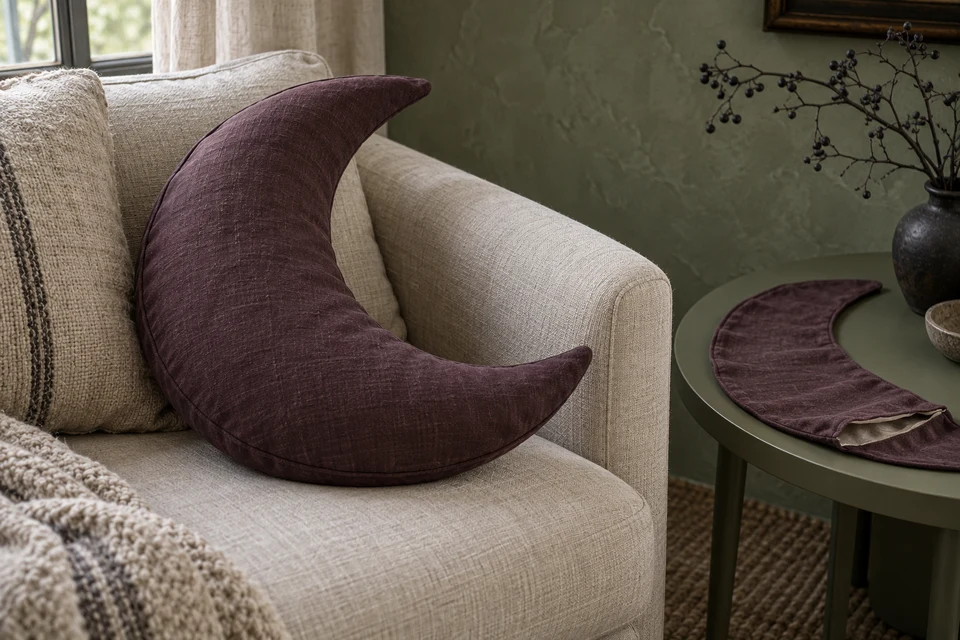
A crescent cushion is defined as much by its empty inner curve as by the fabric around it. Filling that makes the outer arc pleasantly rounded can also close the opening, blunt the tips or twist one face. For a Halloween room-accessory range, the buyer needs a finished silhouette that can be reproduced without hidden support. The task is to approve a shaped decorative textile, not to infer sleep support, ergonomic benefit or child suitability from a moon-like appearance.
Define the opening as part of the shape
Overall height does not describe a crescent
Create a drawing that identifies the outer arc, inner arc and the two endpoints. Add a clear front-facing convention and mark how the sample should rest for measurement. Record the overall height and width, then define useful landmarks for the inner opening and tip separation. A sample can meet the outer dimensions while looking almost closed through the center. Do not leave that important negative space to an informal judgement made from different photographs.
Put the drawing in the product specification pack. Ask the supplier to distinguish the cut-panel shape from the sewn and filled shape. If the proposed seam allowance or filling changes the visible crescent, review the revised outline with the designer. A paper template is a development tool; it does not prove how the completed cushion will sit on a sofa.
- Identify the inner opening and tip gap explicitly.
- Use one resting condition for measurement and comparison.
Inspect the concave seam without pulling it flat
The inner arc reveals turning and assembly choices
Review an empty sewn shell as well as a filled sample. Lay it naturally and observe the inner curve for unintended folds, exposed stitching or local distortion. Ask the maker to explain the proposed seam construction rather than prescribing a workshop correction from a photograph. The appropriate treatment depends on the actual fabric and pattern; procurement should record the approved result and construction reference rather than invent a universal clipping rule.
The seam specification guide can hold that reference. Compare the two faces and follow the seam around both tips. If a visible issue is corrected locally, request another whole-shell and filled comparison. A tidier short section may alter the surrounding curve or move the seam toward one face, so the correction needs approval in context.
- Keep empty-shell and filled references together.
- Review the complete curve after a local alteration.
Make the two tips a separate sample checkpoint
More filling is not an automatic solution
Ask how the proposed filling reaches the tapered ends and where the final opening is placed. Look at both tips from the front and side with the cushion unsupported. A rounded lower tip and a sharply pointed upper tip may be deliberate, but that difference needs to appear in the approved drawing. Do not instruct the packer to bend or pin the tips into a shape that the product cannot maintain after handling.
For a removable-cover design, identify the shaped insert and its relationship to the shell using the insert and cover review. For a permanently filled version, specify the offered filling and closure separately. These are different supply scopes. Record observed fullness and silhouette without converting a visual preference into an unsupported firmness, durability or comfort claim.
- Check each tip independently from front and side.
- State removable insert versus permanently filled construction.
Decide whether both directions are display faces
A moon can face either way, but closures may not
Place the cushion with the opening facing left and then right. Determine whether both arrangements belong in the retail offer. A zip, label or different reverse fabric can become prominent when the item is turned. If one face is the intended front, show that convention in the product images rather than describing the item as reversible simply because it can be physically flipped.
Use the retail photography record to compare the accepted filled sample with both proposed views. Keep ordinary folds visible where they are part of the supplied appearance. Do not digitally widen the opening or sharpen the tips to improve the listing. Generated editorial visuals explain the purchasing topic and must remain distinct from photographs used to approve the actual merchandise.
- Review closure and label visibility in both directions.
- Retain an ordinary unsupported view for the listing team.
Pack the curve without losing its identity
Approve unpacking before promising a ready-to-display form
Trial the intended pack using the completed cushion and any internal support proposed for transport. Observe whether one tip is folded inside the crescent, whether the inner opening closes and whether the two faces shift. Open the pack and document the immediate shape before adjusting it. If hand smoothing is expected, define the simple action and keep the resulting view separate from the initial condition.
The compression-pack review helps organize this comparison without promising a recovery time. Ask about minimums for the shaped shell, insert and color, and price the approved combination rather than a generic cushion volume. Confirm the sample sequence and feasible dispatch plan before making seasonal commitments. A larger version requires another silhouette review because scaling every measurement does not automatically preserve the same visual balance.
- Review each offered size after its actual pack is opened.
- Quote the shell, filling scope and transport arrangement together.
Give FY Bedding the crescent outline, intended resting direction and insert or filling scope. Request an empty shell, a finished unsupported sample and an unpacking comparison. Approve the inner opening and both tips explicitly before releasing the Halloween cushion range.