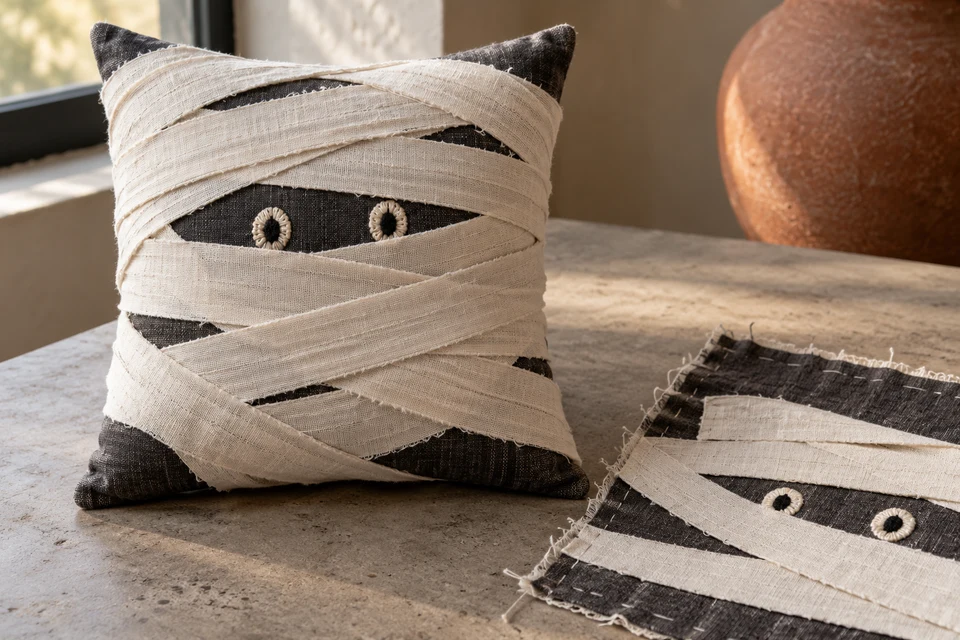
Applied strips give a mummy-themed cushion depth that a printed bandage pattern cannot reproduce. They also create junctions, exposed edges and hidden areas that a buyer must describe before sampling. The important purchasing question is not simply whether the cushion looks wrapped. It is whether the same layered arrangement, usable closure and agreed surface can be supplied consistently. Start with a decorative cushion brief and keep appearance approval separate from any unsupported durability, sleep-support or child-use claim.
Map the strip order before discussing quantities
Over and under are construction instructions
Give each applied strip an identity on a face drawing and show which one passes above the next at every crossing. Mark the eye opening and the visible charcoal base separately. A finished photograph is useful, but shadows can conceal whether a strip is attached along its edge, held only at its ends or caught under another layer. Ask for a flat development face that makes these choices observable before the cushion is closed and filled.
Include this map in the home textile specification pack. Distinguish deliberate asymmetry from uncontrolled placement. If a wrapped diagonal is intended to vary slightly, define the permitted area instead of approving unrestricted random assembly. Ask how the proposed strip layout affects cutting, preparation and minimum quantities. Compare quotations using the same construction scope; a printed imitation and an applied-strip version are not interchangeable offers.
- Identify strip sequence and intended attachment areas.
- Keep eye openings outside the discretionary placement zone.
Inspect the thickness at intersections
A neat flat face may behave differently when filled
View crossing points from an oblique angle on the empty face and again on the filled cushion. Several folded strips can make one junction noticeably higher than the surrounding surface. Decide whether that relief belongs to the design or distracts from it. Ask the maker to propose a repeatable solution using the actual materials rather than requesting that a sample be pressed flat for its approval photograph.
Record the accepted arrangement with the seam and stitch reference. Follow the construction through a junction and into the neighboring exposed section. A local change in strip width or attachment may shift the eye opening or reveal an unwanted base gap. Review the whole face after any correction. Do not turn an attractive photograph into a statement that the junction has passed an abrasion, seam-strength or snagging assessment that has not been specified and performed.
- Compare junction relief before and after filling.
- Recheck adjacent strips whenever a crossing is revised.
Choose the bandage edge deliberately
Raw, folded and bound edges are different products
A softly frayed edge can support the mummy appearance, while a folded edge creates a cleaner graphic. Ask for physical alternatives if the brief does not yet define one. Examine loose yarns, corner ends and the point where a strip disappears under the next layer. Agree how the selected appearance will be maintained through the proposed care process, with any assessment and acceptance criteria defined for the actual construction.
Do not treat the editorial image as a production pattern or evidence that an unfinished edge is suitable. Keep the approved surface reference in the retail image approval record. The listing team should show the same amount of edge texture that customers receive. Removing every loose yarn digitally would misrepresent an intentionally textured design; leaving uncontrolled loose ends because the theme looks distressed is equally unhelpful.
- Approve the edge type and visible texture together.
- Distinguish deliberate distressing from an unresolved finish.
Review base coverage on the filled cushion
Loft changes the visible spaces between strips
Use the intended insert or filling scope for the next sample. When the face curves, strips can separate and expose more base fabric than the flat drawing suggests. Observe the eye area, corners and side seams without pulling the fabric into a preferred pose. Decide which gaps are intentional and which should remain covered. A different insert may change this result even when the shell dimensions stay the same.
Link the shell approval to the insert and cover ratio review. State whether the buyer receives a removable cover, a cover with a separate insert or a permanently filled article. Check that strips do not obstruct the zip or disguise the opening instructions. Review both faces and confirm whether the reverse is plain, patterned or also layered; that choice changes material use and the product description.
- Check gaps with the actual intended filling arrangement.
- Keep closure access separate from the decorative wrapping.
Keep the layered face recognizable after packing
The pack must not become an unapproved shaping tool
Trial the proposed pack with a complete cushion or folded cover as actually supplied. Note where strip ends turn back, where intersections acquire a hard fold and whether the eye area becomes obscured. Open the pack and document the initial condition before smoothing it. If a simple hand adjustment is expected, record it honestly and show the difference between arrival condition and prepared display condition.
Use the packaging comparison process to retain these observations. Quote changes to strip fabric, layer count and packing separately when comparing alternatives. Confirm the sample approval sequence and dispatch feasibility before committing to a seasonal launch. A second size should receive its own face map; scaling the outer square does not automatically preserve strip width, overlap bulk or the relationship between the eyes and the wrapped layers.
- Photograph the unadjusted face immediately after unpacking.
- Approve each size with its own overlap and eye-placement map.
Send FY Bedding a numbered strip drawing, the selected edge treatment and the required cover or filling scope. Request a flat construction face, a filled sample and an actual-pack comparison. Release the mummy-wrap design only when the overlaps, base gaps and closure remain consistent across those views.