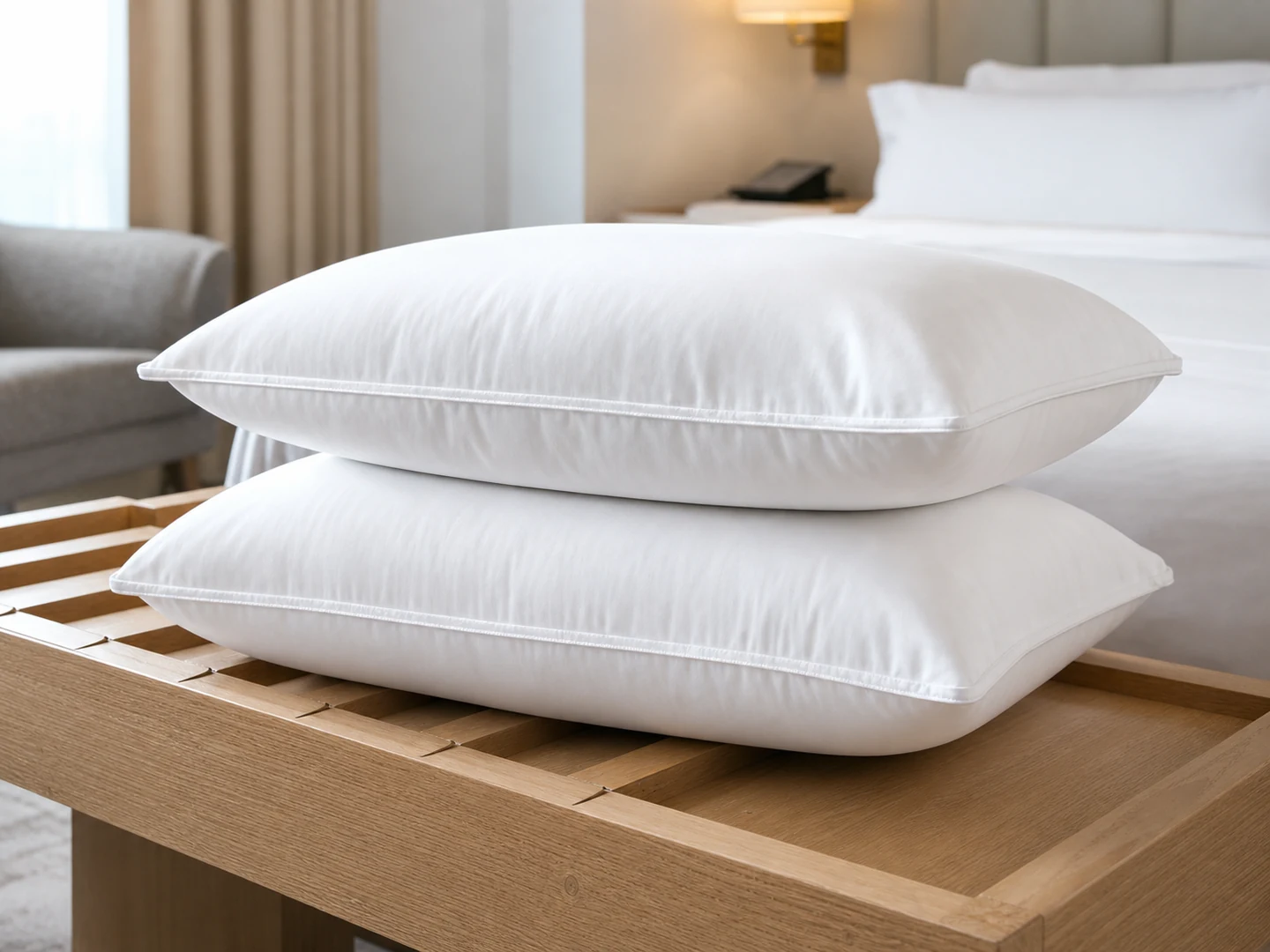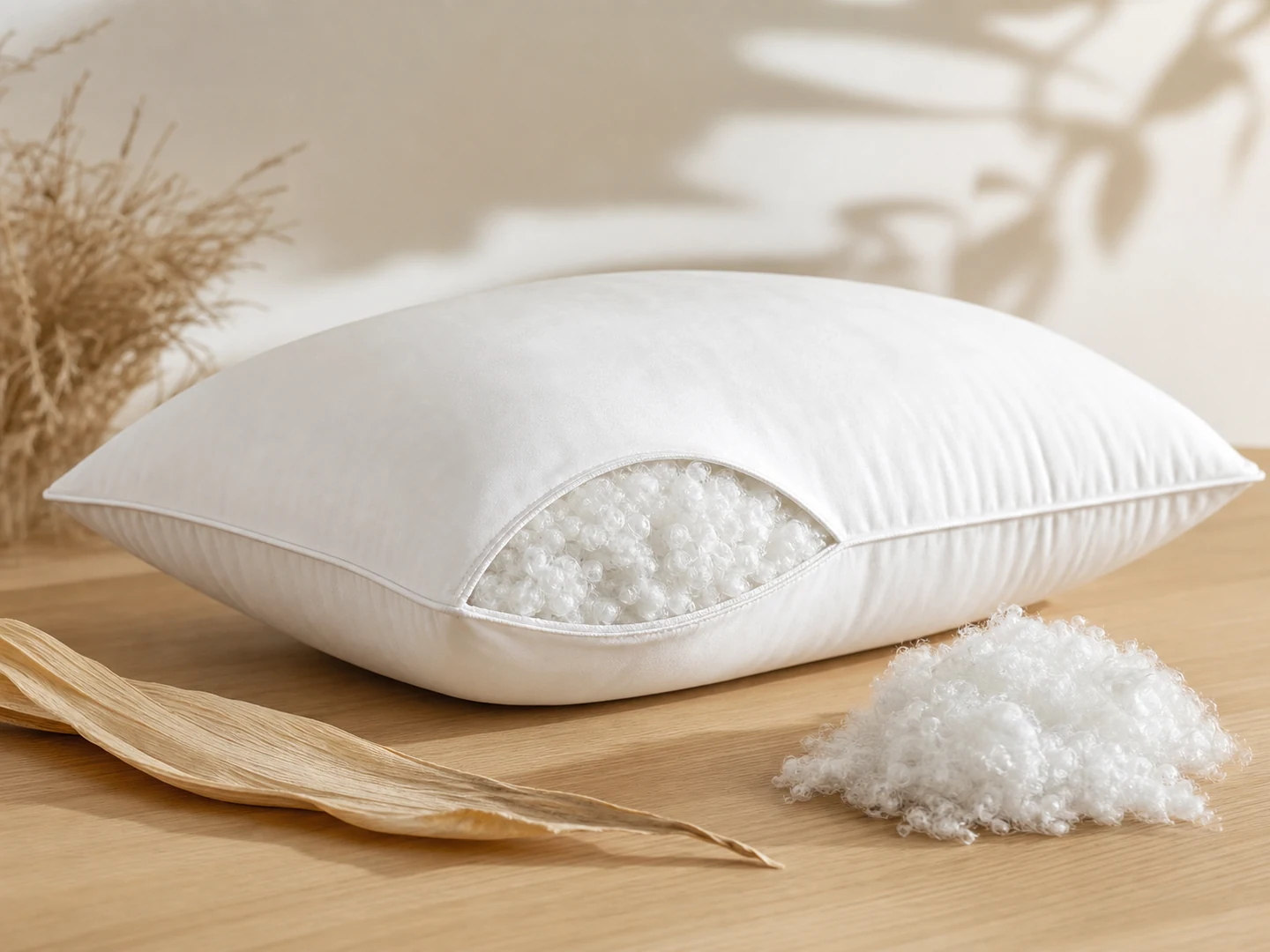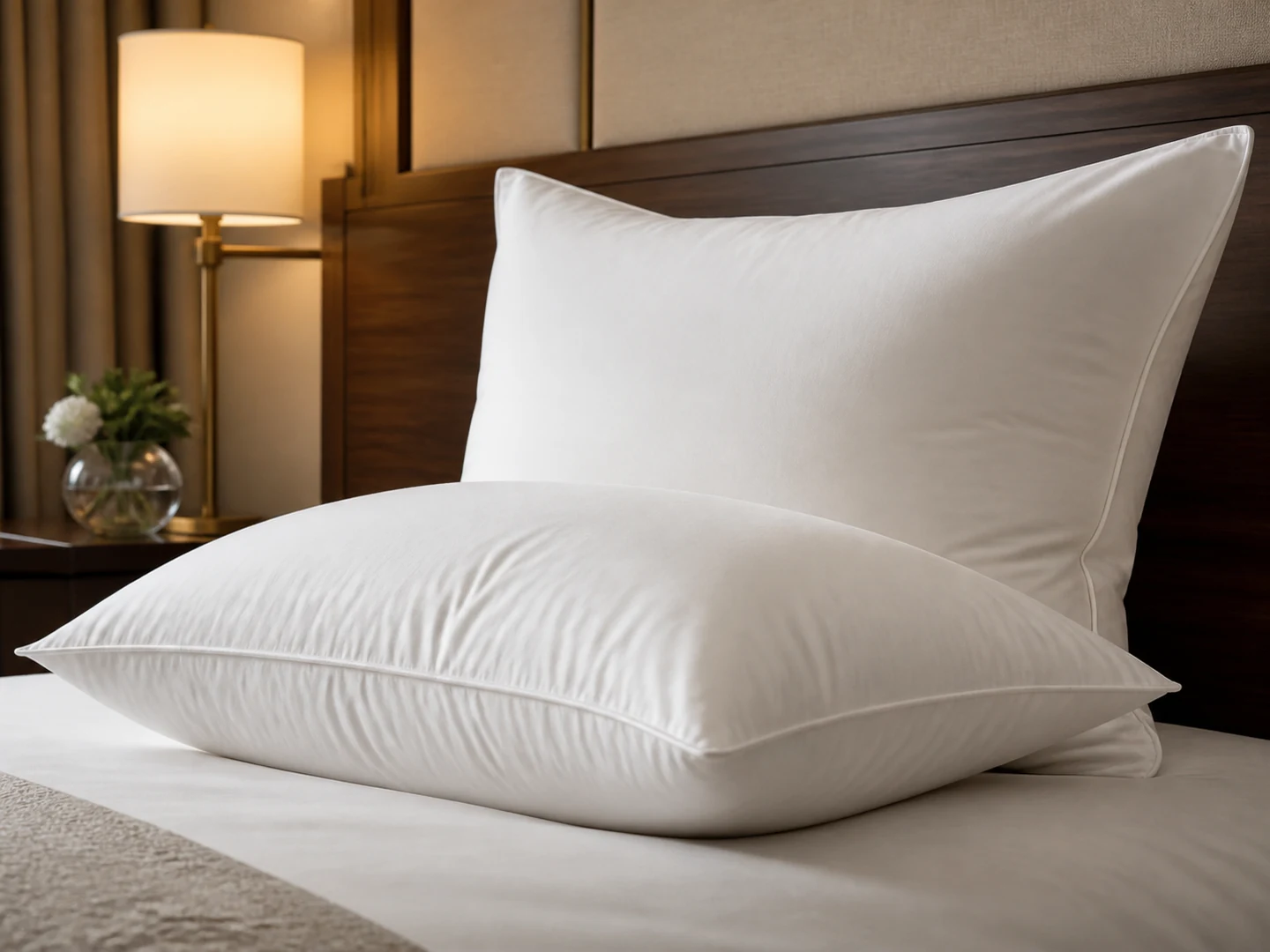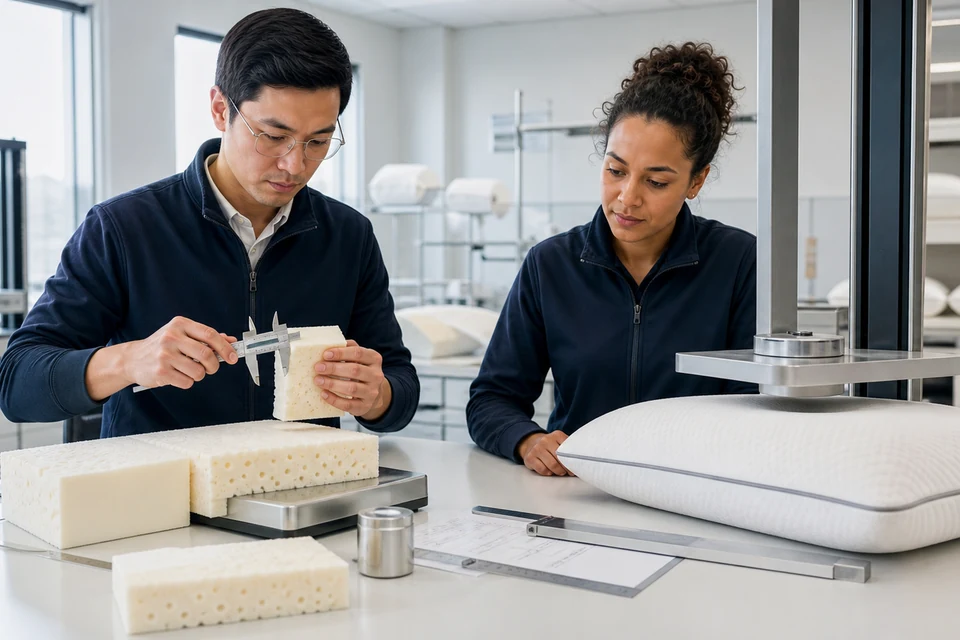
Density, firmness and recovery are related inputs in a memory foam pillow, but they are not interchangeable specifications. Density describes mass relative to a defined foam volume; firmness depends on a stated deformation method and test conditions; recovery describes how the material or finished assembly returns after a defined load history. A pillow's perceived support also changes with core geometry, thickness, perforation, layered construction, temperature, cover tension and the person using it. Buyers create avoidable disputes when a supplier shorthand number is treated as proof of every attribute. This guide builds a controlled specification for molded, cut or otherwise shaped slow-response polyurethane foam pillow cores and their finished assemblies. It distinguishes raw-foam data from finished-pillow performance, and it does not assign a universal density, firmness rating, recovery time or ergonomic outcome. Shredded-foam products require additional particle, blend and fill-distribution controls and should not be represented as equivalent to a one-piece core merely because both use memory foam terminology. The objective is to connect intended use, sample method, physical measurements, functional trials, packaging and bulk traceability before a buyer approves production or a consumer-facing claim.
- 1. Define the foam architecture before comparing numbers
- 2. Specify density with a traceable sampling and calculation method
- 3. Define firmness by method, conditions and sample state
- 4. Measure recovery across compression, handling and packaging
- 5. Carry the approved foam profile into bulk and reorder control
Define the foam architecture before comparing numbers
Separate molded, cut, layered and shredded constructions
Begin with a sectional product drawing and bill of materials. State whether the pillow uses one molded core, a cut block, a contoured or perforated core, bonded layers, an insert system or loose shredded pieces; identify core orientation, finished length, width, thickness profile, contour features and any removable inserts. List the inner liner and outer cover separately because fabric stretch, quilting, zipper construction and assembly tension can change the measured dimensions and perceived firmness of the finished pillow. Use the pillow gusset and finished-shape guide for cover geometry where relevant, while keeping the foam core specification as its own controlled record.
Name the intended sleeping or hospitality program without promising a universal comfort outcome. A hotel may need a range of approved constructions rather than one pillow described as suitable for everyone; the hotel pillow firmness-matrix guide provides a route for assortment decisions. Record which measurements and tests apply to raw foam specimens, uncovered cores, finished pillows or all three. Fiber-fill methods do not automatically transfer: the fiber-fill recovery guide addresses loose or clustered fills, while a coherent memory foam core needs specimen and deformation definitions suited to its own architecture.
- Identify the exact core type, layers, contour and orientation.
- Control inner liner, cover construction and assembly tension separately.
- State whether each requirement applies to foam, core or finished pillow.
- Keep intended use distinct from unsupported universal comfort claims.
Specify density with a traceable sampling and calculation method
Keep mass per volume separate from feel and fill weight
Define the density measurement method in the purchase specification, including specimen source, skin removal where applicable, dimensions, conditioning, measurement equipment, mass reading, volume calculation, units, rounding and number of specimens. A contoured or perforated finished core may not provide a simple rectangular volume, so agree whether density is verified on a representative foam specimen, production witness piece or another documented route. State where samples are taken within the production material and preserve lot identity. Do not calculate an apparent density from a packed finished pillow unless the agreed method explicitly supports that approach.
Density does not by itself prove firmness, slow response, durability or support. It also differs from fill weight: the pillow fill-weight guide controls the quantity of loose fill placed into a shell, whereas a foam-core buyer needs mass and geometric evidence that traces to the defined specimen. Record core mass and finished dimensions as useful production checks, but do not relabel either one as density. Put the chosen foam test and its timing into the bedding product testing plan so development, pre-production and bulk teams know which evidence is required at each gate.
- Define specimen source, conditioning, dimensions, mass and units.
- State how contours, holes, skins or layers affect the calculation.
- Trace every density specimen to the relevant production material lot.
- Report density, core mass and finished dimensions as distinct results.
Define firmness by method, conditions and sample state
Prevent one shorthand value from becoming a false equivalence
A firmness result is meaningful only with its test method and conditions. Specify specimen thickness and geometry, conditioning time and environment, support surface, indenter or loading arrangement, preload where used, deformation or position, loading rate, dwell and reporting point. Temperature is especially relevant for slow-response foam, so record the actual controlled condition instead of comparing results gathered in different rooms or immediately after transport. Use project-approved methods and acceptance criteria; do not convert values across unlike procedures or imply that two foams are equivalent because their supplier labels share the same number.
Decide whether the technical result comes from a foam specimen, the shaped core or the completed pillow and describe the purpose of each. Raw-foam measurements support material control, while a finished-pillow compression profile includes contour, layers, cover and assembly. Add a structured user or room trial only as a separate qualitative record with identified samples and questions; subjective comments should not overwrite the physical specification. Approve comparison samples through the golden sample workflow so the reference has a date, revision, construction and custody trail rather than an informal description such as medium or hotel grade.
- Name the test method, specimen state and reporting point.
- Control temperature, conditioning, loading and support conditions.
- Keep raw-foam results separate from finished-pillow compression data.
- Record qualitative sleep or room trials as a distinct evidence layer.
Measure recovery across compression, handling and packaging
State load history and observation time before judging rebound
Write the recovery sequence before testing: identify the sample, initial dimensions or profile, conditioning, compression direction and level, loading duration or cycle pattern, unloading point, observation intervals and measured or visual endpoints. Record whether the review concerns height recovery, shape, surface impression, force response or another defined property. Slow response may be an intended material behavior, while incomplete geometric recovery, permanent deformation, cover displacement and layer separation are different observations. Photograph the same views with scale and sample identity and avoid describing a single hand-press demonstration as a controlled result.
Packaging needs its own production-representative trial because roll, fold or vacuum compression can impose a different load history from normal use. Pack the complete pillow with the proposed liner, bag, carton and compression route, then record storage or transit simulation, opening method, conditioning environment and staged recovery before dimensional, firmness and appearance checks. Use the compression-packaging validation guide to structure evidence, not to supply a generic recovery deadline. Care instructions must also distinguish washable covers from cores that are not intended for the same process; approve the actual care route instead of exposing test samples to an assumed laundering cycle.
- Define compression direction, level, duration and observation intervals.
- Separate response speed from permanent shape or assembly change.
- Test the complete pillow in production-representative packaging.
- Record opening, conditioning and recovery before final comparison.
Carry the approved foam profile into bulk and reorder control
Link material lot, assembly, claims and final inspection
The pre-production sample record should connect core drawing, foam source reference, density method and results, firmness method and results, recovery sequence, cover and liner BOM, finished dimensions, packaging revision and all approved claims. Use the pre-production sample workflow to resolve open points before bulk release. Define a sampling plan by relevant foam, core-forming, assembly and packaging lots rather than checking only the first attractive pillow. Mark or record lot identity through the agreed traceability route and retain representative samples under conditions that make later comparison meaningful.
Consumer, wellness, material or performance wording needs evidence matched to the actual product and market. Review claims with the retail claim-substantiation matrix and request chemical or material documents only within the scopes explained in the restricted-substance evidence guide; neither step turns a raw-material statement into automatic finished-product proof. Reorders should repeat the defined checks when foam source, formulation reference, core geometry, cover, process or package changes. Buyers can contact FY Bedding with a core drawing, intended construction, comparison sample and required evidence route for a scoped pillow-development discussion, with final acceptance tied to project-approved specifications and test records.
- Freeze foam, core, cover, test and package revisions in one record.
- Sample across relevant material, forming, assembly and packaging lots.
- Match every product claim to evidence for the actual finished SKU.
- Repeat approval when source, geometry, formulation reference or pack changes.
Select one approved memory foam pillow and confirm that its core architecture, density specimen, firmness conditions, recovery sequence, cover assembly, packaging trial, claims and bulk lot record all identify the same controlled revision—without treating density, fill weight, supplier firmness shorthand or hand feel as interchangeable proof.